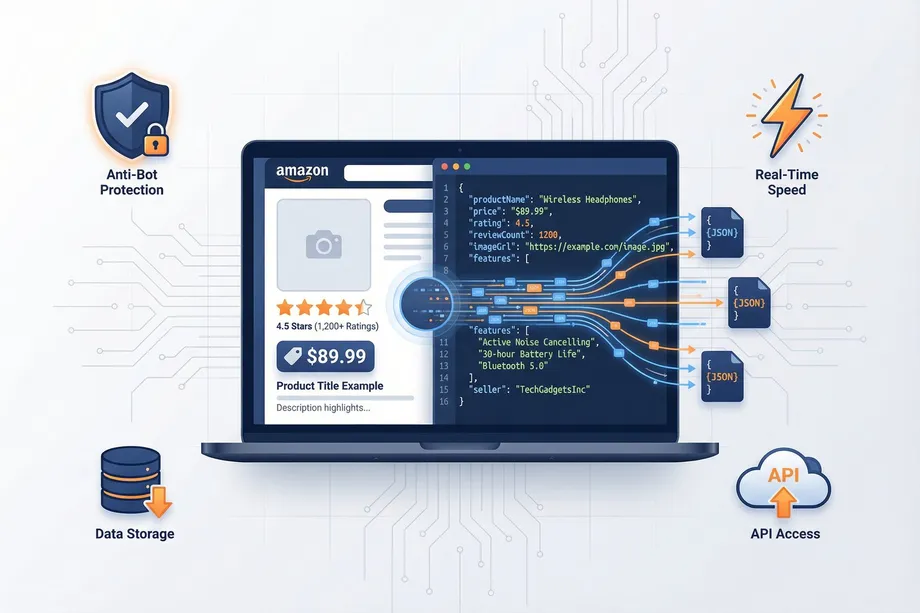

In the fast-paced world of e-commerce, Amazon's prices are in constant flux. For developers, businesses, and data analysts, the ability to track these changes is not just a convenience it's a strategic necessity. Whether you're monitoring competitor pricing, identifying arbitrage opportunities, or simply ensuring you get the best deal, a reliable price tracking system is essential. While many browser extensions exist for casual shoppers, building a scalable, automated solution requires a robust API. This is where Easyparser comes in.
This technical guide will walk you through how to leverage the Easyparser API to track Amazon price changes over time, from making single real-time requests to managing large-scale bulk operations.
Why is Tracking Amazon Prices Crucial?
Amazon's dynamic pricing algorithms adjust prices based on dozens of factors, including demand, competitor pricing, inventory levels, and time of day. Manually keeping up is impossible. An automated price tracking system, powered by an API like Easyparser, unlocks several key advantages:
- Competitive Intelligence: E-commerce sellers can monitor competitor prices in real-time and adjust their own pricing strategies to stay competitive and maximize their chances of winning the Buy Box.
- Dynamic Pricing Models: Businesses can build their own dynamic pricing engines that respond automatically to market changes, optimizing for profit margins and sales volume.
- Investment and Arbitrage: Resellers and deal hunters can identify underpriced items and receive alerts when a product's price drops below a certain threshold, enabling profitable purchasing decisions.
- Market Research: Analysts can collect historical price data to understand market trends, product seasonality, and consumer behavior over time.
Getting Started: Real-Time Price Tracking with Easyparser
For applications that require immediate price data, Easyparser’s Real-Time API is the perfect tool. It allows you to fetch detailed product information, including the current price, with a single, synchronous API call. The primary endpoint for this is the Detail operation, which can query a product using its ASIN or Amazon URL.
Let's say we want to get the current price of a product. The process is straightforward:
- Identify the Product: Get the ASIN (e.g.,
B08N5WRWNW) of the Amazon product you want to track. - Construct the API Request: Make a POST request to the Real-Time API endpoint with the necessary parameters.
Here is a Python code example demonstrating how to make a request:
import requests
import json

# Your Easyparser API Key
API_KEY = 'YOUR_API_KEY'

# API Endpoint
url = 'https://realtime.easyparser.com/v1/request'

# Request Payload for a specific product
payload = {
    'api_key': API_KEY,
    'platform': 'AMZ',
    'domain': '.com',
    'operation': 'DETAIL',
    'asin': 'B08N5WRWNW'
}

# Make the request
response = requests.post(url, json=payload)

if response.status_code == 200:
    data = response.json()
    # Extract relevant information
    product_detail = data.get('result', {}).get('detail', {})
    price = product_detail.get('price')
    availability = product_detail.get('availability')

    print(f"Product Price: {price}")
    print(f"Availability: {availability}")
else:
    print(f"Error: {response.status_code}")
    print(response.text)
The API response is a clean JSON object containing comprehensive data. The price and availability fields give you the exact information needed for real-time monitoring.
Scaling Up: Tracking Multiple Products with the Bulk API
Tracking a single product is useful, but most real-world applications require monitoring hundreds or thousands of products simultaneously. Making thousands of individual real-time requests can be inefficient. This is the problem the Bulk API is designed to solve.
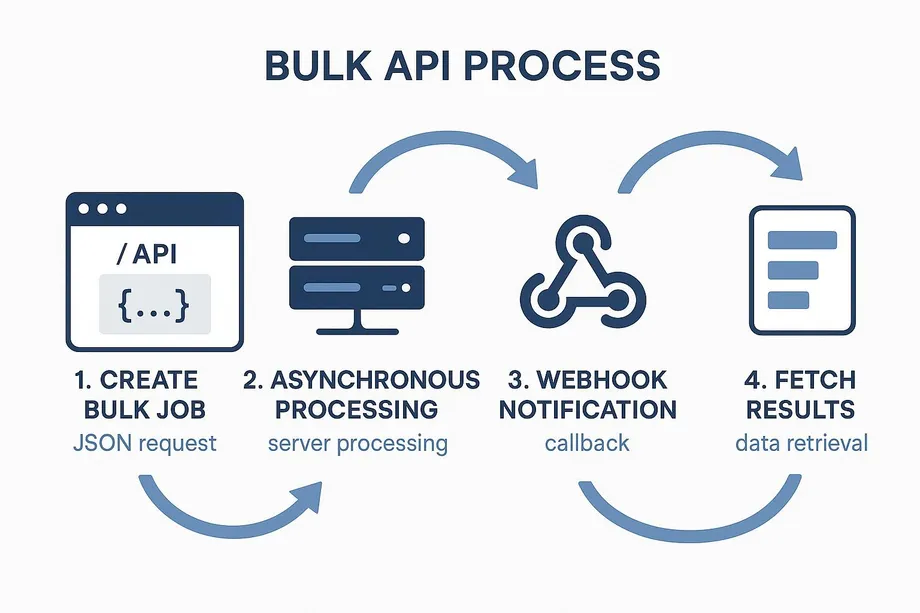
The Bulk API works asynchronously. Instead of waiting for an immediate response, you submit a job containing a list of products to track and provide a callback_url. Easyparser processes the job in the background and sends the results to your endpoint when ready. This workflow is highly scalable and perfect for large-scale data collection.
The Bulk API Workflow:
- Create a Bulk Job: Send a POST request to the
/bulk/createendpoint with a list of ASINs or URLs. - Receive Job IDs: The API immediately responds with a list of unique
result_ids, one for each item in your job. - Get a Webhook Notification: Once the data is processed, Easyparser sends a notification to your specified
callback_url. - Fetch the Results: Use the
result_ids to retrieve the structured JSON data from the Data Service API.
This asynchronous model allows you to build robust, event-driven systems that can handle massive data loads without bottlenecks.
Building a Historical Price Tracker
To track price changes *over time*, you need to store the data you collect. By combining the Easyparser API with a database and a scheduler, you can build a powerful historical price tracker.
Architecture Overview:
- Scheduler: Use a cron job, a cloud scheduler (like AWS EventBridge or Google Cloud Scheduler), or a simple script with a loop to trigger your data collection process at regular intervals (e.g., every hour or once a day).
- Data Collection Service: This service is responsible for calling the Easyparser API. It can use the Real-Time API for a small number of products or the Bulk API for larger lists.
- Database: Store the collected price data in a database. A simple SQL table with columns like
product_asin,price,currency, andtimestampis a great starting point. - Data Visualization (Optional): Use a library like Matplotlib in Python or a frontend charting library like Chart.js to visualize the price history, making it easy to spot trends.
Conclusion
Tracking Amazon price changes is a data-intensive task that is fundamental to modern e-commerce strategy. The Easyparser API provides a reliable, scalable, and developer-friendly solution for automating this process. By leveraging its real-time and bulk endpoints, you can move beyond simple browser extensions and build sophisticated applications for competitive analysis, dynamic pricing, and market research.
Ready to build your own Amazon price tracker? Start your free trial with Easyparser and get 100 free credits to explore the API today.
Setting Up Price Alerts: Complete Python Implementation
A price tracker is only as useful as the alerts it generates. By combining the Easyparser real-time API with a lightweight SQLite database, you can build a fully functional price monitoring and alerting system in under 60 lines of Python. The script below polls a watchlist of ASINs on a schedule, stores every reading in a local database, and fires an alert whenever a price falls below your target threshold.
import requests, sqlite3
from datetime import datetime
# Initialize persistent price history database
conn = sqlite3.connect('price_tracker.db')
conn.execute('CREATE TABLE IF NOT EXISTS prices (asin TEXT, price REAL, currency TEXT, ts TEXT)')
def check_and_alert(asin, threshold, api_key):
params = {'api_key': api_key, 'platform': 'AMZ',
'operation': 'DETAIL', 'asin': asin, 'domain': '.com'}
data = requests.get('https://realtime.easyparser.com/v1/request', params).json()
detail = data.get('result', {}).get('detail', {})
price_obj = detail.get('price', {})
price = price_obj.get('value')
if not price: return
# Persist price snapshot to SQLite
conn.execute('INSERT INTO prices VALUES (?,?,?,?)',
(asin, price, price_obj.get('currency', 'USD'), datetime.now().isoformat()))
conn.commit()
if price <= threshold:
print(f'PRICE ALERT: {asin} = ${price:.2f} (target: ${threshold:.2f})')
# Replace with email / Slack / SMS notification here
# Watchlist: (ASIN, price threshold in USD)
WATCHLIST = [('B0F25371FH', 35.00), ('B08N5WRWNW', 120.00)]
for asin, threshold in WATCHLIST:
check_and_alert(asin, threshold, 'YOUR_API_KEY')
Schedule this script hourly with a cron entry: 0 * * * * python3 /path/to/price_check.py. For notifications, replace the print statement with a call to Python's smtplib for email, a POST to a Slack webhook URL, or Twilio's SMS API. All three can be set up in under 10 additional lines of code.
Competitive Pricing Intelligence: Track 100 Competitors at Once
Real competitive intelligence means monitoring your entire category, not just a handful of products. Making 100 individual real-time requests is slow and credit-inefficient. The Easyparser Bulk API solves this: submit your entire competitor list in a single async job, and receive all pricing data at once via webhook when processing completes - typically in under two minutes for 100 ASINs.
import requests, json
def bulk_competitor_scan(asin_list, api_key, webhook_url):
# Build one DETAIL task per competitor ASIN
tasks = [{'platform': 'AMZ', 'operation': 'DETAIL',
'asin': asin, 'domain': '.com'} for asin in asin_list]
payload = {'api_key': api_key, 'callback_url': webhook_url, 'tasks': tasks}
response = requests.post('https://realtime.easyparser.com/v1/bulk/create', json=payload)
return response.json()
# Webhook handler: process bulk results when Easyparser POSTs them
def process_competitor_data(bulk_results):
summary = []
for item in bulk_results:
detail = item.get('result', {}).get('detail', {})
summary.append({'asin': detail.get('asin'),
'title': detail.get('title', '')[:50],
'price': detail.get('price', {}).get('value')})
return sorted(summary, key=lambda x: x['price'] or 999)
competitor_asins = ['B0F25371FH', 'B08N5WRWNW'] # add up to 100
bulk_competitor_scan(competitor_asins, 'YOUR_API_KEY', 'https://yourapp.com/webhook')
When the bulk job completes, Easyparser POSTs all pricing data to your webhook. Your handler can then update a competitive pricing database, automatically reprice your own listings, or generate a daily report showing where you stand against each competitor across price, rating, and availability.
Visualizing Price History: From Data to Insights
Raw price data in a database has limited value until visualized. A time-series chart transforms rows of numbers into actionable insights - revealing pricing trends, seasonal dips, and competitive moves at a glance. Python's matplotlib makes it straightforward to chart the price history collected with Easyparser:
import sqlite3, matplotlib.pyplot as plt
from datetime import datetime
def plot_price_history(asin):
conn = sqlite3.connect('price_tracker.db')
rows = conn.execute(
'SELECT ts, price FROM prices WHERE asin=? ORDER BY ts', (asin,)).fetchall()
dates = [datetime.fromisoformat(r[0]) for r in rows]
prices = [r[1] for r in rows]
plt.figure(figsize=(12, 5))
plt.plot(dates, prices, linewidth=2, color='#0d6efd')
plt.fill_between(dates, prices, alpha=0.1, color='#0d6efd')
plt.title(f'Price History for ASIN {asin}', fontsize=14)
plt.xlabel('Date'); plt.ylabel('Price (USD)')
plt.grid(True, alpha=0.3); plt.tight_layout()
plt.savefig(f'{asin}_price_history.png', dpi=150)
plot_price_history('B0F25371FH')
Enhance the chart further by overlaying a 30-day rolling average line to smooth out noise, adding horizontal lines marking your alert thresholds, and annotating key dates like Prime Day or Black Friday promotions. For web dashboards, the same SQLite data powers interactive Plotly or Chart.js charts that allow users to zoom, filter, and compare multiple products side-by-side.
Advanced Techniques: Regional Price Tracking by ZIP Code
One of Amazon's lesser-known behaviors is geographic price variation - the same product can be priced differently depending on the buyer's location, due to regional warehouse fulfillment costs, local taxes, and seller-specific delivery zones. Easyparser supports this through the optional address parameter in the DETAIL operation, allowing you to simulate a product lookup as seen by a customer in any ZIP code or postal region.
import requests
# Compare the same product's price across different US regions
REGIONS = {'New York': '10001', 'Los Angeles': '90001', 'Chicago': '60601', 'Houston': '77001'}
for city, zipcode in REGIONS.items():
params = {
'api_key': 'YOUR_API_KEY',
'platform': 'AMZ', 'operation': 'DETAIL',
'asin': 'B0F25371FH', 'domain': '.com',
'address': zipcode # Simulate customer location
}
result = requests.get('https://realtime.easyparser.com/v1/request', params).json()
price = result.get('result', {}).get('detail', {}).get('price', {}).get('value')
print(f'{city} ({zipcode}): ${price}')
Regional price tracking has several practical applications: marketplace sellers can optimize fulfillment center placement by identifying regions where their products are priced most competitively, logistics teams can analyze delivery cost variations, and pricing researchers can map Amazon's geographic strategies across major metropolitan areas. For cross-country or multi-marketplace tracking, combine the address parameter with Easyparser's support for 20+ international Amazon domains to build a global pricing intelligence database.
Start building with the Easyparser API today
Start Your Free Trial100 free credits, no credit card required.