So, you want to get your hands on Amazon's vast ocean of product data, but you're not a seasoned developer with years of web scraping experience. You've heard about the potential for market research, price monitoring, and competitive analysis, but the technical hurdles seem daunting. You're in the right place. This guide is designed for you.
We'll show you how to bypass the steep learning curve of traditional web scraping and start pulling valuable, structured Amazon product data in under 30 minutes using the Easyparser API. No complex code, no proxy management, no headaches.
The Two Paths to Amazon Data: The Hard Way vs. The Easy Way
Traditionally, getting data from Amazon meant building a 'web scraper' a custom script that mimics a browser, navigates web pages, and parses raw HTML to find the data you need. This path is fraught with challenges.
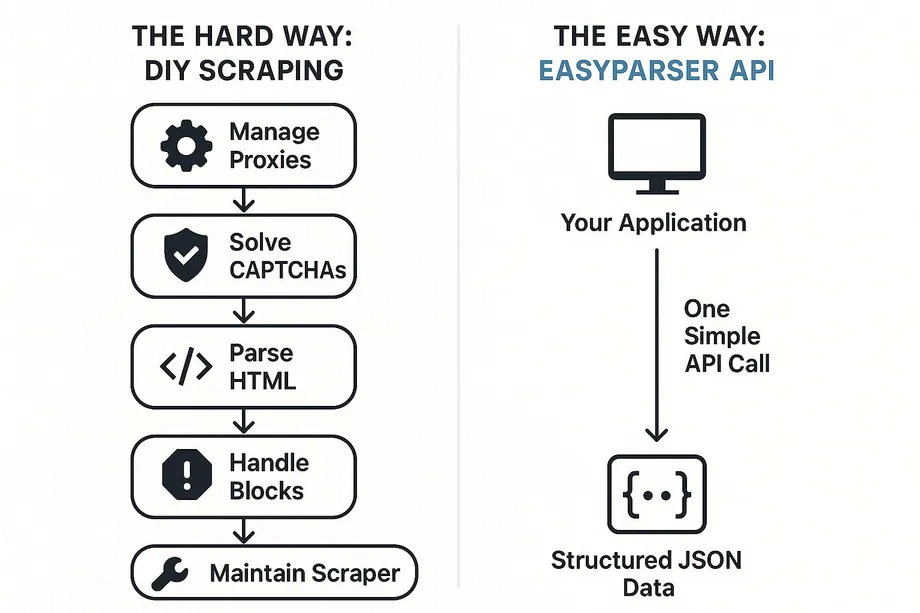
As the diagram shows, the DIY approach forces you to become an expert in bypassing anti-bot measures, managing IP rotations, and constantly maintaining your code as Amazon changes its website layout. It's a full-time job in itself.
The easy way? A single, simple API call to a service that handles all that complexity for you. That's what Easyparser does. You ask for the data you want, and we deliver it in a clean, predictable JSON format.
Your First 30 Minutes: Let's Get Started!
Ready to see how simple it is? We'll walk you through three steps that will take you from zero to your first successful data extraction.
Step 1: Sign Up for a Free Demo Account (5 Minutes)
First things first, you need an account. Easyparser makes this completely risk-free.
- Go to the Easyparser Sign-up Page.
- Create your account. No credit card is required.
- Your account is automatically activated on the **Free Demo Plan**.
This plan gives you **100 free credits every month** to test out the full power of the API. It's the perfect way to get started without any commitment.
Step 2: Find Your API Key (2 Minutes)
Your API key is your unique password for accessing the service. It tells Easyparser that you're authorized to make a request.
- Log in to your new Easyparser Dashboard.
- On the main dashboard screen, you'll see your **API Key** in your profile section.
- Click the 'Copy' button. Keep this key handy and private.
Step 3: Make Your First API Call (15 Minutes)
Now for the exciting part! We'll use a simple Python script to request data for a product. Don't worry if you're not a Python expert; the code is straightforward, and you can run it easily.
First, make sure you have Python installed. Then, open a text editor, paste the following code, and save it as `amazon_test.py`.
import requests
import json
api_key = 'YOUR_API_KEY' # Paste your API key here
product_asin = 'B098FKXT8L' # Example: Bose Headphones ASIN
params = {
'api_key': api_key,
'platform': 'AMZ',
'operation': 'DETAIL',
'asin': product_asin,
'domain': '.com'
}
api_result = requests.get('https://realtime.easyparser.com/v1/request', params)
product_data = api_result.json()
print(json.dumps(product_data, indent=2))
Before you run the script, replace `'YOUR_API_KEY'` with the key you copied from your dashboard. Now, open your terminal or command prompt, navigate to where you saved the file, and run:
python amazon_test.py
Understanding the Result: Clean, Structured Data
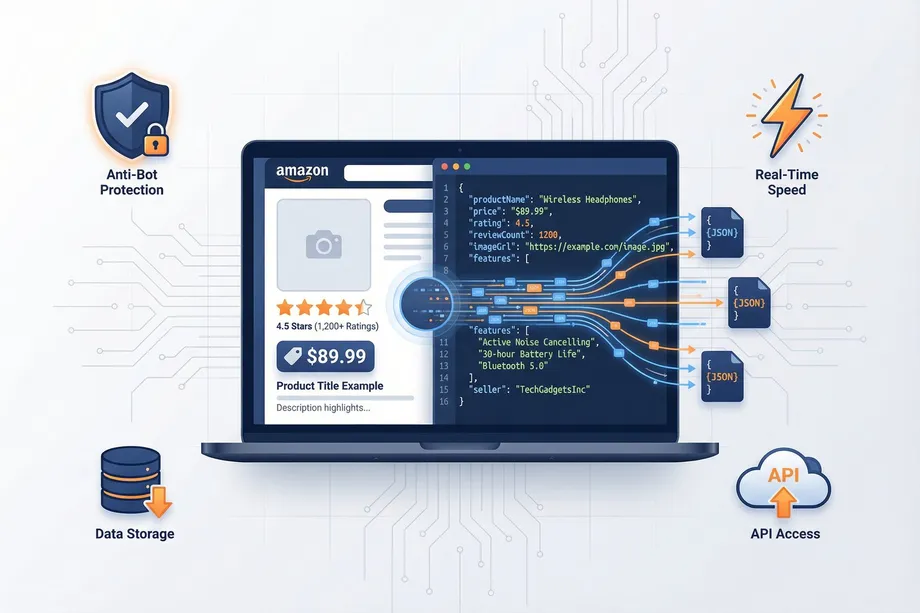
Congratulations! You've just extracted your first piece of Amazon data. Your terminal will display a clean JSON object that looks something like this:
{
"request_info": {
"success": true,
"credits_used": 1
},
"result": {
"detail": {
"title": "Bose QuietComfort 45 Bluetooth Wireless Noise Cancelling Headphones...",
"price": {
"value": 329.00,
"currency": "USD"
},
"availability": "In Stock",
"rating": 4.6,
"reviews_count": 45891
}
}
}
Look at that! No messy HTML, no parsing required. You have the product's title, price, availability, rating, and more, all neatly organized and ready to be used in your application, spreadsheet, or database.
What's Next? (8 Minutes of Exploration)
You've mastered the basics. In the remaining time, why not explore what else is possible?
- Try a Different Product: Change the `product_asin` in your script to another Amazon product ASIN and see the results.
- Explore the Documentation: Visit the comprehensive Easyparser Documentation to see the full range of data you can extract, from seller information to customer reviews.
- Test Different Operations: Try changing the `operation` parameter to `'OFFER'` to get seller and pricing information, or `'SEARCH'` to find products by keywords.
Why This Approach Works Better
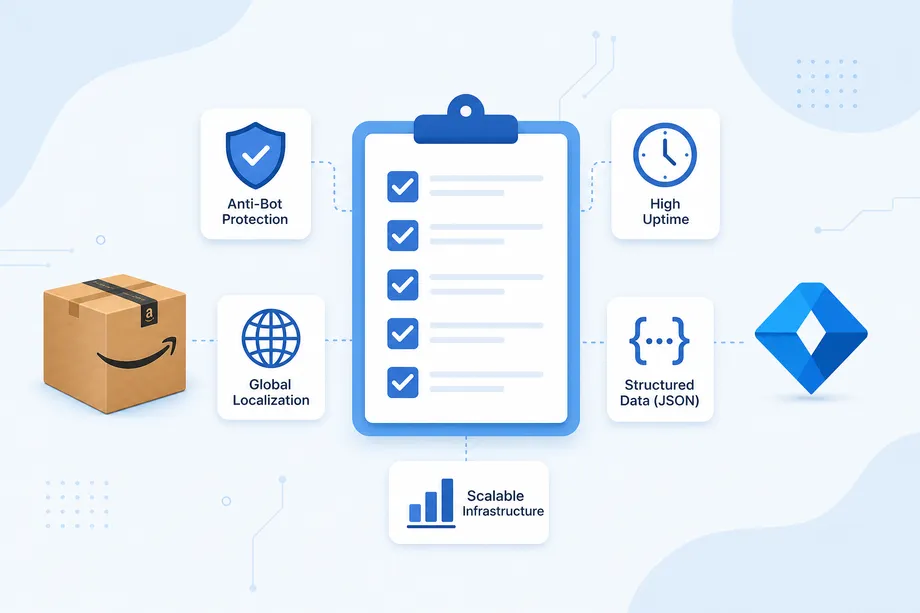
Traditional web scraping requires you to become an expert in multiple complex areas. With Easyparser, you can focus on what matters most: using the data to grow your business. Here's what we handle for you:
| Challenge | Traditional Scraping | Easyparser API |
|---|---|---|
| Anti-bot Detection | Constant cat-and-mouse game | Handled automatically |
| Proxy Management | Expensive and complex | Built-in and optimized |
| Data Parsing | Breaks with layout changes | Always returns structured JSON |
| Rate Limiting | Manual throttling required | Intelligent request management |
| Maintenance | Ongoing developer time | Zero maintenance required |
5 Real-World Use Cases to Build First
Once you have made your first successful API call, the natural question is: what should I build? Here are the five most practical and immediately valuable tools for beginners, ordered from simplest to most complex:
1. Price Monitor
Check a list of product ASINs daily and send an alert when a price drops below a threshold you set. This requires only the DETAIL operation, a list of ASINs, and a simple loop - the perfect first project that introduces the core API pattern without overwhelming complexity.
2. Product Research Tool
Given a list of keywords in a niche, use the SEARCH operation to extract the top 20 organic results for each keyword, then fetch the DETAIL for each ASIN to gather rating, review count, price, and BSR. This automates the manual product research workflow that sellers spend hours on, condensed into under 100 lines of Python.
3. Keyword Rank Tracker
Search for a keyword daily and record the position of your target ASIN in the organic results. Track position changes over time to measure the impact of listing optimization and PPC campaigns. Store results in a CSV or SQLite database to build a ranking history chart.
4. Competitor Watcher
Track a list of competitor ASINs and trigger alerts when their price changes, their Buy Box owner changes, or their review count increases significantly. Use the DETAIL and OFFER operations in combination to deliver the market intelligence that professional sellers pay enterprise tool prices for.
5. Inventory Alert System
Monitor product availability for competitor ASINs. When a competitor goes out of stock, their sales redistribute to other sellers - a window to capture sales at higher margins without increasing ad spend. The DETAIL operation returns an availability field indicating in-stock, limited-stock, or out-of-stock status.
import requests
COMPETITORS = ["B098FKXT8L", "B09V3KX825", "B07C2Z21X5"]
API_KEY = "YOUR_API_KEY"
for asin in COMPETITORS:
params = {"api_key": API_KEY, "platform": "AMZ",
"domain": ".com", "operation": "DETAIL", "asin": asin}
data = requests.get("https://realtime.easyparser.com/v1/request", params=params).json()
detail = data.get("result", {}).get("detail", {})
availability = detail.get("availability", "Unknown")
price = detail.get("price", {}).get("value", "N/A")
if "out of stock" in availability.lower():
print(f"OPPORTUNITY: {asin} is OUT OF STOCK at price {price}")
else:
print(f"{asin}: {availability} at {price}")
Understanding the JSON Response: A Field-by-Field Guide
When you make a DETAIL API call to Easyparser, the response is a structured JSON object. Understanding what each field contains helps you know exactly what to extract for your specific use case.
| Field | Type | What It Contains | Primary Use Case |
|---|---|---|---|
title | string | Full product title as listed on Amazon | Product research, display in dashboards |
price.value | number | Current purchase price (not list price) | Price monitoring, deal detection, margin calculation |
price.currency | string | Currency code (USD, EUR, GBP, etc.) | Multi-marketplace price normalization |
availability | string | Human-readable stock status ("In Stock", "Out of Stock") | Inventory monitoring, competitor stockout alerts |
rating | number | Average star rating (0–5) | Product quality assessment, market research |
reviews_count | number | Total number of customer reviews | Market maturity assessment, review velocity tracking |
buybox_winner | object | Current Buy Box seller name and seller ID | Buy Box monitoring, competitive intelligence |
images | array | Image objects with URLs at multiple resolutions | Automated image auditing, competitor image analysis |
description | string | Full product description text | Content analysis, keyword research, listing quality benchmarking |
best_seller_rank | array | BSR position in each relevant category | Category rank tracking, competitive positioning |
From Single Requests to Bulk Jobs: When to Scale Up
The Easyparser Real-Time API is ideal for most use cases, but there is a point where batch processing becomes more efficient. Understanding when to make this transition saves both time and money.
Use Real-Time API when: You need data immediately, your use case is interactive (a user triggers a search and expects results within seconds), you are processing fewer than 500 ASINs per day, or you need fast reactions to changes such as price alerts and stockout notifications.
Use the Bulk API when: You need to process more than 500–1,000 ASINs in a single run, the data can be processed asynchronously, you are conducting one-time market research scans across an entire category, or you want to minimize overhead by batching thousands of requests into a single job submission. The Bulk API accepts up to 5,000 URLs in a single job and returns results via webhook when processing is complete.
Common Beginner Mistakes (And How to Avoid Them)
Here are the most common mistakes beginners make with Amazon data extraction and exactly how to avoid each one:
Mistake 1: Using the wrong domain. Easyparser supports 20+ Amazon marketplaces. If you are trying to get UK pricing but passing domain=".com", you will receive US prices. Always match the domain parameter to the target marketplace: .co.uk for the UK, .de for Germany, .co.jp for Japan.
Mistake 2: Not handling API errors. Even a 98.2% success rate API will occasionally return an error. Always check the request_info.success field in the response and implement retry logic with exponential backoff. A script that crashes on the first error is not production-ready.
Mistake 3: Not storing the data. Many beginners make API calls, print results to the console, and later realize they have no historical record. Always save data to a file (CSV, JSON) or a database (SQLite, PostgreSQL) immediately. The real value of product data is its historical dimension - a time series reveals trends and opportunities that a single data point cannot show.
Mistake 4: Running requests too fast. Tight loops without delay can trigger rate limits. Add a small pause between requests (time.sleep(0.5)) or use the Bulk API for large batches. The Easyparser dashboard shows your credit usage in real time so you can monitor consumption and stay within your plan limits.
Mistake 5: Hardcoding ASINs. Hardcoding 10 ASINs directly in your script works for initial testing but becomes a maintenance burden as products change. Store your target ASINs in a CSV file, a database table, or an environment variable, and have your script read from that source. Updating your watchlist should be as simple as editing a spreadsheet row.
Start extracting Amazon data for free
Start Your Free Trial100 free credits, no credit card required.