With over 1.9 million active sellers on Amazon, the marketplace is a goldmine for B2B partnerships, wholesale sourcing, and competitive intelligence. However, manually trying to find Amazon sellers in a specific niche is an impossible task. The data is vast, seller information is often obscured, and systematic analysis is out of reach for most.
While many guides explain how to find a seller by clicking through product pages, this approach doesn't scale. Pre-built seller lists are expensive, often outdated, and lack niche specificity. To truly leverage Amazon for B2B lead generation, you need a systematic, automated, and cost-effective method. This is where an API-driven approach becomes a game-changer.
This guide presents a 3-step methodology using the Easyparser API to find, analyze, and contact hundreds of Amazon sellers in any niche. We will walk through the entire process with complete Python code examples, from initial product discovery to exporting a qualified lead list. You will learn how to build a scalable lead generation engine that costs as little as $0.13 per qualified lead, delivering a massive ROI.
Why You Need to Find Amazon Sellers (Beyond Just Shopping)
For e-commerce entrepreneurs, brand owners, and B2B marketers, the ability to find Amazon sellers systematically is not about making a purchase-it's about unlocking strategic opportunities. Understanding who is selling what, how they operate, and where they source their products provides a significant competitive advantage.
1. Wholesale Sourcing Opportunities
Many Amazon sellers are also manufacturers or authorized distributors who are open to wholesale partnerships but never advertise it. By identifying and contacting these sellers directly, you can potentially source inventory at 30-50% below retail prices. For a business operating on tight margins, this difference can be the key to profitability. The challenge is to systematically find Amazon sellers who have these capabilities.
2. Brand Partnership and Co-Marketing
Imagine you sell premium yoga mats. Another seller specializes in high-quality yoga blocks and straps. Your customer bases almost certainly overlap. A strategic partnership to create product bundles or run joint marketing campaigns could significantly boost sales and average order value for both parties. This process begins with identifying complementary sellers and analyzing their market position.
3. In-Depth Competitive Intelligence
Successful sellers don't just focus on their own listings; they use tools to find Amazon sellers in their competitive landscape and monitor them constantly. Systematically analyzing all sellers in your niche allows you to understand market saturation, identify top players, track their pricing strategies, and discover new product launches. This data-driven intelligence is crucial for making informed business decisions and staying ahead of the curve.
4. Private Label Supplier Discovery
For businesses looking to launch their own private label products, finding reliable manufacturers is a major hurdle. Many international manufacturers use Amazon as a direct-to-consumer channel. By analyzing sellers based in manufacturing hubs (e.g., China, India) and examining their product catalogs, you can identify potential OEM/ODM suppliers for your next product line, bypassing traditional sourcing platforms.
The 3-Step API Methodology to Find Amazon Sellers
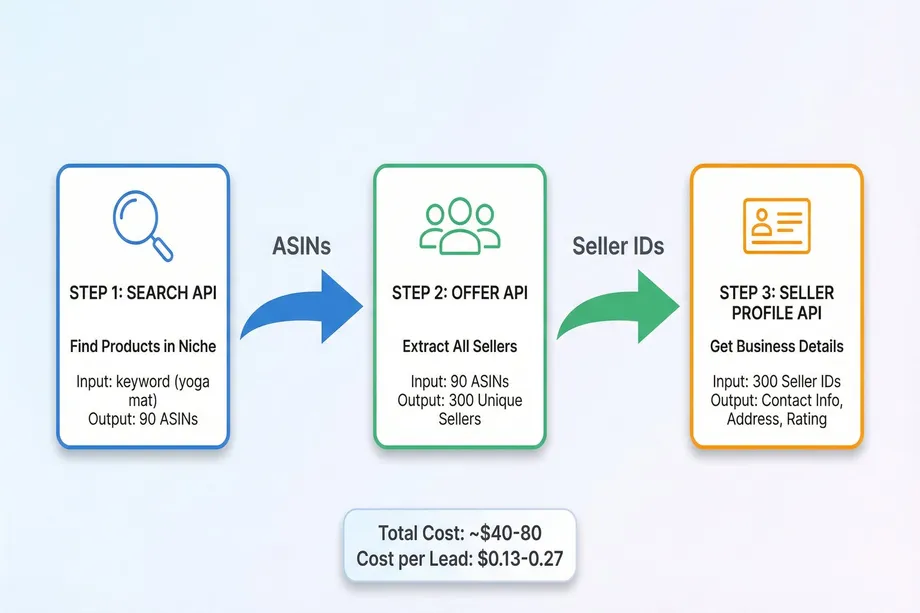
Our approach is a simple yet powerful three-step API chain. We start broad by finding products in a niche, narrow down to the sellers of those products, and then enrich the data with detailed seller profiles. This ensures a comprehensive and highly qualified lead list.
Step 1: Find Products in Your Niche with the Search API
The first step is to identify a list of products that define your target niche. We use the Easyparser Search API to mimic a user searching on Amazon, allowing us to gather a list of relevant ASINs (Amazon Standard Identification Numbers).
The goal is to cast a wide net to capture as many relevant products as possible. We can do this by providing a keyword and specifying the number of pages to retrieve.
import requests
API_KEY = "YOUR_API_KEY" # Get your key from app.easyparser.com
BASE_URL = "https://realtime.easyparser.com/v1/request"
def search_products(keyword, max_pages=3):
"""Step 1: Use Search API to find products in a niche."""
params = {
"api_key": API_KEY,
"platform": "AMZ",
"operation": "SEARCH",
"domain": ".com",
"keyword": keyword,
"exclude_sponsored": "true",
"min_page": 1,
"max_page": max_pages
}
response = requests.get(BASE_URL, params=params)
data = response.json()
asins = [product["asin"] for product in data["result"]["products"]]
return asins
# Example Usage
iphone_case_asins = search_products("iPhone 15 case", max_pages=3)
print(f"Found {len(iphone_case_asins)} products.")
This script will return a list of ASINs for the top products related to "iPhone 15 case" across three search pages. This typically yields 60-90 unique products and forms the foundation for the next step.
Step 2: Extract All Sellers for Each Product with the Offer API
Now that we have a list of products, we need to find out who is selling them. The Easyparser Offer API retrieves all seller offers for a given ASIN, including the seller's name and a link to their storefront, which contains the crucial Seller ID.
We will loop through each ASIN from Step 1 and call the Offer API. This is where we start to build our comprehensive Amazon seller list.
def get_sellers_for_asin(asin):
"""Step 2: Use Offer API to find all sellers for an ASIN."""
params = {
"api_key": API_KEY,
"platform": "AMZ",
"operation": "OFFER",
"domain": ".com",
"asin": asin
}
response = requests.get(BASE_URL, params=params)
data = response.json()
sellers = []
for offer in data.get("result", {}).get("offer", {}).get("offer_results", []):
seller_link = offer.get("seller", {}).get("link", "")
if "seller=" in seller_link:
seller_id = seller_link.split("seller=")[1].split("&")[0]
sellers.append({"seller_id": seller_id, "seller_name": offer["seller"]["name"]})
return sellers
# Process all ASINs and remove duplicates
all_sellers = []
for asin in iphone_case_asins:
all_sellers.extend(get_sellers_for_asin(asin))
unique_sellers = {s["seller_id"]: s for s in all_sellers}
print(f"Found {len(unique_sellers)} unique sellers.")
A single product can have dozens of sellers. After processing all ASINs, we perform a crucial deduplication step based on the `seller_id` to ensure we only have unique sellers in our list. From an initial 90 ASINs, it's common to find 250-350 unique sellers.
Step 3: Get Detailed Business Information with the Seller Profile API
This is the final and most valuable step. With a list of unique Seller IDs, we use the Easyparser Seller Profile API to retrieve the legal business name, business address, country of origin, and detailed performance metrics for each one. This transforms a simple seller list into a rich Amazon seller database for B2B lead generation.
def get_seller_profile(seller_id):
"""Step 3: Use Seller Profile API to get detailed business info."""
params = {
"api_key": API_KEY,
"platform": "AMZ",
"operation": "SELLER_PROFILE",
"domain": ".com",
"seller_id": seller_id
}
response = requests.get(BASE_URL, params=params)
data = response.json()
seller_data = data.get("result", {}).get("seller", {})
return {
"seller_id": seller_id,
"business_name": seller_data.get("business_name"),
"business_address": seller_data.get("business_address"),
"country": seller_data.get("country"),
"rating_lifetime": seller_data.get("feedback", {}).get("lifetime", {}).get("positive"),
"storefront_url": seller_data.get("storefront_url")
}
# Get profiles for all unique sellers
seller_profiles = []
for seller_id in unique_sellers.keys():
profile = get_seller_profile(seller_id)
seller_profiles.append(profile)
print(f"Retrieved {len(seller_profiles)} detailed seller profiles.")
This final step provides the actionable data needed for outreach, including the legal business name and address, which are often hidden on the public storefront.
From Data to Deals: Cost Analysis and ROI
Automating the process to find Amazon sellers is not just about speed; it's about economic efficiency. Let's break down the costs and potential return on investment for a typical scenario.
Credit Consumption Breakdown
Consider a campaign to find sellers in the "iPhone 15 case" niche:
| Step | Operation | Quantity | Credits per Unit | Total Credits |
|---|---|---|---|---|
| 1 | Search API | 3 pages | 1 | 3 |
| 2 | Offer API | 90 ASINs | 1 | 90 |
| 3 | Seller Profile API | 300 unique sellers | 1 | 300 |
| TOTAL | 393 credits |
With a total cost of just 393 API credits (approximately $40-$80 depending on your plan), you can generate a list of 300 unique sellers with their full business details. This translates to a remarkable cost per lead of just $0.13 to $0.27.
Calculating the Return on Investment (ROI)
The true value is realized when these leads convert into partnerships. Based on industry averages for B2B outreach:
- Leads Contacted: 300
- Response Rate (10%): 30 responses
- Call Rate (30% of responses): 9 calls
- Closing Rate (25% of calls): 2-3 new partnerships
If a single wholesale partnership generates $5,000 in annual profit, the ROI on an $80 investment is astronomical. This is the power of scalable, API-driven lead generation.
B2B Outreach: Turning Leads into Partnerships
Having a list of contacts is only half the battle. Effective outreach is what turns data into deals. The key is a personalized, value-first approach that respects the seller's time and business.
Initial Contact and Follow-up
Start by using Amazon's built-in "Ask a Question" feature, as it has the highest response rate (10-15%). Your initial message should be concise, personalized, and clearly state your value proposition.
Example Wholesale Inquiry Template:
Subject: Wholesale Partnership Opportunity - [Your Company]
Hi [Seller Name],
I came across your [Product Category] listings on Amazon and was impressed by your excellent product range and 98% positive feedback rating.
We're [Your Company], a [your business type] specializing in [your niche], and we are interested in discussing wholesale purchasing opportunities for your [specific product line]. Our typical order volume is [X units/month].
Would you be open to discussing wholesale pricing and terms?
Best regards,
[Your Name]
A persistent but respectful follow-up sequence is critical. A common strategy is to send a gentle reminder on Day 3, a value-add message (like a market insight) on Day 7, and a final attempt on Day 14.
Conclusion: Your New B2B Lead Generation Engine
The days of manually searching for business opportunities on Amazon are over. By leveraging a 3-step API methodology, you can systematically find Amazon sellers in any niche, gather their detailed business information, and build a highly qualified lead list at an unprecedented scale and cost-efficiency. This automated approach not only saves hundreds of hours but also uncovers partnerships and sourcing opportunities that your competitors will likely miss.
The process is straightforward: use the Search API to identify products, the Offer API to find the sellers, and the Seller Profile API to get their contact details. By investing a small amount in API credits, you create a powerful, repeatable B2B lead generation engine with the potential for a massive return on investment. The only remaining step is to start your outreach and turn that data into profitable relationships.
Start Finding Amazon Sellers Today
Get your Easyparser API key and start building your B2B lead list in minutes. Access real-time data from 1.9M active Amazon sellers with full documentation and code examples.
Get Your API KeyView DocumentationStart building your Amazon data pipeline today
Start Your Free Trial100 free credits, no credit card required.