Amazon Search Results API
Programmatically retrieve Amazon organic results and sponsored placements for any keyword or Amazon search URL, including titles, prices, images, ratings, and ranking positions.


• Monthly 100 free credit!
All features No credit card
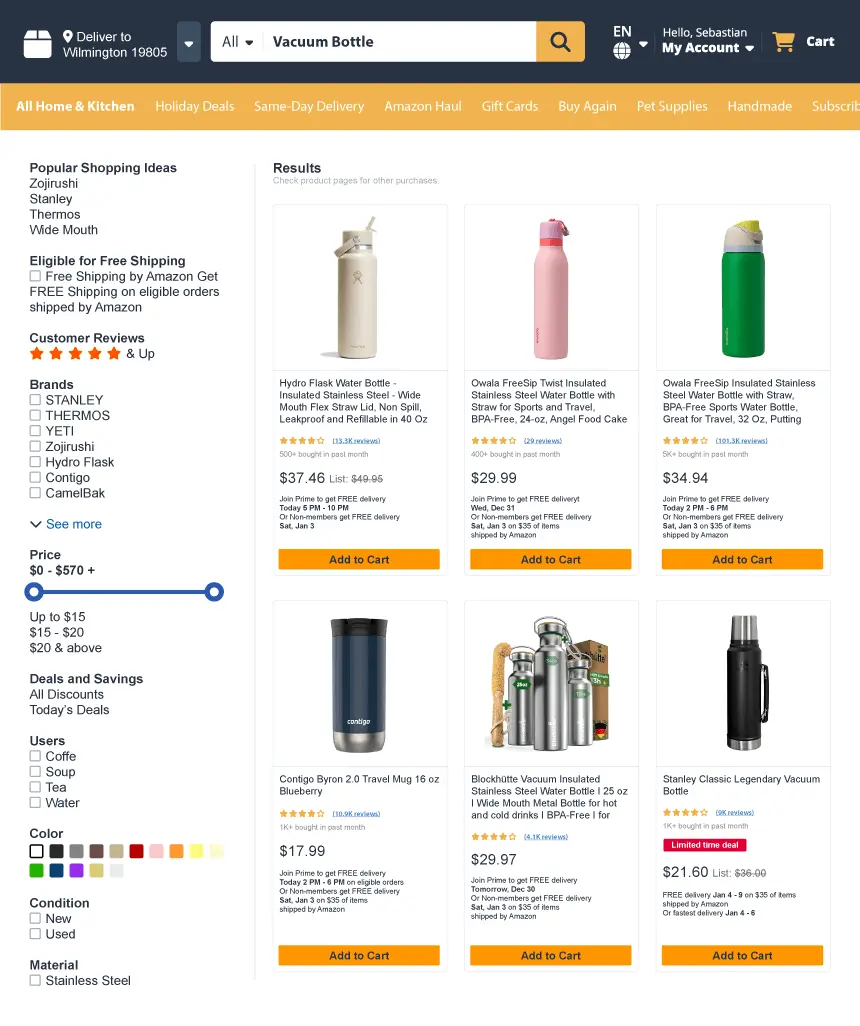
Master Search Data with Ease
Stop relying on fragile amazon search scraper setups. With Easyparser, you can programmatically replicate the live experience and access structured amazon organic results, sponsored placements, and ranked product listings using the amazon search results api.
This amazon search results api is built for automation and analytics, delivering a clean and comprehensive dataset that includes:
- Organic results and sponsored placements with ASINs
- Product titles and current prices
- Thumbnail images and review counts
- Ratings and Prime eligibility indicators
- Sponsored placements when present
- Availability status, page 1 presence, and ranking position
- And More Fields...
No credit card  100 credit free Real-time or Bulk

Amazon Search Listing API How-to
How to start tracking organic results and keyword rankings?
- 1 Create your account
Create an account to receive 100 free monthly credits and test our high-performance amazon search listing api.
- 2 Get your API token
Retrieve your auto-generated token from the Plan Page to securely access the amazon keyword search api.
- 3 Choose an endpoint
Get clean JSON instantly using the amazon product search results api to retrieve real-time organic results, sponsored products, and availability. Choose an endpoint now.
Stop relying on a fragile amazon search scraper. Instead, monitor organic results, sponsored placements, and keyword visibility with our amazon keyword rank tracking api.
The examples on the right show a sample request payload and response for the amazon search results api.
⚡No IP blocks, no CAPTCHAs to manage, fast real-time Amazon search results data for organic and sponsored positions.
curl -X GET \
"https://realtime.easyparser.com/v1/request" \
-G \
-d api_key=YOUR_API_KEY \
-d platform=AMZ \
-d operation=SEARCH \
-d domain=.com \
-d keyword=vacuum bottle
import requests
import json
# set up the request parameters
params = {
"api_key": "YOUR_API_KEY",
"platform": "AMZ",
"operation": "SEARCH",
"domain": ".com",
"keyword": "vacuum bottle"
}
# make the http GET request to Easyparser API
api_result = requests.get("https://realtime.easyparser.com/v1/request", params=params)
# print the JSON response from Easyparser API
print(json.dumps(api_result.json()))
const axios = require('axios');
// set up the request parameters
const params = {
api_key: 'YOUR_API_KEY',
platform: 'AMZ',
operation: 'SEARCH',
domain: '.com',
keyword: 'vacuum bottle'
};
// make the http GET request to Easyparser API
axios.get('https://realtime.easyparser.com/v1/request', { params })
.then(response => console.log(response.data));
<?php
// set up the request parameters
$params = array(
'api_key' => 'YOUR_API_KEY',
'platform' => 'AMZ',
'operation' => 'SEARCH',
'domain' => '.com',
'keyword' => 'vacuum bottle'
);
// make the http GET request to Easyparser API
$url = 'https://realtime.easyparser.com/v1/request?' . http_build_query($params);
$response = file_get_contents($url);
echo $response;
?>
package main
import (
"fmt"
"io"
"net/http"
"net/url"
)
func main() {
// set up the request parameters
params := url.Values{}
params.Add("api_key", "YOUR_API_KEY")
params.Add("platform", "AMZ")
params.Add("operation", "SEARCH")
params.Add("domain", ".com")
params.Add("keyword", "vacuum bottle")
requestUrl := "https://realtime.easyparser.com/v1/request?" + params.Encode()
// make the request to Easyparser API
resp, _ := http.Get(requestUrl)
defer resp.Body.Close()
body, _ := io.ReadAll(resp.Body)
fmt.Println(string(body))
}
using System;
using System.Net.Http;
using System.Threading.Tasks;
using System.Collections.Generic;
class Program
{
static async Task Main(string[] args)
{
// set up the request parameters
var client = new HttpClient();
var query = new Dictionary<string, string> {
{ "api_key", "YOUR_API_KEY" },
{ "platform", "AMZ" },
{ "operation", "SEARCH" },
{ "domain", ".com" },
{ "keyword", "vacuum bottle" }
};
var queryString = await new FormUrlEncodedContent(query).ReadAsStringAsync();
var url = "https://realtime.easyparser.com/v1/request?" + queryString;
// make the request to Easyparser API
var response = await client.GetStringAsync(url);
Console.WriteLine(response);
}
}
import java.net.URI;
import java.net.http.HttpClient;
import java.net.http.HttpRequest;
import java.net.http.HttpResponse;
import java.net.URLEncoder;
import java.nio.charset.StandardCharsets;
import java.util.Map;
import java.util.LinkedHashMap;
public class EasyparserExample {
public static void main(String[] args) {
// set up the request parameters
HttpClient client = HttpClient.newHttpClient();
Map<String, String> params = new LinkedHashMap<>();
params.put("api_key", "YOUR_API_KEY");
params.put("platform", "AMZ");
params.put("operation", "SEARCH");
params.put("domain", ".com");
params.put("keyword", "vacuum bottle");
StringBuilder sb = new StringBuilder();
for (Map.Entry<String, String> entry : params.entrySet()) {
if (sb.length() > 0) sb.append("&");
sb.append(URLEncoder.encode(entry.getKey(), StandardCharsets.UTF_8))
.append("=")
.append(URLEncoder.encode(entry.getValue(), StandardCharsets.UTF_8));
}
String url = "https://realtime.easyparser.com/v1/request?" + sb.toString();
// make the request to Easyparser API
HttpRequest request = HttpRequest.newBuilder().uri(URI.create(url)).build();
HttpResponse<String> response = client.send(request, HttpResponse.BodyHandlers.ofString());
System.out.println(response.body());
}
}


Key API Features
Use cases for the Amazon Search Results API
Turn real-time Amazon search results API data into automated workflows for keyword rank tracking, organic results monitoring, and market analysis.
Keyword Research for Amazon SEO
Use the real-time amazon search results api to identify which products dominate Page 1 organic results for high-intent keywords. Ideal for listing optimization, keyword targeting, and category-level analysis.
Competitor Monitoring by Keyword
Track how often competitors appear across organic and sponsored positions. Understand who owns keyword visibility and how it changes over time.
Seasonal & Event Trend Tracking
Capture how the SERP evolves during peak periods like Black Friday or Prime Day. Leverage the real-time amazon search results api to monitor hourly shifts in organic results and adjust your strategy based on changing page 1 rankings.
Market Gap & Opportunity Discovery
Identify high-potential niches where low-rated or out-of-stock items dominate the amazon ranked product listings. Use the amazon search api for developers to find underserved keywords and validate entry points for new product launches.
Product Rank Tracking by Keyword
Feed keyword-level search positions into internal dashboards, PPC tools, or AI-driven listing optimization systems to track product rank across organic results over time.
Price Parity & Competitive Intelligence
Monitor price fluctuations across entire categories without visiting individual pages. Use the amazon search results api to capture real-time pricing data and track competitor shifts within the amazon product listings at scale.
Ad Visibility & PPC Auditing
Utilize the amazon keyword search api to track where sponsored products appear relative to organic results. Essential for optimizing ad spend, analyzing share of voice, and understanding the paid search landscape.
Geographic Performance Testing
Analyze how search visibility varies across different regions by using specific zip codes. Use the amazon search api to detect regional ranking differences and optimize your supply chain or ad spend based on local amazon ranked product listings.
Enterprise Data Infrastructure
Replace unstable amazon search scraper scripts with a robust amazon product search results api. Guarantee data delivery for critical business applications that depend on accurate amazon ranked product listings without maintenance headaches.
Start free trial. No credit card required.
Frequently Asked Questions
Quick answers about the amazon search api for developers, data freshness, and integration capabilities.
Amazon organic results are the unpaid product listings that rank because Amazon considers them relevant for a search keyword. They are separate from sponsored results, which are paid placements inside the same search results page.
Yes. The Amazon Search Results API returns structured listings with position data and sponsored flags, so you can separate organic results from paid placements for keyword tracking, SEO analysis, and PPC research.
Yes. Responses reflect Amazon's live search order, including both organic results and sponsored placements.
Yes. Prime badges are included in the response when available.
Yes. Sponsored placements are flagged, allowing clear separation between ads and organic results.
You can track organic and sponsored keyword rankings as frequently as needed hourly, daily, or within custom automation cycles.
Absolutely. You can query using simple keywords or full Amazon search result URLs.
We provide a real time amazon search results api, ensuring that every request returns the current live data on Amazon without any caching.
You can programmatically retrieve amazon product listings by keyword or full search URL to get structured data including titles, prices, organic positions, and sponsored placements instantly.
Yes. Unlike a fragile amazon search scraper that gets blocked easily, our API manages proxies and CAPTCHAs automatically for uninterrupted access.
Monitor keywords, competitors, sponsored placements, and ranking volatility using real-time Amazon search data.