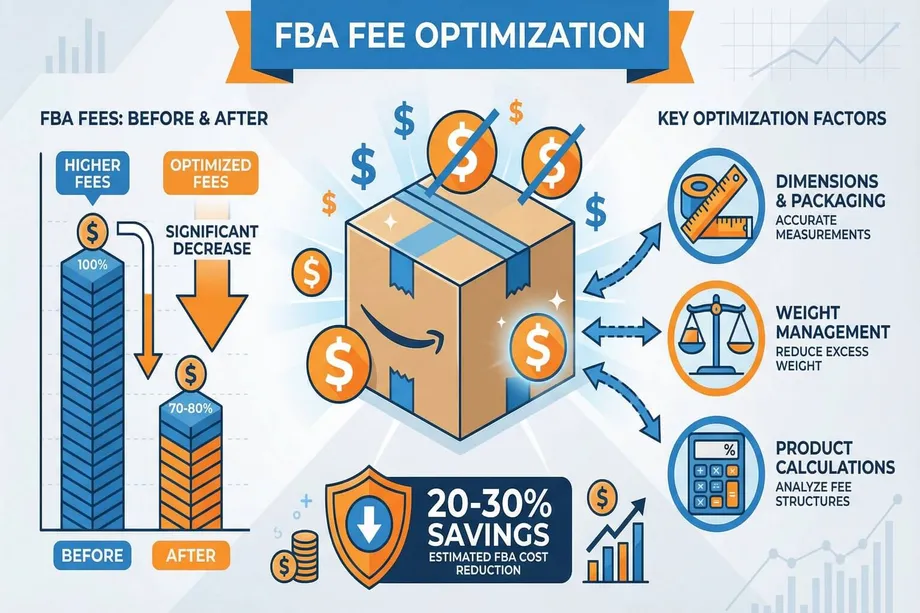
Are your Amazon FBA fees eating up 30%, 40%, or even 50% of your revenue? You're not alone. For many sellers, these ever-increasing costs feel like a black box, silently shrinking profit margins. With the 2026 fee adjustments adding even more pressure, it's more critical than ever to take control. The good news is that a significant portion of these costs is directly tied to a factor you can influence: your product's package dimensions. This guide will show you how to use a data-driven approach to reduce amazon fba fees by 20-30% through strategic package optimization, powered by the one piece of data most sellers are missing.
Understanding the FBA Fee Structure: Why Packaging is Your Biggest Lever
Think of Amazon's fulfillment network as a giant, complex game of Tetris. Every inch of space matters. Amazon's FBA fee structure is designed to penalize inefficiency and reward compact, easy-to-handle products. To effectively reduce amazon fba fees, you must first understand the two core concepts that govern your costs: Product Size Tiers and Dimensional Weight.
Amazon categorizes your products into tiers based on their fully-packaged dimensions and weight. The main tiers for most sellers are:
- Small Standard: Typically items under 1 lb and smaller than 15 x 12 x 0.75 inches.
- Large Standard: Items up to 20 lbs and smaller than 18 x 14 x 8 inches.
- Oversize: Anything larger than the standard tiers.
A tiny fraction of an inch can push your product into a more expensive tier, sometimes increasing your fulfillment fee by 30-50% overnight. This is where the first major opportunity for cost savings lies.
The Hidden Cost Multiplier: Are You Paying a Dimensional Weight Penalty?
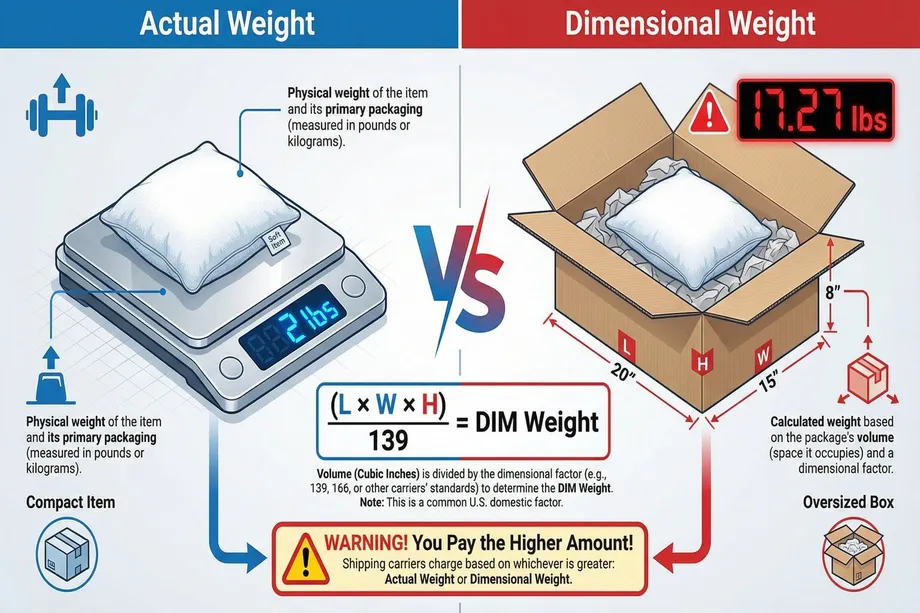
This is the concept that trips up most sellers. Amazon doesn't just care about what your product weighs on a scale; it cares more about how much space it takes up in their trucks and warehouses. This is called Dimensional Weight (DIM Weight). Amazon calculates both the actual weight and the DIM weight of your product and charges you based on whichever is higher.
The Formula for Dimensional Weight (US):
DIM Weight (lbs) = (Length x Width x Height in inches) / 139
Let's use an analogy. Imagine you're shipping a 2 lb pillow. Its actual weight is low, but it's bulky. If its box is 20 x 15 x 8 inches, its DIM weight is (20 * 15 * 8) / 139 = 17.27 lbs. Amazon will charge you the fulfillment fee for a 17.27 lb item, not a 2 lb one. This is the dimensional weight penalty, and it's a primary reason why sellers overpay. The first step to reduce amazon fba fees is to identify if you're a victim of this penalty.
Size Tier Optimization: The $36,000-a-Year Strategy
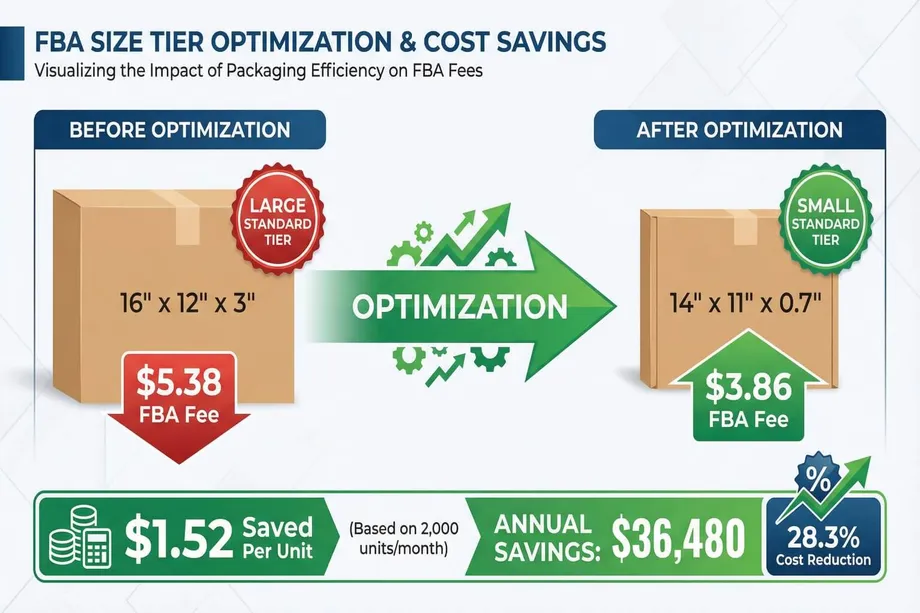
Now for the most powerful strategy: moving a product from a higher fee tier to a lower one. The financial impact is staggering. Consider a product that is just over the line for Small Standard and falls into the Large Standard tier. By slightly redesigning the packaging, you can achieve massive savings.
Case Study: From Large to Small Standard
- Before: A product in a 16 x 12 x 3 inch box is classified as Large Standard, incurring a fulfillment fee of around $5.38.
- After: By redesigning the packaging to 14 x 11 x 0.7 inches, the product now qualifies for Small Standard. The new fee is just $3.86.
The result is a **$1.52 savings per unit**. If you sell 2,000 units a month, that's an extra **$36,480 in your pocket annually**. This isn't just a minor tweak; it's a fundamental shift in your product's profitability. The key to unlocking these savings is having the precise package dimension data for your entire catalog.
The Data Advantage: How to Get the Dimensions You're Missing
So, how do you get this critical package dimension data for hundreds or thousands of ASINs? Manually checking each product on Amazon is impossible. Standard scraper tools can't access it. This is the data gap that prevents most sellers from effectively optimizing their costs.
This is where Easyparser provides a unique, game-changing advantage. Unlike other tools that only provide surface-level data, Easyparser offers a specialized Rank & Dimension API. This is the only API on the market designed to pull the precise, technical package dimensions and weight directly from Amazon's logistics data feeds.
Our 3-API workflow makes large-scale analysis simple:
- Search API: Get a list of all ASINs in your category or for a specific keyword.
- Rank & Dimension API: Loop through those ASINs to get the exact package dimensions and weight for each one.
- Detail API: Pull the current price for each ASIN to calculate fee percentages and profitability.
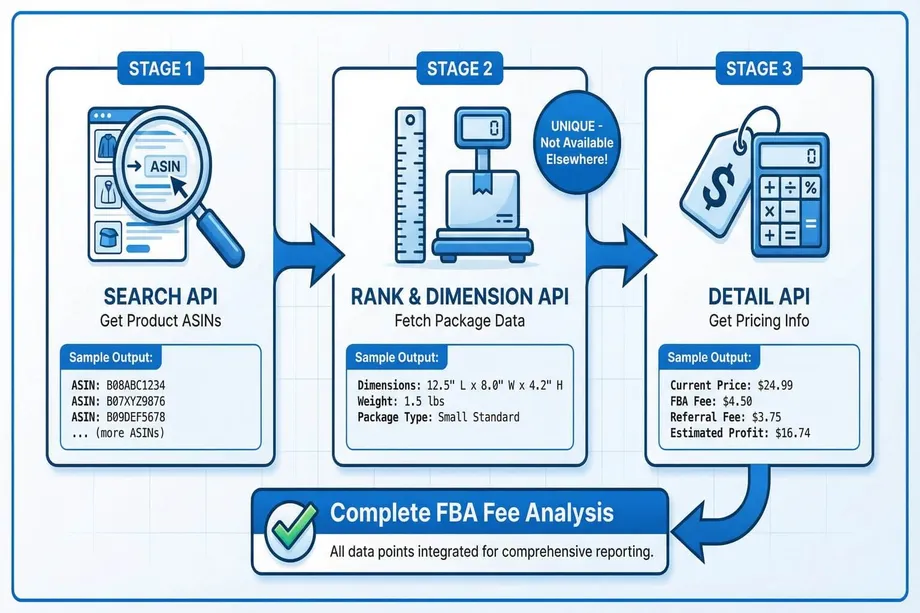
This automated workflow gives you a complete dataset to systematically reduce amazon fba fees across your entire product line.
import requests
API_KEY = "YOUR_API_KEY" # Get your key from app.easyparser.com
ASIN = "B098FKXT8L"
params = {
"api_key": API_KEY,
"platform": "AMZ",
"operation": "RANK_DIMENSION",
"asin": ASIN,
"domain": ".com"
}
response = requests.get("https://realtime.easyparser.com/v1/request", params=params)
data = response.json()
print(data.get('product_dimensions'))
print(data.get('shipping_weight'))
Automating Your Savings: A Python FBA Fee Calculator
With the right data, you can automate the entire analysis. We've developed a Python script that takes the output from Easyparser and automatically calculates the FBA fees, identifies the size tier, and flags optimization opportunities. This allows you to analyze thousands of products in minutes, not weeks.
The script performs the following actions:
- Calculates DIM weight and billable weight.
- Determines the correct 2026 FBA size tier.
- Calculates the total fulfillment fee.
- Identifies products where fees are over 30% of the selling price.
- Creates a prioritized list of your biggest optimization opportunities.
This turns the complex task to reduce amazon fba fees into a clear, actionable, and data-driven process.
def calculate_fba_fee(dimensions, weight, price):
# ... (fee calculation logic based on 2026 rates) ...
length = dimensions['length']
width = dimensions['width']
height = dimensions['height']
dim_weight = (length * width * height) / 139
billable_weight = max(weight, dim_weight)
# ... determine size tier and return fee ...
return total_fee
The SIPP Program: Get Paid to Use Less Packaging
Another powerful, yet underutilized, strategy is Amazon's Ships in Product Packaging (SIPP) program. If your product's own packaging is sturdy enough to ship without an additional Amazon box, you can get it certified. In return, Amazon gives you a discount on your fulfillment fee for every unit shipped, ranging from **$0.04 to $1.32 per item**.
This is a win-win: you reduce amazon fba fees, lower your environmental impact, and improve the customer unboxing experience. With Amazon ending its own FBA prep services in 2026, having SIPP-certified products becomes an even more significant competitive advantage. The investment in ISTA-6 testing for certification often has an ROI of over 1,000% in the first year.
Your Practical Roadmap to Lower FBA Fees
Feeling overwhelmed? Don't be. Here is a simple, step-by-step roadmap to get started:
- Audit Your Catalog: Use Easyparser to pull the package dimensions for your top 100 products.
- Identify Red Flags: Create a spreadsheet and flag all products where FBA fees are >30% of the price or where DIM weight is higher than actual weight.
- Find the Low-Hanging Fruit: Prioritize the products that are closest to the next-lowest size tier threshold. A half-inch reduction here could save you thousands.
- Model the Savings: Use our Python calculator to model the financial impact of a 10% reduction in package size for your top 5 flagged products.
- Contact Your Supplier: Armed with data, go to your supplier and discuss packaging redesign options. The potential ROI is your leverage.
By following this data-first approach, you transform fee optimization from a guessing game into a predictable science. You can finally reduce amazon fba fees in a systematic and scalable way.
Beyond the Basics: Advanced Cost Control Strategies
Once you have mastered the fundamentals of package dimension optimization, there are additional layers of cost control that experienced sellers leverage. These strategies compound your savings and create a truly lean, efficient operation.
First, consider your inventory velocity. Products that sit in Amazon's warehouses for extended periods incur long-term storage fees, which can be as high as $6.90 per cubic foot for items stored over 365 days. By using Easyparser's data to track your sales rank trends over time, you can predict slow-moving inventory and adjust your shipment quantities accordingly. This prevents the double penalty of both storage fees and tied-up capital.
Second, take advantage of Amazon's inbound placement service fee structure. In 2026, Amazon introduced more granular pricing for how your inventory is distributed across their fulfillment network. By strategically choosing minimal shipment splits and using Amazon's partnered carrier program, you can save an additional 5-10% on your inbound logistics. These savings, when combined with your FBA fee reductions, create a powerful cumulative effect on your bottom line.
Start Slashing Your FBA Fees Today
Stop guessing and start analyzing. Get the package dimension data you need to unlock 20-30% savings. Try the Easyparser Rank & Dimension API and see for yourself.
Start making data-driven decisions today
Start Your Free Trial100 free credits, no credit card required.