

• Monthly 100 free credit!
All features No credit card
Monitor competitor portfolios with our comprehensive Amazon Seller Products API. Access complete product listings, pricing strategies, and stock availability to track market trends programmatically.
• Monthly 100 free credit!
All features No credit card

The Amazon Seller Products API operation provides a detailed view into any given seller's complete product portfolio. By aggregating structured product listings containing essential attributes and performance metrics, developers can build powerful tools for competitive analysis and product research across various Amazon marketplaces. Instead of building an unreliable amazon storefront scraper or attempting to manually scrape amazon seller products, you can rely on our stable endpoints. It practically works like an amazon seller scraper api, delivering accurate results instantly without the hassle of maintaining complex scrapers.
Key Data Points Provided:
No credit card  100 credit free Real-time or Bulk

Sign up today to receive free monthly credits and start using our Amazon competitor analysis and seller tracking capabilities instantly.
Get your secure, auto-generated API token from your Plan page to authorize your requests.
Send a request using the SELLER_PRODUCTS type by providing either a seller_id or storefront url. This is the most effective method for auditing a seller's complete catalog, delivering clean, structured amazon seller catalog data in seconds via Real-Time or Bulk Integration. Choose an endpoint now.
Monitor competitor catalogs, analyze pricing strategies, and track market shifts without scraping or manual checks.
⚡ No IP blocks, no CAPTCHAs just fast, reliable Amazon seller data.
curl -X GET \
"https://realtime.easyparser.com/v1/request" \
-G \
-d api_key=YOUR_API_KEY \
-d platform=AMZ \
-d operation=SELLER_PRODUCTS \
-d domain=.com \
-d seller_id=AXCB29L39I26U
import requests
import json
# set up the request parameters
params = {
"api_key": "YOUR_API_KEY",
"platform": "AMZ",
"operation": "SELLER_PRODUCTS",
"domain": ".com",
"seller_id": "AXCB29L39I26U"
}
# make the http GET request to Easyparser API
api_result = requests.get("https://realtime.easyparser.com/v1/request", params=params)
# print the JSON response from Easyparser API
print(json.dumps(api_result.json()))
const axios = require('axios');
// set up the request parameters
const params = {
api_key: 'YOUR_API_KEY',
platform: 'AMZ',
operation: 'SELLER_PRODUCTS',
domain: '.com',
seller_id: 'AXCB29L39I26U'
};
// make the http GET request to Easyparser API
axios.get('https://realtime.easyparser.com/v1/request', { params })
.then(response => console.log(response.data));
<?php
// set up the request parameters
$params = array(
'api_key' => 'YOUR_API_KEY',
'platform' => 'AMZ',
'operation' => 'SELLER_PRODUCTS',
'domain' => '.com',
'seller_id' => 'AXCB29L39I26U'
);
// make the http GET request to Easyparser API
$url = 'https://realtime.easyparser.com/v1/request?' . http_build_query($params);
$response = file_get_contents($url);
echo $response;
?>
package main
import (
"fmt"
"io"
"net/http"
"net/url"
)
func main() {
// set up the request parameters
params := url.Values{}
params.Add("api_key", "YOUR_API_KEY")
params.Add("platform", "AMZ")
params.Add("operation", "SELLER_PRODUCTS")
params.Add("domain", ".com")
params.Add("seller_id", "AXCB29L39I26U")
requestUrl := "https://realtime.easyparser.com/v1/request?" + params.Encode()
// make the request to Easyparser API
resp, _ := http.Get(requestUrl)
defer resp.Body.Close()
body, _ := io.ReadAll(resp.Body)
fmt.Println(string(body))
}
using System;
using System.Net.Http;
using System.Threading.Tasks;
using System.Collections.Generic;
class Program
{
static async Task Main(string[] args)
{
// set up the request parameters
var client = new HttpClient();
var query = new Dictionary<string, string> {
{ "api_key", "YOUR_API_KEY" },
{ "platform", "AMZ" },
{ "operation", "SELLER_PRODUCTS" },
{ "domain", ".com" },
{ "seller_id", "AXCB29L39I26U" }
};
var queryString = await new FormUrlEncodedContent(query).ReadAsStringAsync();
var url = "https://realtime.easyparser.com/v1/request?" + queryString;
// make the request to Easyparser API
var response = await client.GetStringAsync(url);
Console.WriteLine(response);
}
}
import java.net.URI;
import java.net.http.HttpClient;
import java.net.http.HttpRequest;
import java.net.http.HttpResponse;
import java.net.URLEncoder;
import java.nio.charset.StandardCharsets;
import java.util.Map;
import java.util.LinkedHashMap;
public class EasyparserExample {
public static void main(String[] args) {
// set up the request parameters
HttpClient client = HttpClient.newHttpClient();
Map<String, String> params = new LinkedHashMap<>();
params.put("api_key", "YOUR_API_KEY");
params.put("platform", "AMZ");
params.put("operation", "SELLER_PRODUCTS");
params.put("domain", ".com");
params.put("seller_id", "AXCB29L39I26U");
StringBuilder sb = new StringBuilder();
for (Map.Entry<String, String> entry : params.entrySet()) {
if (sb.length() > 0) sb.append("&");
sb.append(URLEncoder.encode(entry.getKey(), StandardCharsets.UTF_8))
.append("=")
.append(URLEncoder.encode(entry.getValue(), StandardCharsets.UTF_8));
}
String url = "https://realtime.easyparser.com/v1/request?" + sb.toString();
// make the request to Easyparser API
HttpRequest request = HttpRequest.newBuilder().uri(URI.create(url)).build();
HttpResponse<String> response = client.send(request, HttpResponse.BodyHandlers.ofString());
System.out.println(response.body());
}
}

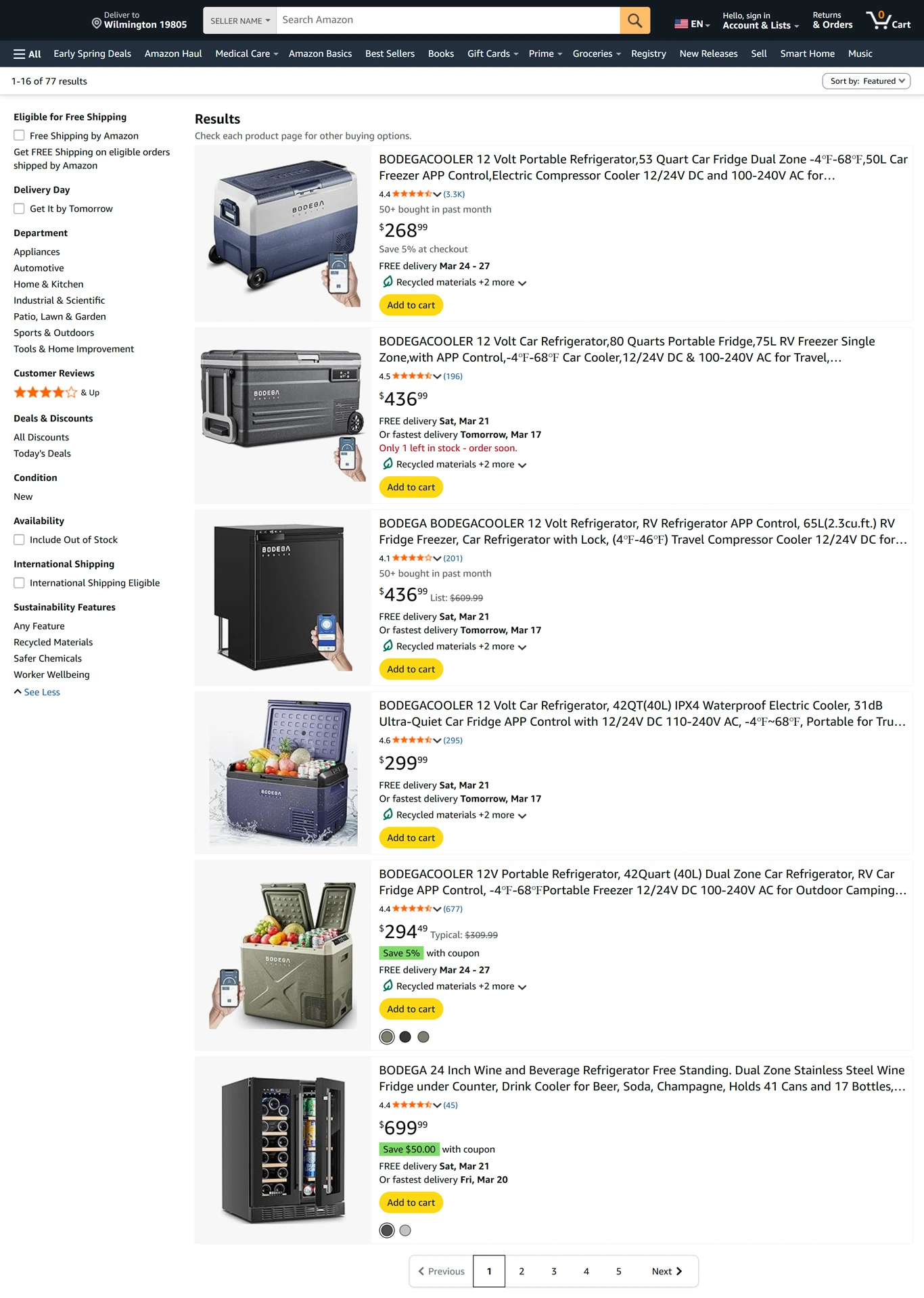
Turn raw seller catalog data into actionable market intelligence for competitive analysis, product sourcing, and brand protection strategies.
Extract amazon seller listings to analyze the complete product portfolios, pricing strategies, and stock levels of your competitors. This allows you to identify distinct market gaps and track competitor amazon sellers to gain a competitive edge.
Discover best-selling products, identify emerging niche markets, and evaluate potential products for sourcing by deeply analyzing successful seller offerings.
Monitor continuous changes in seller product listings, pricing adjustments, and availability to identify early shifts in consumer demand and market trends.
Track unauthorized sellers listing your products globally. Gather structured data on their offerings, pricing, and stock levels to streamline platform enforcement actions.
For sellers, monitor amazon seller inventory, product listings, and stock levels systematically across different Amazon marketplaces to optimize your stock and prevent stockouts. Because of its real-time stock-checking capabilities, it works like a dedicated amazon seller inventory api for your business operations.
Build advanced seller monitoring tools, automated product research platforms, or sophisticated inventory management systems tailored for e-commerce professionals.
Identify highly profitable products, track minute pricing fluctuations, and optimize your sourcing strategies by monitoring what top sellers are stocking.
Empower analysts to develop sophisticated market strategies, conduct reliable amazon competitor product tracking, and identify massive new product opportunities at a glance.
Utilize the Bulk Integration feature to asynchronously audit thousands of seller products simultaneously, identifying macro-level trends and opportunities at scale.
Start free trial. No credit card required.
Quick answers regarding targeted seller queries, bulk data processing, and interpreting competitor metrics efficiently.
You can retrieve detailed seller product data by providing one of two input parameters: the unique marketplace identifier (seller_id, e.g., A1XXCCSDP0GH9G) or the full Amazon seller storefront url. If you are wondering how to keep track of competitors sellers on amazon, using these inputs is the perfect starting point.
Yes. While our Real-Time Integration is designed for instant product data retrieval and on-the-fly analysis, you can use our Bulk Integration to asynchronously audit thousands of seller products to identify trends at scale.
This operation is built to serve a diverse group of e-commerce stakeholders. It is ideal for e-commerce analysts developing market strategies, product managers conducting in-depth market research, SaaS developers building advanced seller monitoring tools, and brand owners protecting their intellectual property across the platform.
Yes, the operation includes extensive Refinement Options. You can easily filter and sort the seller's product listings based on various criteria such as product availability, condition, and department.
Yes, the detailed product information provided for each listing includes the brand context, specific categories, high-quality images, and direct URLs to the Amazon product pages.
The API delivers essential product performance metrics alongside the listing data, giving you direct access to product ratings and total review counts information to accurately gauge a product's success.
Yes, the Seller Products operation is designed to help you track market trends, monitor product listings, and analyze competitor stock levels across various Amazon marketplaces globally.
Absolutely. Brand owners can leverage this operation to track unauthorized sellers who are listing their products, gather detailed data on their specific offerings, and ensure brand consistency across the platform to streamline enforcement actions.
Analyze Amazon seller portfolios, pricing strategies, and stock availability with one powerful API request.