
In the vast, anonymous expanse of the Amazon marketplace, do you truly know who you are competing with or buying from? Behind every storefront name lies a legal business entity, a physical address, and a detailed performance history. This information is the bedrock of strategic decisions, from brand protection to competitive intelligence. However, accessing it has been a long-standing challenge for sellers, brands, and investors alike.
While regulations like the INFORM Consumers Act have mandated more transparency since June 2023, the data remains fragmented and difficult to extract at scale. Manually visiting each seller's profile page, copying business names, and tracking feedback percentages across dozens or hundreds of sellers is simply not feasible. This is where programmatic access through a dedicated amazon seller profile data extraction API becomes not just an advantage, but a necessity for any serious marketplace operator.
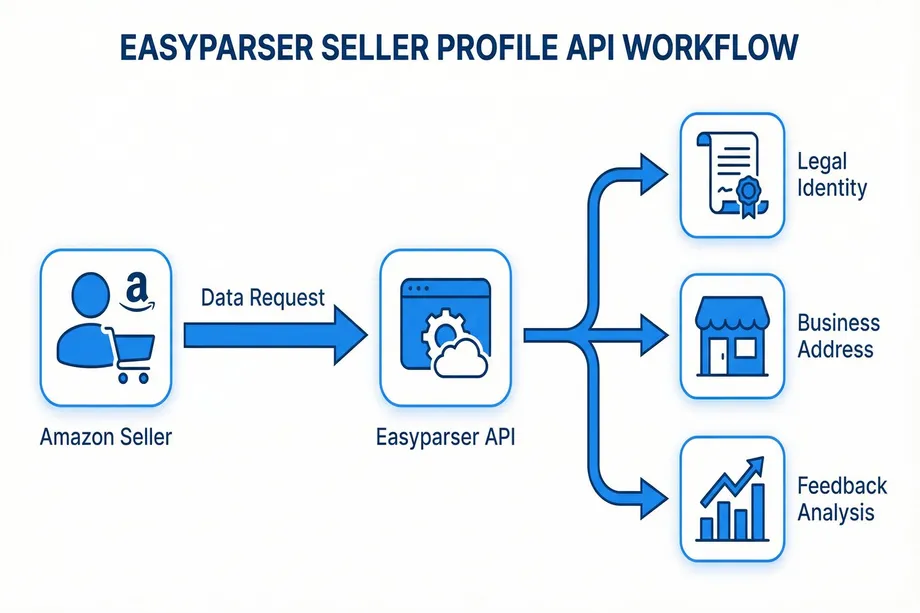
The Easyparser Seller Profile API is engineered to solve this exact problem. It acts as a master key, unlocking the official legal identity and comprehensive performance metrics of any Amazon seller across all global marketplaces. Forget fragile, custom-built scrapers that break with every Amazon page update. This is a robust, reliable solution for accessing verified business names, addresses, and deep feedback analytics that other tools simply cannot provide. This guide will walk you through how to leverage this powerful API to protect your brand, vet suppliers, and gain an unparalleled edge in the marketplace.
Why Amazon Seller Profile Data Matters More Than Ever
Amazon's marketplace hosts millions of third-party sellers. For brands, this means a constant battle against unauthorized resellers, counterfeiters, and MAP (Minimum Advertised Price) violators. For wholesale buyers and online arbitrageurs, it means the risk of partnering with unreliable suppliers. For investors evaluating marketplace acquisitions, it means needing verifiable data for due diligence. In every case, the starting point is the same: knowing who the seller actually is.
Since September 2020, Amazon has required U.S. sellers to display their business name and address on their public profile page. The INFORM Consumers Act, which took effect on June 27, 2023, further strengthened this by mandating that online marketplaces verify and disclose the identities of high-volume third-party sellers (those with $20,000 or more in annual revenue). This regulatory shift has made seller identity data more accessible in theory, but extracting it programmatically at scale remains a technical challenge that the Seller Profile API solves elegantly.
Unmasking the True Identity: Business Name and Address Extraction
The single most powerful feature of the Seller Profile API is its ability to perform amazon seller profile data extraction to reveal the legal business name and registered address behind any seller account. While a storefront might be named "SuperFast Gadgets", the API can reveal the legal entity is "Global Imports LLC" located at "123 Commerce St, Wilmington, DE". This capability is a game-changer for several critical reasons.
For brand protection, when an unauthorized seller is listing your products, a storefront name alone is not enough to take action. You need a legal business name and a physical address to issue a formal Cease and Desist letter or to file an accurate infringement claim with Amazon Brand Registry. The API provides exactly this data, enabling your legal team to act swiftly and decisively.
For seller due diligence, investors or acquirers evaluating a potential Amazon business acquisition need to verify the legal identity of the target. The API allows you to confirm that the business entity matches what has been represented, check the registered address, and cross-reference this information with public business registries.
For B2B lead generation, identifying the actual businesses behind successful storefronts allows you to build a highly targeted list for wholesale outreach, partnership proposals, or service offerings. Instead of guessing who runs a top-performing store, you get verified business data that can be fed directly into your CRM.
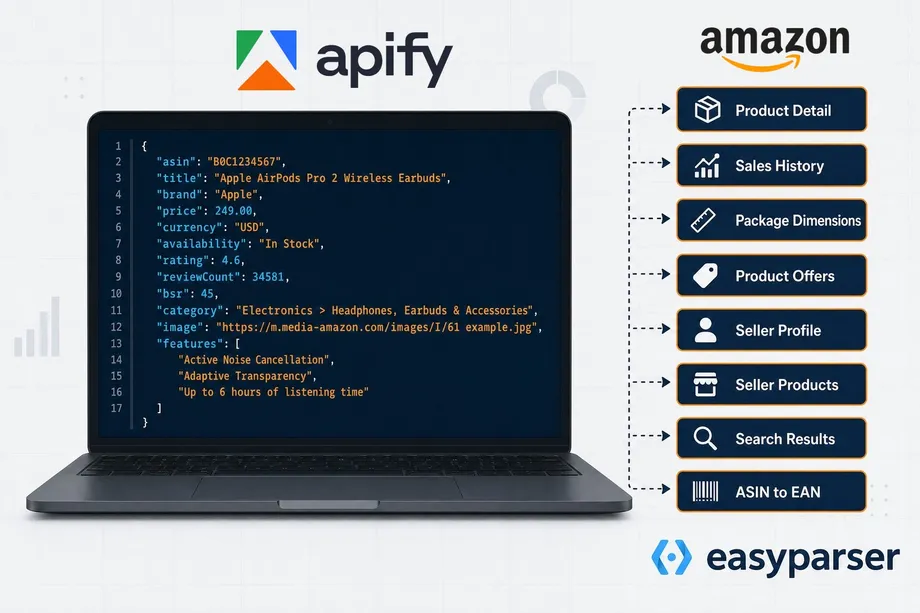
This level of identity verification moves beyond simple data scraping and into the realm of strategic business intelligence. Most competing tools like Apify, Bright Data, and WebScraper.io focus on surface-level data such as seller name and overall rating. They do not provide the legal business name and registered address extraction that makes the Easyparser Seller Profile API uniquely valuable.
Beyond the Stars: Deep Seller Feedback Analysis
A seller's star rating only tells a fraction of the story. A 4.5-star rating could mean consistently good service, or it could mask a recent decline in performance. To truly understand a seller's reputation and operational health, you need to analyze the trends and nuances within their feedback history. The Seller Profile API provides a structured breakdown of feedback metrics that is impossible to get from manual inspection alone.
Feedback Trend Analysis (30/90/365 Days and Lifetime)
The API returns a feedback_summary object that breaks down positive, neutral, and negative feedback percentages across four distinct timeframes: 30 days, 90 days, 12 months, and lifetime. This granular temporal analysis allows you to answer critical questions that a single aggregate rating cannot.
Is a seller's recent negative feedback a temporary blip caused by a holiday rush, or is it a worsening trend that signals deeper operational problems? How does their 12-month performance compare to their lifetime average? Are they improving their customer service over time, or are they cutting corners? These are the kinds of insights that separate informed decision-making from guesswork.
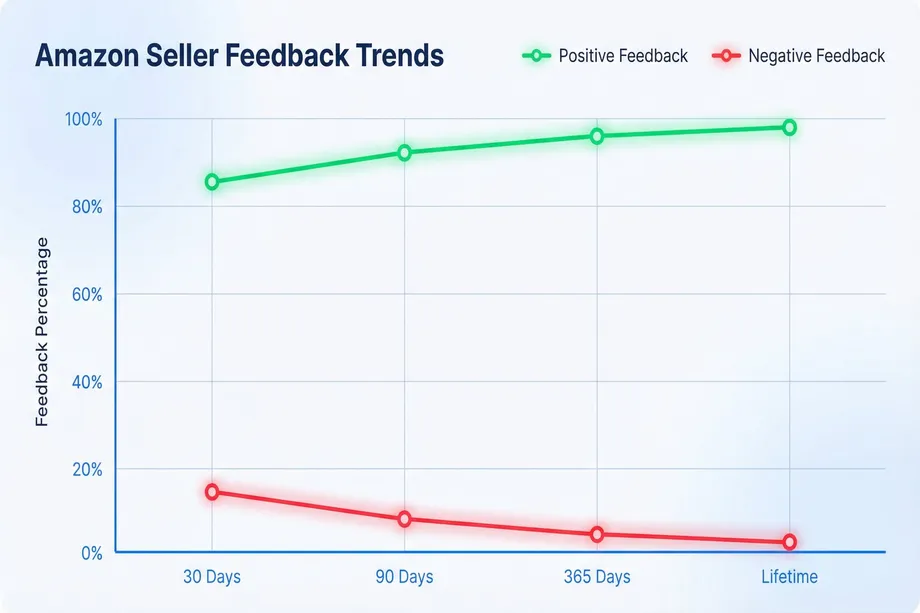
For example, if a seller shows 95% positive feedback over their lifetime but only 70% positive in the last 30 days, this is a clear red flag. It could indicate a change in fulfillment strategy, a supply chain issue, or a decline in product quality. This temporal analysis is crucial for assessing a seller's current operational health and predicting their future reliability, whether as a competitor, a potential partner, or an acquisition target.
Understanding Seller Feedback vs. Product Reviews
It is important to distinguish between two types of customer input on Amazon. Seller Feedback is about the buying experience: shipping speed, packaging quality, customer service responsiveness, and overall seller reliability. It appears on the seller's profile page and directly impacts the seller's account health metrics. Product Reviews, on the other hand, are about the product itself: its quality, features, functionality, and value for money. They appear on the product listing page.
The Seller Profile API focuses exclusively on Seller Feedback, which is the most direct indicator of a seller's operational performance. While product reviews tell you about the item, seller feedback tells you about the business behind it. This distinction is critical for anyone performing seller feedback analysis for vetting or competitive benchmarking purposes.
Detecting Amazon-Suppressed (Strikethrough) Feedback
A unique and highly valuable feature of the API is the is_strikethrough boolean field in the feedback array. When Amazon takes responsibility for a negative customer experience, typically related to FBA (Fulfillment by Amazon) fulfillment issues like late delivery or damaged packaging, it strikes through the feedback entry. This means the feedback is still visible but does not count against the seller's rating.
A high frequency of strikethrough feedback entries reveals important intelligence. It indicates that the seller relies heavily on FBA and may be experiencing logistical issues that Amazon is absorbing on their behalf. For competitive analysis, this tells you about their fulfillment strategy (FBA vs. FBM). For supplier vetting, it helps you understand the true customer experience beyond what the headline rating suggests.
Traditional Scrapers vs. Easyparser: Why the Difference Matters
Many Amazon data tools operate as generic proxy services that scrape visible HTML data from product pages. While this approach works for basic information, it falls short of the depth and reliability required for serious seller intelligence work. Here is how Easyparser compares to traditional scraping solutions:
| Feature | Traditional Scrapers (Apify, Bright Data, etc.) | Easyparser Seller Profile API |
|---|---|---|
| Legal Business Name | Not available or unreliable | Extracted from official records |
| Registered Business Address | Not available or unreliable | Full address extraction |
| Feedback Trend Breakdown | Overall rating only | 30/90/365 days + Lifetime |
| Strikethrough Detection | Not available | Full is_strikethrough support |
| Infrastructure Management | Proxy rotation, CAPTCHA solving required | Fully managed, no maintenance |
| Global Marketplace Support | Varies by tool | All Amazon marketplaces |
| Data Format | Raw HTML parsing needed | Clean, structured JSON |
The key advantage is clear: while generic scrapers give you a seller's public name and a single rating number, the Easyparser API gives you the legal entity behind the storefront, their registered address, and a multi-dimensional view of their performance over time. This is the difference between surface-level data and actionable intelligence.
How to Extract Seller Profile Data: Step-by-Step with Python
Accessing this data is straightforward. By making a single GET request to the Easyparser API endpoint with the operation set to SELLER_PROFILE and providing a seller_id, you receive a clean JSON object containing all the intelligence you need. Here is a complete Python example:
import requests
import json
API_KEY = "YOUR_API_KEY" # Get your key from app.easyparser.com
SELLER_ID = "A23X8TYK8IHNZF" # Target Seller ID
params = {
"api_key": API_KEY,
"platform": "AMZ",
"operation": "SELLER_PROFILE",
"seller_id": SELLER_ID,
"domain": ".com"
}
response = requests.get("https://realtime.easyparser.com/v1/request", params=params)
data = response.json()
# Extract seller identity
seller = data["result"]["seller_details"]
print(f"Store Name: {seller['name']}")
print(f"Legal Info: {seller['about_this_seller']}")
print(f"Rating: {seller['rating']} ({seller['ratings_total']} ratings)")
# Analyze feedback trends
summary = data["result"]["feedback_summary"][0]
print(f"30-Day Positive: {summary['thirty_days']['positive_percent']}%")
print(f"12-Month Positive: {summary['twelve_months']['positive_percent']}%")
# Check for strikethrough feedback
for fb in data["result"]["feedback"]:
status = "[SUPPRESSED]" if fb["is_strikethrough"] else ""
print(f"{status} {fb['rating']} - {fb['body'][:80]}")
This script will output the seller's public store name, the crucial about_this_seller string containing the registered business name and address, their overall rating, feedback trend percentages, and individual feedback entries with suppression status. All of this actionable data is returned in a single API call that typically completes in under 5 seconds.
Real-World Use Cases for Seller Profile Data
The practical applications of amazon seller profile data extraction span across multiple business functions and industries. Here are the most impactful use cases that demonstrate the value of this capability.
1. Brand Protection and Unauthorized Seller Tracking
Brand owners can use the API to systematically identify and unmask unauthorized sellers listing their products. By extracting the legal business name and address, your legal team can issue targeted Cease and Desist letters, file accurate Brand Registry violation reports, and build a database of known unauthorized resellers. This is far more effective than relying on Amazon's automated enforcement alone.
2. Supplier Vetting for Online Arbitrage and Wholesale
Before committing to a wholesale relationship or sourcing products from a particular seller, you can audit their 12-month feedback trends and negative feedback ratio. A seller with a declining positive feedback percentage or a high rate of strikethrough entries may not be a reliable long-term partner. This data-driven approach to seller due diligence reduces risk and protects your investment.
3. Marketplace Investor Due Diligence
Investors evaluating Amazon FBA business acquisitions can use the API to verify the seller's legal identity, assess their customer service track record, and identify any hidden performance issues. The feedback trend data provides a longitudinal view of the business's health that financial statements alone cannot capture.
4. Competitive Benchmarking
Compare your own seller feedback velocity and rating trends against your top competitors. Analyze their "About this seller" descriptions to understand their positioning and customer service philosophy. Track how their feedback metrics change over time to identify shifts in their operational strategy.
5. Building Seller Intelligence SaaS Tools
SaaS developers can integrate the Seller Profile API into Chrome extensions, monitoring dashboards, or automated alert systems. Imagine a tool that displays a seller's legal identity and feedback health score directly on the Amazon product page, or an automated system that alerts you when a new unauthorized seller appears on your listings.
Ready to Unmask Amazon Sellers?
Start extracting legal identities, business addresses, and feedback analytics with the Easyparser Seller Profile API. Get 100 free credits every month with no credit card required.
Conclusion: From Anonymity to Actionable Intelligence
In a marketplace defined by intense competition and growing regulatory requirements, the ability to look behind the curtain and perform accurate amazon seller profile data extraction is a strategic superpower. The Easyparser Seller Profile API provides a level of transparency and depth that standard scraping tools cannot match. By programmatically accessing legal identities, business addresses, and nuanced feedback trends across all Amazon marketplaces, you can transform your approach to brand protection, competitive analysis, and supplier vetting.
Stop making critical business decisions based on incomplete information. Whether you are a brand owner fighting unauthorized sellers, an arbitrageur vetting suppliers, or an investor performing due diligence, the Seller Profile API gives you the verified data you need to operate with confidence and clarity. With 100 free monthly credits and no credit card required, there is no barrier to getting started today.
Start extracting Amazon data for free
Start Your Free Trial100 free credits, no credit card required.