Supplier price lists, warehouse scans and wholesale catalogs identify products by barcode. Amazon identifies them by ASIN. Before you can compare prices, check sales rank or list an item, you need a reliable UPC to ASIN conversion. Doing that by pasting barcodes into the Amazon search bar works for one product and breaks down at a hundred. This guide covers the difference between the two codes, the pitfalls of matching them, and an automated workflow built on Easyparser's Product Lookup API, from a single lookup to bulk matching.
UPC vs ASIN: What Is the Difference?
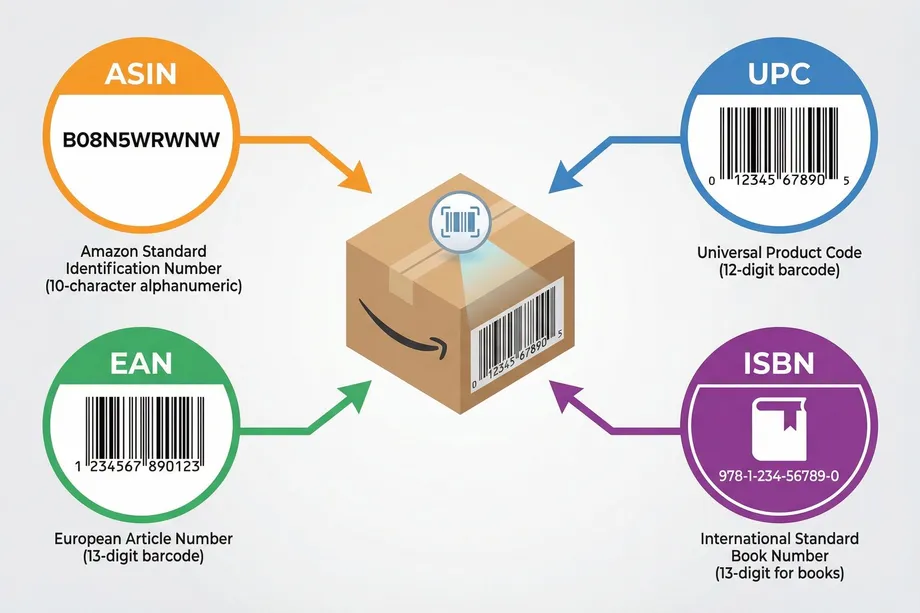
A UPC (Universal Product Code) is a 12-digit GS1 barcode number, technically a GTIN-12, that the brand owner assigns to a product so any retailer, warehouse or point-of-sale system can identify it. An ASIN (Amazon Standard Identification Number) is a 10-character code that Amazon assigns to a product detail page in its own catalog. The UPC travels with the product; the ASIN only exists inside Amazon.
| UPC | ASIN | |
|---|---|---|
| Issued by | GS1, to the brand owner | Amazon, when a new detail page is created |
| Format | 12 digits (UPC-A) | 10 letters and digits, for example B00FEUHH5M |
| Where it works | Every retailer and supply chain system | Amazon catalog only |
| Identifies | A trade item and its packaging level | An Amazon product detail page |
| Relationship | One UPC can match several ASINs | One ASIN can list several barcodes |
Because the two codes come from different systems, converting UPC to ASIN is a catalog lookup, not a formula. You cannot calculate one from the other. For EAN, ISBN, GTIN and the reverse ASIN to UPC direction, see our explainer on ASIN, UPC, EAN and ISBN identifiers.
Why UPC to ASIN Conversion Is Harder Than It Looks
- One-to-many matches: duplicate listings, bundles, multipacks and legacy pages can share one barcode. In the Product Lookup documentation sample, the UPC 724382975021 matches two separate ASINs for the same album.
- Marketplace differences: a product listed on amazon.com may be missing or listed under another ASIN on amazon.co.uk or amazon.de.
- Formatting damage: spreadsheets drop leading zeros and turn long numbers into scientific notation, so a valid UPC becomes an invalid one.
- Wrong or reused codes: barcodes bought from resellers or assigned carelessly can point to unrelated products.
- No public mapping table: there is no free, complete UPC to ASIN database. The mapping lives in Amazon's catalog and changes as listings are created and merged.
Manual Lookups vs a UPC to ASIN Converter API
The traditional options are pasting codes into Amazon search, spreadsheet add-ons that build search URLs, and free online converter tools. They are fine for a few checks, but each one adds manual work or breaks when page layouts change.
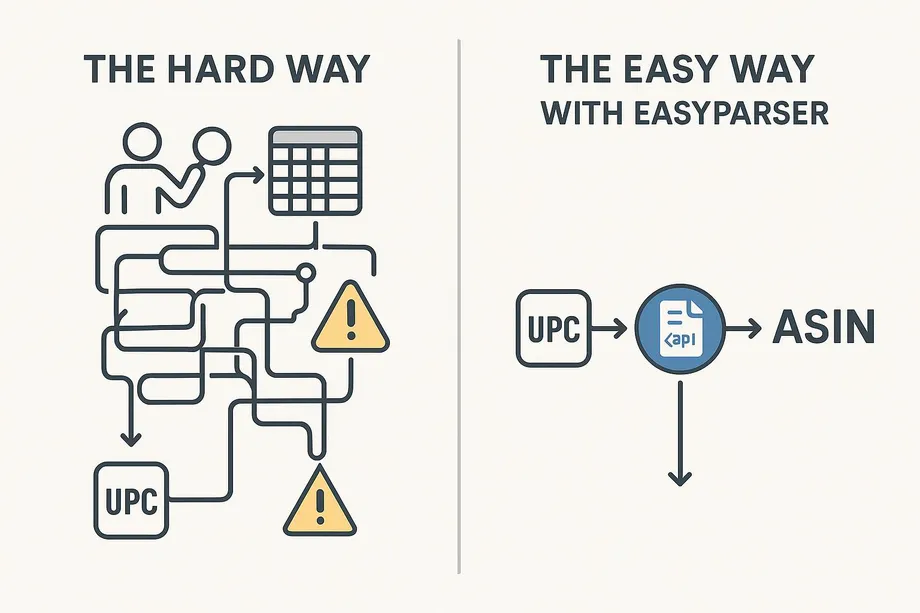
| Need | Manual search or free online tool | Product Lookup API |
|---|---|---|
| Volume | One code or a short list at a time | Single requests, or up to 5,000 inputs per bulk request |
| Automation | Copy and paste | Runs from your script, ERP or scheduler |
| Freshness | Depends on the tool and its cache | Real-time lookup against the chosen marketplace |
| Output | Usually the ASIN only | ASIN, title, brand, manufacturer, model number, images and all barcodes |
| Ambiguous matches | Often shows only the first result | Returns every matching listing with a match count |
Not ready to write code? ASINInfo offers a no-code converter for the same job: paste up to 1,000 UPC, EAN or ASIN values, review the matches in a table and export them as CSV. Use the API below when the lookup has to run inside your own system.
How to Convert a UPC to an ASIN with the Product Lookup API
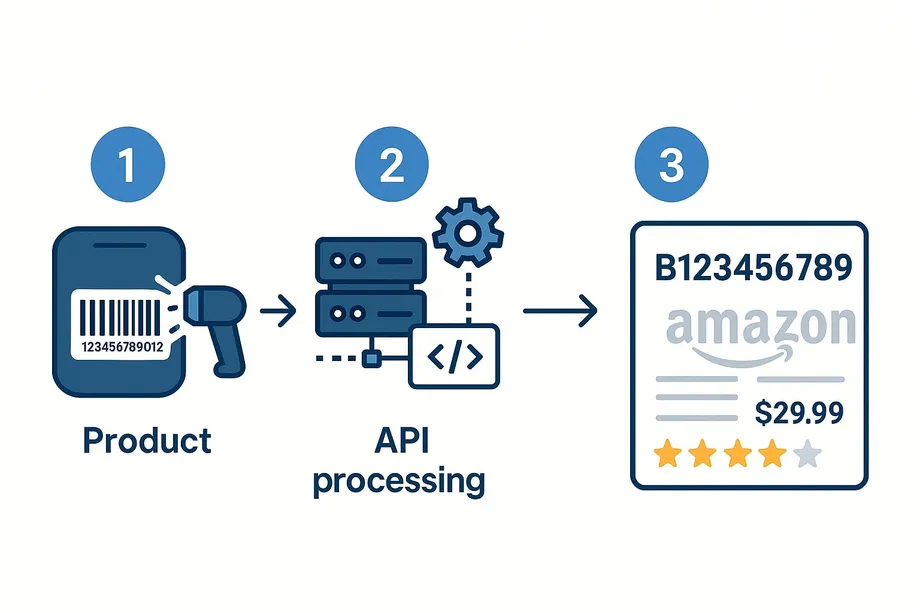
The PRODUCT_LOOKUP operation takes an identifier_type (ASIN, UPC, EAN, GTIN, ISBN, JAN or MINSAN) and the identifier value, and returns every Amazon listing that matches. Create a free account, copy your API key and run:
import requests
params = {
"api_key": "YOUR_API_KEY",
"platform": "AMZ",
"operation": "PRODUCT_LOOKUP",
"domain": ".com",
"identifier_type": "UPC",
"identifier": "012000809941", # always send barcodes as strings
}
resp = requests.get("https://realtime.easyparser.com/v1/request", params=params, timeout=60)
resp.raise_for_status()
data = resp.json()
if not data["request_info"]["success"]:
print(data["request_info"]["error_details"])
else:
found = data["result"]["search_result"]
print("matches:", found["total_product_count"])
for product in found["products"]:
codes = {i["type"]: i["value"] for i in product.get("identifiers", [])}
print(product["asin"], product.get("brand"), product["title"], codes)
Check request_info.success even when the HTTP status is 200, and set identifier_type to the type that matches the code you send. Each successful request costs 1 credit.
What the response contains
Easyparser's published Product Lookup sample looks up the EAN form of this barcode, 0012000809941, and returns one listing:
| Field | Sample value | Use it for |
|---|---|---|
total_product_count | 1 | Unique match, no match or several candidates |
products[].asin | B00FEUHH5M | The ASIN to store next to your supplier row |
products[].title | Pepsi, 12 Oz Per Can, Case Of 24 Cans | Checking pack size against the supplier description |
products[].brand / manufacturer | Pepsi / PEPSI-COLA NORTH AMERICA INC. | Brand checks before accepting a match |
products[].identifiers[] | upc 012000809941, ean 0012000809941 | Every barcode registered for the listing |
products[].main_image.link | Main product image URL | Visual review of ambiguous rows |
country_code | US | Confirming which marketplace answered |
Note that the title says "Case Of 24 Cans". If your supplier sells single cans under a different code, this is exactly the kind of pack-size mismatch the review step should catch.
After the Lookup: Price, Rank and Offers
Product Lookup answers one question: which ASIN is this barcode? It does not return price, rating or sales rank. Once a match is approved, pass the ASIN to the Product Detail API (DETAIL) for the Buy Box price, availability, rating, review count and Best Sellers Rank, or to OFFER for every seller's price on the listing. Keeping identity and commercial data in separate steps also keeps your audit trail clean: you can show why a barcode was matched to an ASIN independently of what the listing costs today.
Typical workflows that start with a UPC to ASIN lookup:
- Wholesale and supplier onboarding: match a distributor's price list to Amazon listings before calculating margins.
- Online arbitrage sourcing: scan retail barcodes and check whether the product exists on Amazon. Our online arbitrage guide covers the full sourcing flow.
- Catalog enrichment: fill missing brand, manufacturer and model numbers in a PIM from the matched listing.
- Duplicate listing checks: a barcode that returns several ASINs often points to duplicate or bundle listings worth reviewing.
Bulk UPC to ASIN Matching for Supplier Catalogs
Single lookups are fine for spot checks. A supplier price list with thousands of barcodes needs a batch workflow that you can rerun every time the list changes. The steps below keep a bulk UPC to ASIN job clean and auditable.
1. Normalize the barcodes first
Supplier files mix 12-digit UPCs, 13-digit EANs and values that lost their leading zeros in a spreadsheet. Store every code as text, strip spaces and dashes, and decide which identifier type each one is. In Easyparser's published Product Lookup sample, the EAN 0012000809941 resolves to ASIN B00FEUHH5M, and the response lists the matching UPC 012000809941: the same product, written with and without the leading zero. Remove duplicates after normalizing so you do not pay twice for one product.
2. Submit one bulk job per identifier type
The Bulk API accepts up to 5,000 input values per request, counted across all groups in that request. Each group names the operation, the marketplace domain, a callback_url and a payload with the identifiers list and their identifier_type (UPC, EAN, GTIN, ISBN, JAN, MINSAN or ASIN).
import requests
upcs = ["012000809941"] # normalized, de-duplicated list from your supplier file
job = [{
"platform": "AMZ",
"operation": "PRODUCT_LOOKUP",
"domain": ".com",
"callback_url": "https://example.com/easyparser/webhook",
"payload": {"identifiers": upcs, "identifier_type": "UPC"},
}]
resp = requests.post(
"https://bulk.easyparser.com/v1/bulk",
headers={"api-key": "YOUR_API_KEY"},
json=job,
).json()
print(resp["meta_data"]) # accepted, invalid, failed and credit counts
Partial acceptance is normal, so check every outcome group in the response (accepted, invalid, insufficient credit, failed and rate limited), not just the success flag. Save the returned query IDs next to the original supplier rows.
3. Collect results when the webhook fires
The webhook only says that results are ready; it does not carry the parsed data. Fetch each result from the Data Service and store it promptly, because parsed results are kept for at most 24 hours. Our Bulk API guide covers callbacks, retries and idempotent processing in more detail.
4. Classify every match before you use it
| Lookup result | What it usually means | What to do |
|---|---|---|
| No product found | The item is not listed on that marketplace, or the code is wrong | Check the code and try the EAN or GTIN form; mark the row as not listed |
| Exactly one product | A clean UPC to ASIN match | Accept, then spot-check the title and brand against the supplier name |
| Several products | Variations, multipacks or duplicate listings share the code | Send to a review queue; compare pack size, brand and title before choosing |
The total_product_count field tells you which bucket a row falls into. Keeping ambiguous rows out of automated pricing or repricing rules is the single most effective way to avoid costly mismatches.
UPC to ASIN Across Amazon Marketplaces
An ASIN is checked per marketplace, so set domain to the store you sell in, for example .com, .co.uk, .de or .co.jp. Easyparser covers 22 Amazon marketplaces. If you expand into a new country, run the same barcode list against that domain and compare: a product can be listed in one store and missing in another, or sit under a different ASIN. Store the marketplace with every match so a .com mapping is never reused for .de by accident.
Best Practices for a Reliable UPC to ASIN Converter
- Keep codes as text end to end. Read CSV columns as strings and keep the raw value next to the normalized one.
- Branch on the match count. Zero, one and several products need different handling; never take the first product of a multi-match blindly.
- Cache approved matches. Store the barcode, marketplace, ASIN and lookup date, and refresh on a schedule instead of looking up the same code every day.
- Retry transient errors only. Use backoff for timeouts and rate limits; do not retry invalid codes.
- Watch credits. Each response includes your remaining credits, so log them in long-running jobs.
Start Converting UPCs to ASINs
A dependable UPC to ASIN workflow has three parts: clean barcodes, a lookup that returns every matching listing with its evidence, and a review rule for anything that is not a single clean match. If you are new to Amazon identifiers, start with our explainer on what an ASIN is. Easyparser's Demo plan includes 100 credits with no credit card required, enough to test the scripts above on a sample of your own supplier file. Create a free account and convert your first barcodes.
Sources
- What is an ASIN?, Amazon (accessed )
- What is a GTIN?, GS1 US (accessed )
- Product Lookup, Easyparser Documentation (accessed )
- Product Lookup Response, Easyparser Documentation (accessed )
- Bulk Integration Overview, Easyparser Documentation (accessed )
Start your Amazon data journey for free
Start Your Free Trial100 free credits, no credit card required.