
A category manager asks a chat assistant whether a new headphone listing is a credible sourcing option. The assistant can explain what a healthy offer set looks like, but it cannot safely answer from memory. A amazon ai agent easyparser workflow changes that: it retrieves live marketplace evidence, checks the response, and states what the evidence does and does not support. That distinction matters to wholesale buyers evaluating supply risk and sellers watching a crowded Buy Box. The goal is not to make a model sound certain. The goal is to give it a bounded, current record that it can inspect, compare, and communicate.
Why an Amazon AI Agent with Easyparser Needs Live Evidence
Amazon product information moves faster than a model's training window. Price, availability, offers, review counts, and seller participation can change after an answer has been generated. An agent therefore needs two separate capabilities. First, the language model must understand the question, decide what evidence is relevant, and communicate the finding. Second, a data tool must retrieve the current facts. When those roles are mixed together, an answer can sound polished while quietly blending assumptions with data.
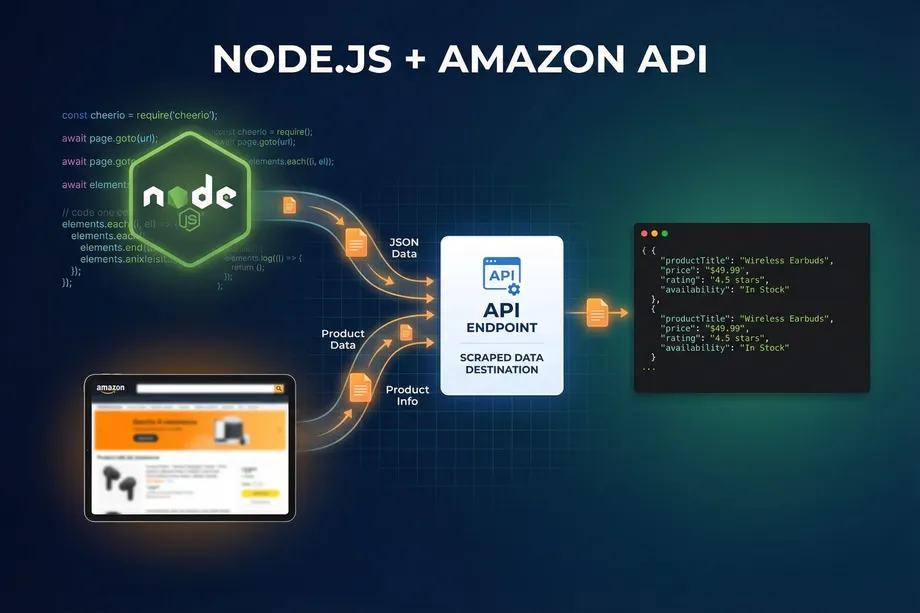
Easyparser is useful as the evidence layer because it returns structured Amazon data rather than a page of raw markup. The current documentation distinguishes synchronous Real-Time requests from asynchronous Bulk jobs, while using a consistent JSON response approach across both modes. That lets a development team use the same normalized fields for one ASIN at a time or for a large catalog pipeline. The model then receives a compact, purposeful payload instead of trying to infer meaning from unstable HTML.
Quick Answer: Design the Agent as Three Layers
The fastest reliable design separates the conversational layer from the evidence layer and the decision rules. The model should not decide that missing data means a product is unavailable, and the API should not be expected to interpret an ambiguous business request. A small orchestration layer connects the two.
| Layer | Responsibility | Example output |
|---|---|---|
| LLM | Interpret the question, choose a permitted action, and write a clear explanation. | A request for a buyer comparison or a seller monitoring summary. |
| Easyparser data tool | Fetch current public marketplace evidence for a narrow operation. | Product attributes, active offers, seller records, or search results. |
| Validation rules | Check inputs, required fields, timestamps, and scope before analysis. | A normalized record marked ready, incomplete, or needing a retry. |
This architecture also makes it easier to test. You can replay a stored JSON response and judge whether the prompt and rules produce a helpful answer without repeatedly hitting an API. For teams building an amazon ai agent easyparser workflow, this replayable evidence is the difference between a confident demo and a reviewable production process. For production, keep the model's permissions deliberately small. Give it a tool for a product detail lookup, an offer lookup, or a search task instead of a vague tool that can request anything.
Define the Boundary: Public Research Versus Private Actions
An AI agent can serve very different Amazon users. A buyer may want to compare sellers, fulfillment types, price spread, and feedback before requesting a quote. A seller may want to notice a new competing offer, a Buy Box change, or a change in public listing attributes. Those are public marketplace-research questions. They do not require access to a merchant's private Seller Central inventory, advertising account, or order data.
That distinction should appear in the system prompt and the product interface. Tell the agent that it analyzes public marketplace evidence, never performs account changes, and never claims access to private business data. A read-only research boundary makes the workflow easier to audit and safer to share across merchandising, procurement, and agency teams. It also keeps recommendations honest: a public offer record can indicate competitive pressure, but it cannot reveal another merchant's profit margin or future pricing plan.
Choose the Right Amazon Data Operation
Start from the decision, not from the API menu. When a user has a known ASIN and needs specifications, variation context, current availability, or basic pricing, use the Product Detail API. When the question asks who is selling, how prices differ, whether FBA or FBM sellers are present, or who holds the Buy Box, use the Product Offer API. When the work begins with a category or phrase rather than an ASIN, use the Search Listing API to discover candidates before drilling into individual records.
| User question | Best evidence | Agent behavior |
|---|---|---|
| Is this ASIN suitable for our catalog? | Product details, brand, attributes, availability, and variation context. | Summarize known fields and flag missing compliance data for a human check. |
| Who is competing for this listing right now? | Offer-level price, condition, seller, fulfillment, and Buy Box information. | Compare the active offer set without assuming each seller has equal delivery or reputation. |
| Which products match a new market signal? | Search results followed by selected product lookups. | Return a ranked research queue, not a final purchasing decision. |
| What changed across a large catalog? | Bulk results, stored baselines, and job-status logs. | Identify exceptions for review after the job completes. |
Operation selection is the first place where an agent adds value. It converts a broad natural-language question into a small, inspectable data request. It should also confirm the marketplace domain before calling the tool. An offer comparison from one country should not be presented as evidence for another marketplace where currency, stock, or seller participation differs.

Build the Evidence Loop Before You Add Autonomy
A good amazon ai agent easyparser implementation behaves less like a free-form chatbot and more like an evidence loop. The loop is simple enough to explain to nontechnical teammates, yet it prevents many common errors in automated research. Each step should leave a trace that a human can inspect later.
- Classify the question. Decide whether the prompt is about one product, competing offers, discovery, historical context, or a catalog-wide job.
- Validate the input. Normalize the ASIN, marketplace, delivery context, and any filters before calling the data service.
- Retrieve the smallest useful record. Request detail data for specifications, offers for competition, or search for discovery. Avoid collecting unrelated fields simply because they exist.
- Check the response. Verify that the expected ASIN or query is present, required fields are not absent, and the returned marketplace matches the request.
- Reason with evidence. Ask the LLM to separate observed facts from conclusions, mention uncertainty, and identify the next best question.
- Log the result. Store inputs, response identifiers, timestamps, and the final explanation so the team can reproduce a decision.
This pattern benefits buyers and sellers differently but equally. A buyer can see why a sourcing candidate was flagged, rather than receiving a black-box score. A seller can investigate a pricing or seller-count movement before changing a public strategy. In both cases, the agent becomes a research assistant, not an unreviewed decision maker.
Build a Product Research Agent with an OpenAI-Compatible Tool
The first production experiment should solve one narrow question. For example: given an ASIN and marketplace, return the live product facts needed for a listing-quality or sourcing review. The application can expose a function with required inputs such as asin and domain, call Easyparser, remove unused fields, and provide the normalized result to the model. The model should be instructed to say that it lacks evidence when a required field is missing.
The following simplified call demonstrates the data layer. In a real application, keep the API key in a server-side secret manager, validate the ASIN before making a request, and pass a short response schema to the LLM rather than an unrestricted payload.
import requests
API_KEY = 'YOUR_API_KEY'
ASIN = 'B0CJB6V2L5'
params = {
'api_key': API_KEY,
'platform': 'AMZ',
'operation': 'DETAIL',
'domain': '.com',
'asin': ASIN
}
response = requests.get('https://realtime.easyparser.com/v1/request', params=params)
record = response.json()
print(record.get('asin'))
print(record.get('title'))
Make the Output Interpretable
Do not ask the model to decide whether a product is objectively good. Ask for a limited, evidence-based summary: title, brand, current availability, price or price range, relevant variation observations, and fields that were not returned. Then add a short action prompt such as: identify the two facts a buyer should verify outside the public listing. This turns a raw API response into a useful briefing without disguising a recommendation as certainty.
Support Buyer and Seller Questions with Different Prompts
The same data can lead to poor answers if the agent uses one generic prompt for every persona. Buyers need signals that support sourcing diligence. Sellers need signals that support competitive monitoring and listing research. Build separate templates, each constrained to evidence available in the operation response.
| Audience | Useful question | Bounded answer |
|---|---|---|
| Wholesale buyer | Does this listing show a stable, credible offer environment? | Summarize seller count, price dispersion, fulfillment mix, and public reputation signals. Do not infer supplier authorization. |
| Brand seller | What changed in the public offer set since yesterday? | Compare stored snapshots and identify visible changes in price, Buy Box, or fulfillment type. |
| Marketplace analyst | Which products deserve a deeper review? | Produce a research queue from search and detail signals, with a reason beside each candidate. |
| Agency strategist | What can we explain to a client with current evidence? | Separate observed listing facts from hypotheses and state the data timestamp. |
This is where the primary advantage of an agent appears. It can adapt the narrative to the role without changing the factual record. A buyer does not need a seller's dashboard language, and a seller does not need a generic catalog-enrichment answer. The tool call stays narrow while the explanation becomes relevant.
Use n8n for a Controlled No-Code Agent Workflow
Not every team needs a custom application for the first version. An n8n workflow can receive a scheduled event or a form submission, call an Easyparser operation, store the response, and send a selected subset of fields to an AI step. This works well for daily competitor checks, sourcing briefs, or alert preparation. Keep the AI step after the data step, not before it. The workflow should retrieve and validate a record first, then ask the model to summarize the prepared evidence.
A practical no-code flow has five stages: trigger, input validation, Easyparser request, structured-data storage, and LLM explanation. If the API returns an error or an incomplete record, route the workflow to a review queue rather than creating an optimistic summary. That failure path is a feature, not a nuisance. It prevents a downstream email or report from presenting a failed request as a market finding.
Use MCP When a Compatible Client Needs Discoverable Tools
Model Context Protocol is useful when a compatible client needs to discover a set of approved research tools and their input schemas. It does not replace the data contract or the validation rules described above. Whether the agent uses an HTTP function, an n8n workflow, or MCP, it should know what a tool is allowed to retrieve, which inputs are mandatory, and what it must do when the evidence is incomplete. Treat tool discovery as a convenience layer, not permission to let the model roam across an unbounded integration.
Choose Real-Time or Bulk by Decision Speed
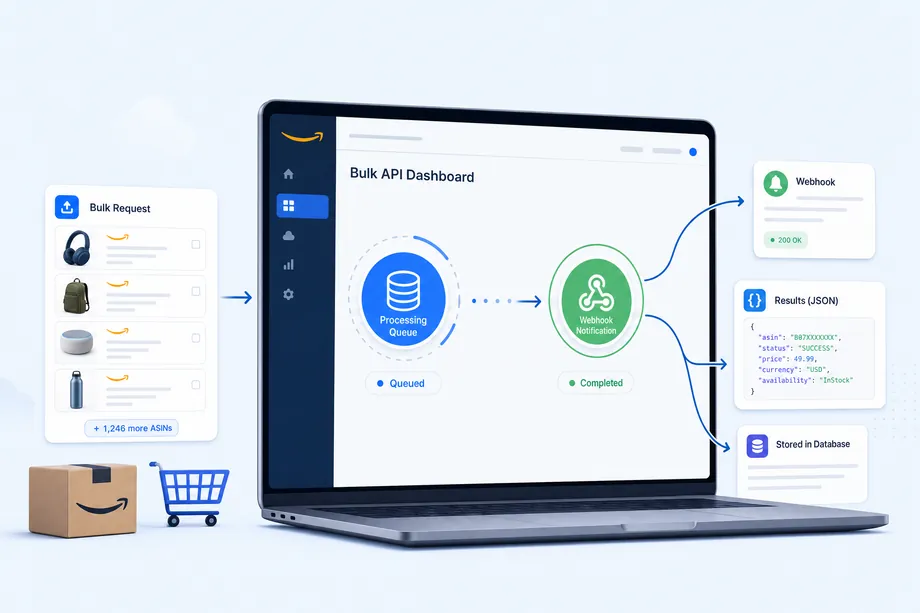
Real-Time requests fit a chat interaction where a person asks about one ASIN and expects an answer now. Bulk processing fits a list of hundreds or thousands of records, a recurring monitoring job, or a workflow that can wait for a webhook or job result. Do not force a large catalog scan into the chat window. Let the agent submit the job, monitor completion, and summarize the result after the records are ready.
| Requirement | Real-Time API | Bulk API |
|---|---|---|
| Best for | One immediate question, prototype, or live dashboard lookup. | Scheduled catalog work, large comparison sets, and asynchronous analysis. |
| Response pattern | Inline response that the application can validate immediately. | Job-based response, then a callback or later result retrieval. |
| Agent design | Explain one current record with a visible scope and timestamp. | Report job status, then summarize only completed items and exceptions. |
| Common mistake | Using one lookup to make a broad market claim. | Waiting inside a user chat for a large job to finish. |
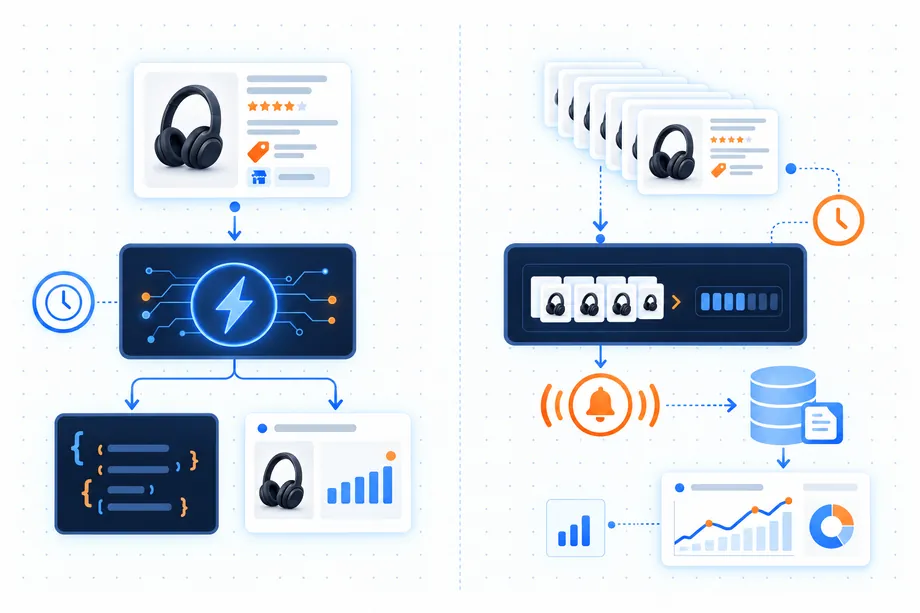
For sellers, Bulk is often the right choice for recurring offer or catalog monitoring because the workflow can compare completed snapshots against a previous run. For buyers, Real-Time is often better during active sourcing research because an analyst wants to inspect one candidate before adding it to a longer list. The same team may use both paths in one week, so keep the normalized response model consistent.
Turn Returned JSON into a Data Contract
A mature amazon ai agent easyparser project does not pass every raw field to the model. It defines a response contract for each decision. A sourcing-review contract might require ASIN, marketplace, title, current availability, price context, and a fetch timestamp. An offer-review contract might require seller count, price range, fulfillment classification, and Buy Box observations. When a required field is missing, the contract should return an incomplete status rather than letting the model fill the gap with plausible language.
Use three output labels in the user experience: observed, inferred, and unknown. Observed means the fact appears in the returned record. Inferred means a rule compares observed fields, such as noticing a wide offer-price range. Unknown means the workflow did not retrieve the field or the record was incomplete. These labels are simple, but they make agent answers much more trustworthy for procurement and competitive-intelligence teams.
Run a 30-Minute Pilot Before Scaling
Begin with one business question, one marketplace, and five known ASINs. Write the expected answer format before building the agent. Then test the same question with deliberately incomplete inputs, a nonexistent ASIN, and a result that lacks a preferred field. If the agent clearly explains each failure case, you have a safer foundation than a demo that only works with perfect data.
Next, invite one buyer-facing user and one seller-facing user to review the output. Ask each person which evidence they would need before acting. Their answers will expose fields that should be displayed, thresholds that require human review, and questions the current tool set cannot answer. Only after this review should you add scheduled Bulk jobs, alerts, or a client-facing report.
Conclusion: Build for Evidence, Not Just Conversation
An amazon ai agent easyparser workflow is most valuable when it helps a team see current marketplace evidence faster and explain it more clearly. Start with a narrow read-only question, retrieve the smallest useful structured record, validate it, and separate observed facts from interpretation. That foundation supports buyer diligence, seller monitoring, and scalable catalog research without asking an LLM to pretend it knows what the data did not show.
Start building with the Easyparser API today
Start Your Free Trial100 free credits, no credit card required.