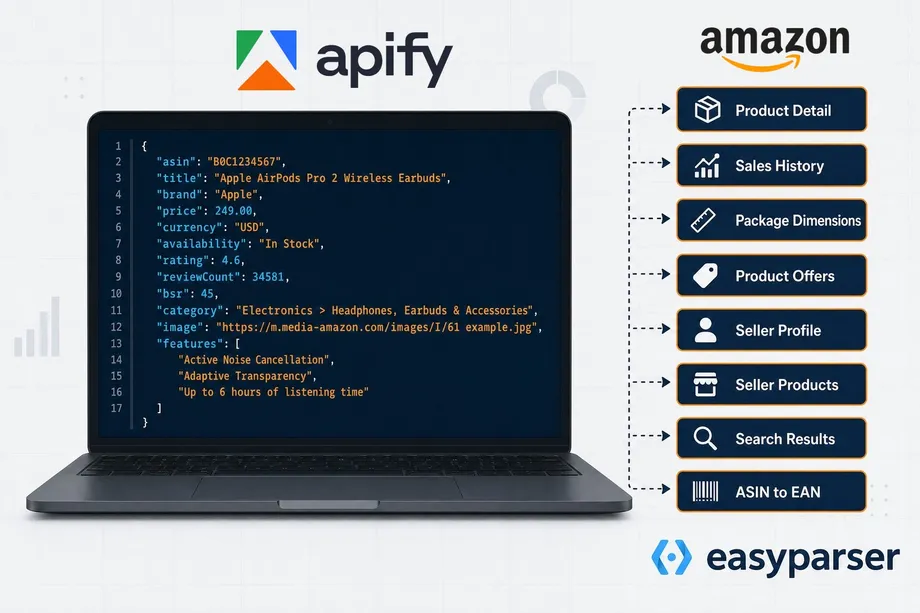
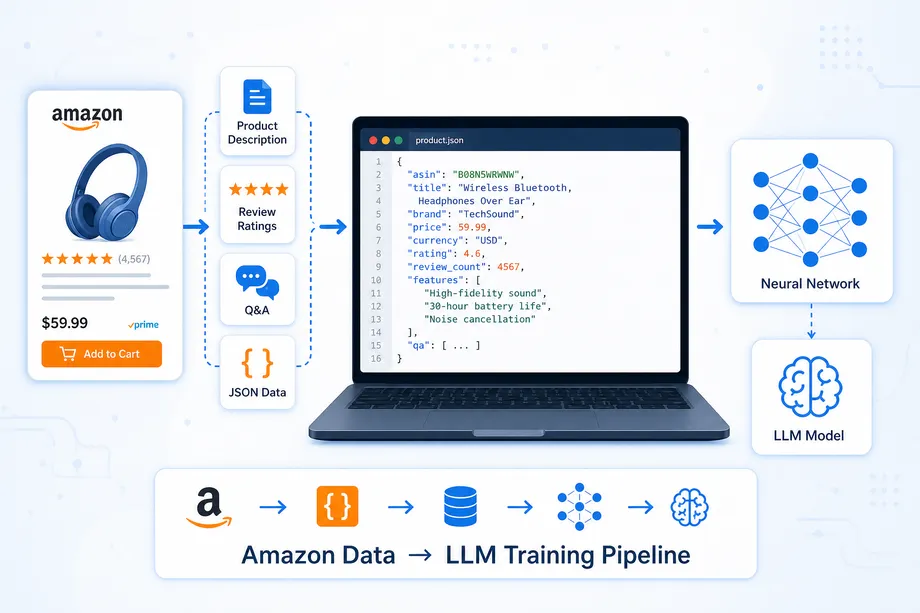
In 2026, the race to build domain-specific Large Language Models (LLMs) has shifted from model architecture to data quality. While general-purpose models are trained on the broader internet, building an AI that truly understands e-commerce, consumer sentiment, or product specifications requires specialized data. For developers, Amazon represents the largest and richest repository of structured e-commerce text in the world, containing hundreds of millions of product descriptions, billions of customer reviews, and vast libraries of product Q&A exchanges.
However, turning raw Amazon pages into a clean, structured amazon data llm training dataset is a complex engineering challenge. You must navigate aggressive anti-bot systems, extract nested HTML elements, handle pagination, and format the output for machine learning pipelines. This comprehensive guide explores how developers are leveraging Amazon product descriptions, reviews, and Q&A data to fine-tune LLMs, and how to build a scalable data collection pipeline using Easyparser.
Why Amazon Data Is Valuable for LLM Training
General-purpose LLMs often struggle with the nuances of e-commerce. They might not understand the difference between a product feature and a marketing claim, or how to interpret complex sentiment in a review where a user loves the product but hates the shipping. By utilizing an amazon product data training dataset, developers can fine-tune models to excel in specific commercial tasks that generic models handle poorly.
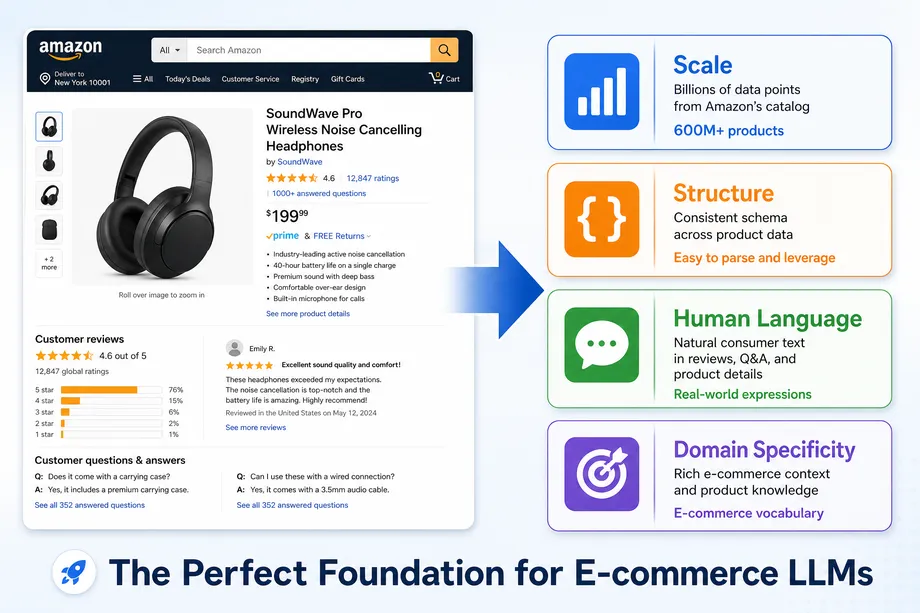
The value of Amazon data lies in its scale, structure, and human element. It provides a unique combination of factual product specifications written by manufacturers and subjective evaluations written by real consumers. This dual nature makes it an incredibly powerful resource for training AI agents, recommendation engines, automated customer service bots, and product catalog enrichment systems.
Consider the scope: Amazon hosts over 600 million products across hundreds of categories, each with structured metadata, bullet-point features, and technical specifications. Layered on top of this are billions of customer reviews written in natural, conversational language, and millions of Q&A pairs that represent real customer intent. No other publicly accessible dataset offers this combination of scale, structure, and authentic human language in a commercial context.
Types of Amazon Data for AI Training
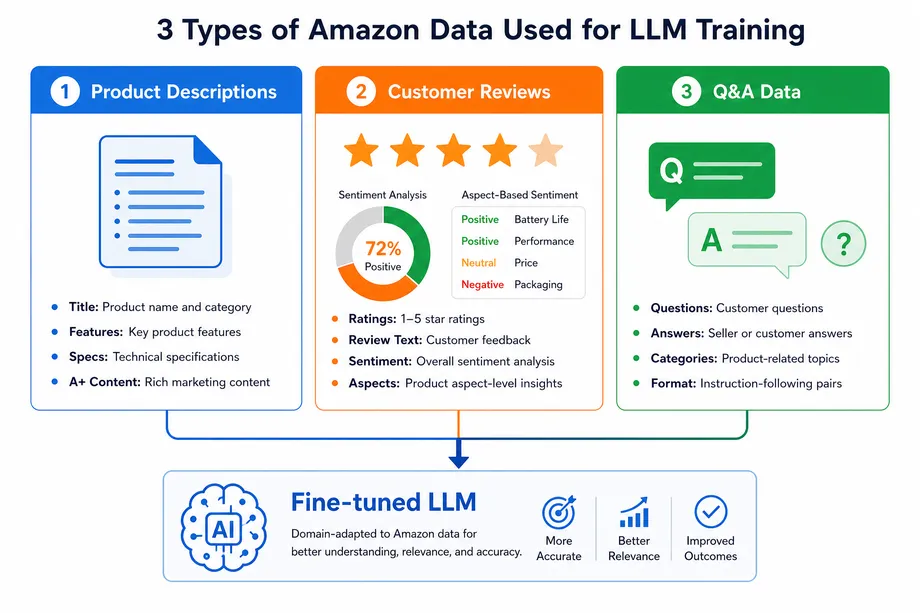
When building an ecommerce training dataset amazon, not all data is created equal. Different parts of an Amazon product page serve different purposes in the machine learning lifecycle. Understanding these distinctions is crucial for designing effective fine-tuning strategies and allocating your data collection budget wisely.
Product Descriptions: Rich Text for Language Models
Product descriptions and A+ content provide dense, factual information about items. This data is essential for training models to understand product taxonomies, extract key features, and generate marketing copy. By feeding an LLM thousands of high-converting product descriptions across multiple categories, you can teach it the specific vocabulary and structure of successful e-commerce writing.
When extracting this data, it is critical to capture not just the main description, but also the bullet points (feature highlights), technical specifications, and A+ content sections. This structured product description training data amazon helps the model learn the relationship between a product's category and its defining attributes. For example, a model trained on electronics descriptions learns to associate battery life, processor speed, and display resolution as relevant specifications, while a model trained on apparel learns to focus on material composition, sizing, and care instructions.
Product titles are also particularly valuable training data. Amazon product titles follow a specific structure (Brand + Product Type + Key Features + Size/Color) that teaches models how to generate concise, information-dense text that balances SEO requirements with readability. This is directly applicable to tasks like automated product listing generation and catalog enrichment.
Review Data: Sentiment and Opinion Mining
Customer reviews are perhaps the most sought-after data type for Natural Language Processing (NLP). An amazon review data machine learning dataset provides raw, unfiltered human language expressing satisfaction, frustration, and specific feature evaluations across millions of products and categories.
Training an LLM on review data allows it to perform advanced sentiment analysis. Unlike basic positive/negative classification, a fine-tuned model can identify aspect-based sentiment, meaning it can determine that a reviewer loves the battery life but is frustrated by the build quality, even within a single sentence. This capability is invaluable for brands looking to automate product feedback analysis, build intelligent review summarization tools, or identify specific product improvement opportunities at scale.
Review data also contains valuable signals for training recommendation models. Phrases like "I bought this for my elderly mother" or "perfect for camping trips" provide rich contextual information about use cases and buyer personas that structured product metadata simply cannot capture. This natural language context is exactly what makes review data so powerful for training conversational AI systems.
Q&A Data: Instruction-Following Training
The Customer Questions and Answers section is a goldmine for instruction tuning. This data naturally forms prompt-completion pairs (Question to Answer), which is exactly the format required to train conversational AI and chatbots. Unlike reviews, which are monologues, Q&A data represents genuine dialogues between curious customers and knowledgeable sellers or other buyers.
By utilizing Amazon Q&A data, developers can fine-tune LLMs to accurately answer user queries about product compatibility, usage instructions, and troubleshooting. A model trained on thousands of Q&A pairs from the electronics category, for example, will learn to answer questions like "Is this compatible with my iPhone?" or "Can I use this outdoors?" with the same accuracy and tone as a knowledgeable product expert, creating highly effective customer support agents that require minimal human oversight.
Data Collection Pipeline with Easyparser
The biggest hurdle in creating an amazon data ai training dataset is the collection process itself. Amazon employs sophisticated anti-bot mechanisms, IP rate limiting, and CAPTCHAs to prevent automated scraping. Building and maintaining a DIY scraper requires constant proxy rotation, HTML parsing updates after every Amazon layout change, and significant infrastructure investment.
To build a reliable pipeline, developers use the Easyparser Amazon Scraping API. Easyparser handles the entire infrastructure complexity, allowing you to focus on data processing and model training rather than fighting anti-bot systems. It provides structured JSON output directly from Amazon pages, completely bypassing anti-bot defenses and returning consistent, schema-validated data regardless of changes to Amazon's underlying HTML structure.
Extracting Product Details at Scale
To gather product descriptions and specifications for your amazon data nlp training dataset, you use the Easyparser DETAIL operation. This endpoint returns comprehensive product data including titles, bullet points, A+ content text, technical specifications, and category information, all formatted as clean JSON ready for your data pipeline.
import requests
API_KEY = "YOUR_API_KEY" # Get your key from app.easyparser.com
ASIN = "B098FKXT8L"
params = {
"api_key": API_KEY,
"platform": "AMZ",
"operation": "DETAIL",
"asin": ASIN,
"domain": ".com"
}
response = requests.get("https://realtime.easyparser.com/v1/request", params=params)
data = response.json()
product = data.get("product", {})
print(f"Title: {product.get('title')}")
print(f"Description: {product.get('description')}")
print(f"Features: {product.get('features')}")
print(f"Rating: {product.get('rating')} ({product.get('ratings_total')} reviews)")
Scaling with the Bulk API
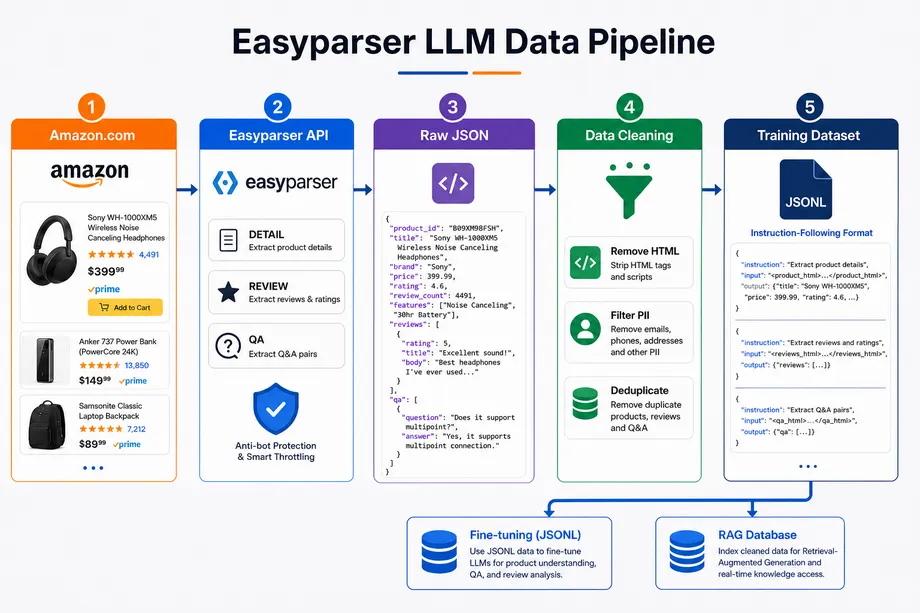
Training an LLM requires massive amounts of data. While the Real-Time API is great for testing and small-scale extraction, building a production-grade llm training amazon data dataset with hundreds of thousands of ASINs requires the Easyparser Bulk API. The Bulk API allows you to submit large batches of ASINs asynchronously and receive the parsed JSON data via webhooks, making it the ideal solution for building large-scale training pipelines without managing complex queuing systems.
A typical large-scale collection workflow might look like this: you start with a seed list of ASINs from a specific category, submit them in batches of 1,000 to the Bulk API, receive the structured JSON responses via webhook, store them in a database or data lake, and then use the SEARCH operation to discover additional related ASINs to expand your dataset. This iterative approach allows you to build a comprehensive, category-specific training corpus over time.
Cleaning and Formatting Data for Training
Once you have extracted the data using Easyparser, the next critical step is cleaning and formatting. Raw JSON from an API cannot be fed directly into a language model. You must transform it into the specific format required by your training framework, whether that is Hugging Face Transformers, PyTorch, or the OpenAI fine-tuning API.
Data Sanitization
Before formatting, the data must be sanitized to ensure high quality and compliance. This process involves several key steps that directly impact the quality of your trained model. First, you must remove any residual HTML tags from product descriptions, as some fields may contain formatting markup that will confuse the tokenizer. Libraries like BeautifulSoup make this straightforward in Python.
Second, if you are using review data, you must filter out Personally Identifiable Information (PII) such as reviewer names, email addresses, or phone numbers that occasionally appear in review text. This is not just a best practice but a legal requirement in many jurisdictions. Third, deduplication is essential: Amazon often has the same product listed multiple times under different ASINs, and reviews can be duplicated across listings. Removing these duplicates prevents the model from over-fitting to repeated examples.
Formatting for Instruction Tuning
For fine-tuning models to follow instructions, such as LLaMA-3, Mistral, or Qwen, the data is typically formatted into JSONL (JSON Lines) files containing prompt-completion pairs. Here is an example of how you might format Amazon Q&A data for instruction tuning:
{"instruction": "Answer the customer's question about the product based on the context.", "context": "Product: Wireless Noise Cancelling Headphones. Battery life: 30 hours.", "response": "The headphones offer up to 30 hours of battery life on a single charge."}
{"instruction": "Extract the main complaint from this review.", "context": "The sound quality is amazing, but the ear cups get very warm after an hour of use.", "response": "The main complaint is that the ear cups become uncomfortably warm during extended use."}
{"instruction": "Summarize the key product features from the description.", "context": "40mm drivers, active noise cancellation, 30-hour battery, USB-C charging, foldable design.", "response": "This headphone features 40mm drivers with active noise cancellation, 30-hour battery life, USB-C charging, and a foldable design for portability."}
By structuring your amazon data fine tuning llm dataset in this manner, you teach the model exactly how to respond to specific types of e-commerce queries. The instruction field defines the task, the context field provides the relevant Amazon data, and the response field shows the ideal output. This three-part structure is compatible with most modern instruction-tuning frameworks.
Building a Multi-Task Training Dataset
The most effective approach to building an amazon product data dataset for LLM training is to create a multi-task dataset that combines all three data types. Rather than training separate models for product description generation, sentiment analysis, and Q&A answering, you can create a single dataset with diverse task types that teaches the model to handle the full spectrum of e-commerce language tasks.
A well-designed multi-task dataset might include: product title generation tasks (where the model learns to create optimized titles from specifications), sentiment classification tasks (where it learns to categorize reviews by sentiment and aspect), feature extraction tasks (where it learns to identify key selling points from descriptions), and question answering tasks (where it learns to respond to customer queries based on product information). This diversity prevents the model from over-specializing and creates a more versatile e-commerce AI assistant.
Real-World Use Case: Building an E-Commerce AI Startup
To illustrate how these concepts come together in practice, consider the scenario of an AI startup building a specialized LLM for e-commerce sellers. The goal is to create an AI assistant that can help Amazon sellers optimize their listings, analyze competitor reviews, and answer customer questions automatically.
The team starts by using Easyparser to collect 500,000 product descriptions across the top 20 Amazon categories, along with 2 million customer reviews and 300,000 Q&A pairs. They use the DETAIL operation for product data and the SEARCH operation to discover new ASINs systematically. The entire collection process takes three days using the Bulk API, compared to the weeks it would take with a DIY scraper that constantly breaks against Amazon's anti-bot systems.
After cleaning and formatting the data into JSONL format, they fine-tune a Mistral-7B base model using LoRA (Low-Rank Adaptation), which allows efficient training on consumer-grade hardware. The resulting model outperforms GPT-4 on e-commerce specific benchmarks, including product feature extraction accuracy and review sentiment classification, while being 10 times cheaper to run at inference time. This is the power of domain-specific amazon data llm training: targeted data beats raw model size for specialized tasks.
Fine-Tuning vs. RAG: Choosing the Right Approach
When building an e-commerce AI system, developers often face a fundamental architectural decision: should they fine-tune a model on Amazon data, or use Retrieval-Augmented Generation (RAG) with a real-time Amazon data source? The answer depends on the specific use case and the nature of the data involved.
Fine-tuning is the right choice when you want the model to internalize domain knowledge that changes slowly, such as the vocabulary of product descriptions, the structure of effective titles, or the patterns of customer sentiment expression. Once fine-tuned, the model applies this knowledge without needing to look anything up, making it fast and cost-efficient for high-volume tasks like automated listing generation.
RAG, on the other hand, is ideal for dynamic data that changes frequently, such as current pricing, stock availability, or the latest customer reviews. Rather than retraining the model every time prices change, a RAG system queries a real-time data source at inference time. For this use case, you can integrate the Easyparser Product Offer API as the retrieval backend, giving your AI agent access to live pricing and availability data for any ASIN on demand.
The most sophisticated e-commerce AI systems combine both approaches: a fine-tuned model that understands e-commerce language deeply, augmented with real-time retrieval for dynamic data. This hybrid architecture delivers both the domain expertise of fine-tuning and the freshness of RAG, creating an AI assistant that is both knowledgeable and current.
Legal Considerations for Training Data Collection
When building an amazon data nlp training dataset, developers must navigate the complex legal landscape of web scraping and AI training. While the laws are continually evolving in 2026, several key principles apply to responsible data collection for machine learning purposes.
Generally, scraping publicly available factual data such as product prices, technical specifications, and category information is widely considered permissible under fair use and open web principles. Courts in multiple jurisdictions have affirmed that publicly accessible data can be used for training AI models, particularly when the purpose is transformative (i.e., creating a new AI system rather than reproducing the original content). However, scraping copyrighted creative content such as unique marketing copy or proprietary product images can present risks and should be approached carefully.
Developers must also respect privacy regulations. Customer review data, while publicly posted, may contain personal information that falls under GDPR in Europe or CCPA in California. Best practice is to anonymize review data by removing reviewer names and any other identifying information before using it in training datasets. This is not just legally prudent but also improves model quality by removing irrelevant personal details that could introduce noise.
Furthermore, developers should avoid aggressive scraping that disrupts the target website's operations. This is another reason why using a managed service like Easyparser is advantageous: it ensures requests are distributed responsibly and handled at a rate that does not impact Amazon's infrastructure, minimizing the risk of legal or technical repercussions while you focus on building your amazon product data dataset.
Evaluating Your Training Dataset Quality
Before committing to a full training run, it is essential to evaluate the quality of your Amazon training dataset. A poorly curated dataset will produce a poorly performing model, regardless of how sophisticated your training infrastructure is. Several key metrics help assess dataset quality for LLM training purposes.
First, check for label consistency in classification tasks. If you are using star ratings as sentiment labels, verify that the distribution is reasonable and that the text content actually aligns with the rating. A 1-star review that says "great product, just not what I needed" is a mislabeled example that will confuse the model. Second, assess linguistic diversity by checking the vocabulary size and sentence structure variation in your corpus. A dataset dominated by very short or formulaic reviews will produce a model that generates stilted, repetitive text.
Third, evaluate domain coverage by ensuring your dataset spans multiple product categories, price points, and buyer demographics. A model trained only on luxury electronics reviews will struggle with budget kitchen appliances. The broader and more diverse your ecommerce training dataset amazon, the more versatile and robust your trained model will be in production environments.
Conclusion: Building the Future of E-Commerce AI
The combination of Amazon's unparalleled e-commerce data and modern LLM fine-tuning techniques creates an extraordinary opportunity for developers building the next generation of AI-powered commerce tools. From automated listing optimization to intelligent customer support agents and real-time competitive intelligence systems, the applications of amazon data llm training are vast and commercially significant.
The key to success lies in building a reliable, scalable data collection pipeline that delivers clean, structured data without the operational overhead of managing anti-bot infrastructure. By using Easyparser to handle the complexity of Amazon data extraction, developers can focus their energy on what truly matters: designing effective training pipelines, curating high-quality datasets, and building AI systems that deliver measurable business value.
As LLM capabilities continue to advance in 2026 and beyond, the competitive advantage will increasingly belong to those who have invested in domain-specific training data. Amazon's rich ecosystem of product information, consumer sentiment, and commercial intent represents one of the most valuable training data sources available to e-commerce AI developers today.
Start extracting Amazon data for free
Start Your Free Trial100 free credits, no credit card required.