In the highly competitive e-commerce landscape of 2026, data is the ultimate currency. For businesses operating on the world's largest marketplace, mastering amazon data scraping use cases is no longer just a technical advantage; it is a fundamental requirement for survival and growth. Whether you are an e-commerce manager trying to optimize pricing, a data analyst building market forecasting models, or a developer constructing an internal intelligence tool, extracting accurate, real-time data from Amazon provides actionable insights that directly impact the bottom line.
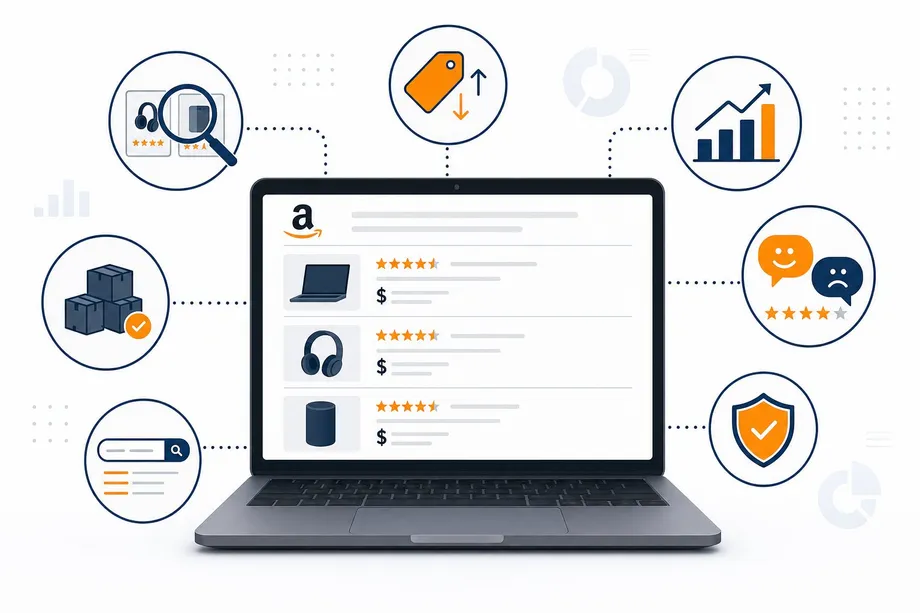
This comprehensive guide explores the seven most critical business applications for Amazon data extraction. We will cover how modern businesses leverage scraping for price monitoring, competitor analysis, and brand protection. Furthermore, we will provide practical implementation notes for each use case, demonstrating how a robust API infrastructure can transform raw HTML into structured, strategic intelligence.
Why Businesses Scrape Amazon Data
Before exploring specific amazon data scraping use cases, it is crucial to understand the reasoning behind the practice. Amazon's marketplace is dynamic; prices change millions of times a day, new competitors emerge constantly, and customer sentiment shifts with every new review. Relying on manual observation or delayed reporting tools leaves businesses vulnerable to market fluctuations they cannot see in time.
Automated data extraction allows companies to monitor these changes systematically. For an e-commerce manager, this means the ability to react instantly to a competitor's discount. For a data analyst, it provides the historical pricing and review data necessary to build predictive models. For developers, a reliable scraping API removes the burden of maintaining proxy networks and parsing complex HTML, allowing them to focus on integrating data into internal dashboards. By treating Amazon as a massive, real-time database, businesses can move from reactive strategies to proactive market dominance.
Use Case 1: Real-Time Price Monitoring
One of the most prevalent amazon data scraping use cases is real-time price monitoring. In a marketplace where the Buy Box is heavily influenced by competitive pricing, knowing exactly what your competitors are charging at any given moment is critical. Businesses use automated scrapers to track price fluctuations across thousands of ASINs, allowing them to adjust their own pricing strategies dynamically.
Instead of manually checking competitor listings, companies integrate pricing data directly into their repricing algorithms. When a competitor lowers their price, the system can automatically match or beat it, ensuring maximum Buy Box visibility. The typical implementation involves polling the Product Detail API at regular intervals and feeding the price field into a repricing engine. For a deeper dive into this strategy, you can read our comprehensive guide on Amazon Dynamic Pricing.
Use Case 2: Competitor Product Research
Understanding what your competitors are selling, how they are positioning their products, and what features they highlight is essential for market positioning. Competitor product research involves extracting data such as product titles, bullet points, descriptions, and high-resolution images to analyze their marketing strategies.
By scraping this data, businesses can identify gaps in the market or areas where competitor listings are weak. For example, if a competitor's product description lacks specific technical details that customers frequently ask about, a brand can emphasize those details in their own listings. This approach also helps identify pricing sweet spots and feature combinations that resonate with buyers. To learn more about tracking competitor performance, check out our article on How to See Your Competitors' Sales Data on Amazon.
Use Case 3: Market Trend Analysis
Beyond individual competitors, businesses need to understand broader market trends. This involves scraping category-level data, Best Sellers Rank (BSR) fluctuations, and new product releases to identify emerging consumer interests and seasonal demand patterns.
Market trend analysis allows companies to forecast demand and optimize their inventory accordingly. By analyzing historical BSR data, a business can predict when a particular product category will peak and ensure they have sufficient stock available. This proactive approach minimizes stockouts and maximizes sales during high-demand periods. Combining BSR tracking with the Product Lookup API provides a comprehensive view of category dynamics. For advanced insights, explore our Amazon Brand Analytics Guide.
Use Case 4: Review Sentiment Analysis
Customer reviews are a goldmine of unfiltered product feedback. However, manually reading thousands of reviews is impossible at scale. Review sentiment analysis is one of the most powerful amazon data scraping use cases, utilizing Natural Language Processing (NLP) pipelines to extract actionable insights from customer feedback at volume.
By scraping reviews and applying aspect-based sentiment analysis, businesses can identify specific product features that customers love or hate. For instance, a sentiment analysis pipeline might reveal that while customers praise a product's design, they consistently complain about its durability. This data is invaluable for product development teams looking to improve future iterations or for marketing teams aiming to highlight competitive advantages.
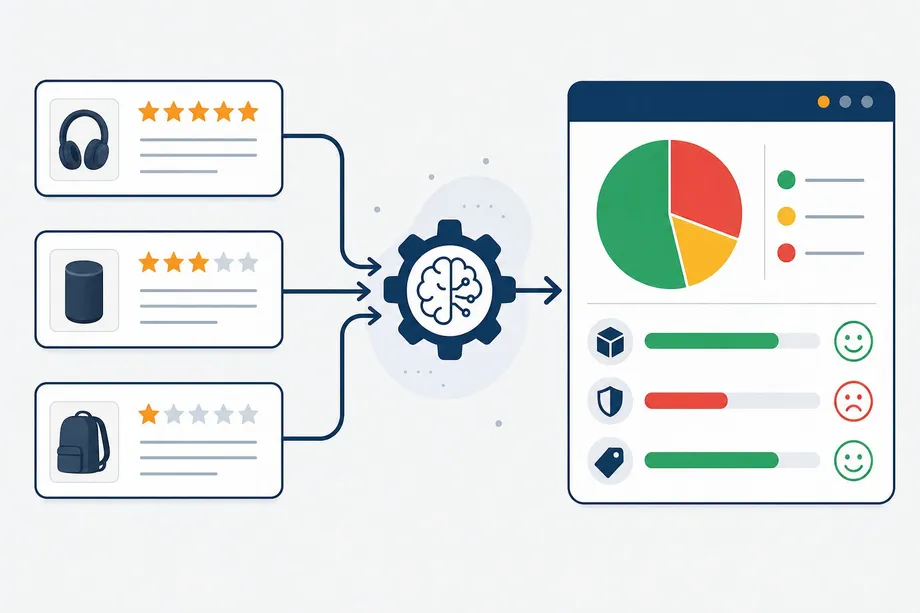
The typical NLP pipeline for Amazon review analysis includes these stages: data extraction via API, text preprocessing (tokenization, stopword removal), sentiment classification (positive, neutral, negative), and aspect extraction to identify which product attributes drive each sentiment. Competitor sentiment comparison is particularly valuable, as it reveals where your product outperforms or underperforms relative to alternatives in the same category. For a detailed breakdown of review data, read our Ultimate Guide to Amazon Customer Reviews.
Use Case 5: Inventory and Stock Monitoring
Monitoring competitor inventory levels provides a significant strategic advantage. While Amazon does not explicitly display exact stock counts, scraping techniques can often infer inventory levels or track "Out of Stock" statuses across competing ASINs.
When a major competitor runs out of stock, it presents a prime opportunity to increase prices or aggressively increase advertising spend to capture the displaced demand. Automated stock monitoring alerts e-commerce managers the moment a competitor's listing goes inactive, allowing for immediate strategic adjustments. This use case pairs well with the Product Offers API, which provides seller-level availability data including fulfillment method and shipping timelines.
Use Case 6: Amazon SEO and Keyword Research
Visibility on Amazon is driven by its search algorithm, A9. Amazon SEO and keyword research rely heavily on scraping search results pages to understand which keywords drive traffic and how products rank for those terms. This is a critical amazon data scraping use cases application for optimizing product visibility and organic traffic.
Businesses extract search term data, track their own ranking positions over time, and analyze the keywords competitors are successfully targeting. By identifying high-volume, low-competition keywords, sellers can optimize their titles and backend search terms to improve organic ranking. The process typically involves scraping Amazon search results for target keywords, recording position data daily, and correlating ranking changes with listing modifications. To master this process, review our Amazon SEO Keyword Research Guide.
Use Case 7: Brand Protection and MAP Monitoring
For established brands, protecting their reputation and pricing integrity is paramount. Minimum Advertised Price (MAP) monitoring is a vital amazon data scraping use cases application that involves tracking all sellers offering a brand's products to ensure they are not violating pricing agreements.
Unauthorized sellers and price wars can erode brand value and profit margins significantly. U.S. brands lose an estimated $2.6 billion annually due to MAP violations driven by unauthorized sellers and lack of real-time monitoring. Automated scrapers continuously monitor listings, detecting unauthorized sellers and immediately alerting brand managers to price violations. This allows brands to take swift enforcement action, protecting their distribution channels and maintaining consistent pricing across the marketplace. The implementation involves regularly polling product offer pages to identify new sellers and comparing their listed prices against the brand's MAP policy.
Implementing Your Scraping Strategy with Easyparser
While the business value of these amazon data scraping use cases is clear, building and maintaining the necessary infrastructure is complex. Amazon employs sophisticated anti-scraping measures that can quickly block internal tools. This is where a specialized API solution like Easyparser becomes essential.
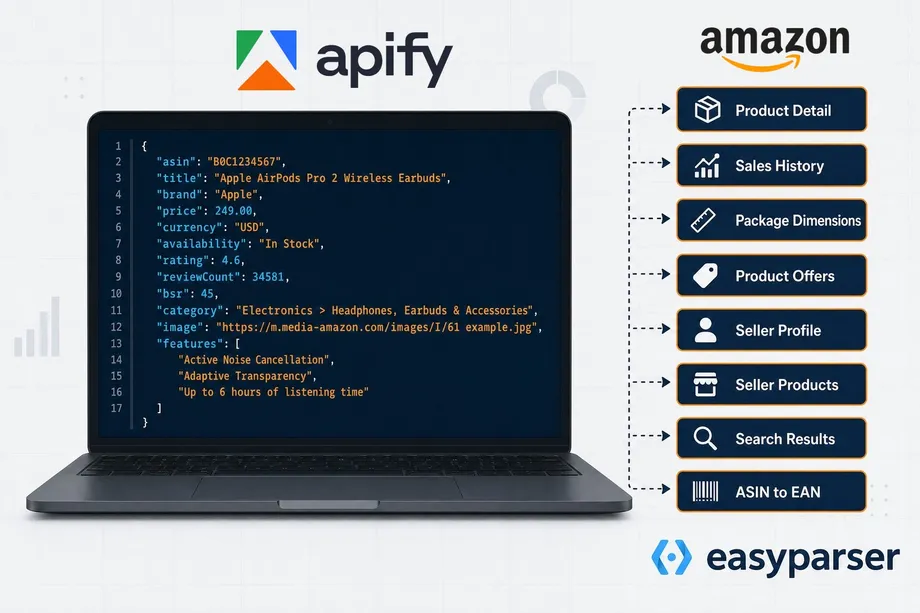
Easyparser handles the complexities of proxy management, CAPTCHA solving, and HTML parsing, delivering clean, structured JSON data. Whether you need real-time pricing data for a repricing algorithm or bulk review data for an NLP pipeline, Easyparser provides reliable access to Amazon's data ecosystem. The platform offers both a Real-Time API (instant responses in approximately 7.5 seconds) and a Bulk API (asynchronous processing with webhook delivery) to match different throughput requirements. For a complete list of supported operations, visit our Amazon Scraping API page.
Below is a Python example demonstrating how to retrieve real-time product details, including pricing and Buy Box information, using the Easyparser API:
import requests
API_KEY = "YOUR_API_KEY" # Get your key from app.easyparser.com
ASIN = "B098FKXT8L"
params = {
"api_key": API_KEY,
"platform": "AMZ",
"operation": "DETAIL",
"asin": ASIN,
"domain": "com"
}
response = requests.get("https://realtime.easyparser.com/v1/request", params=params)
data = response.json()
product = data.get("product", {})
print(f"Title: {product.get('title')}")
print(f"Price: ${product.get('price')}")
print(f"Buy Box Winner: {product.get('buybox_winner')}")
Which Use Cases Match Your Business Role?
The value of these amazon data scraping use cases varies depending on your specific role within an organization. The table below maps each use case to the business roles that benefit most from it:

E-commerce managers typically prioritize real-time price monitoring and inventory tracking to maintain immediate competitiveness. Data analysts focus on market trend analysis and review sentiment analysis to build long-term strategic models. Developers, meanwhile, require robust APIs to support SEO keyword extraction and brand protection systems without the overhead of maintaining scraping infrastructure.
By identifying the use cases most relevant to your business objectives and leveraging a reliable data extraction partner like Easyparser, you can transform Amazon's vast marketplace data into a sustainable competitive advantage. The key is starting with one or two high-impact use cases, proving ROI, and then expanding your data strategy across additional applications as your team's capabilities grow.
Start extracting Amazon data for free
Start Your Free Trial100 free credits, no credit card required.