In the fiercely competitive landscape of Amazon retail, promotional strategies are often the deciding factor between a product that languishes in obscurity and one that achieves bestseller status. For sellers, data analysts, and developers, extracting accurate promotional data is essential for maintaining a competitive edge. Using a dedicated amazon lightning deals api as a deal tracking API or promotional data API allows teams to move beyond manual checks and build automated systems that track price drops, coupons, limited-time discounts, and promotional pricing at scale.
This guide is written for developers and data teams, not casual shoppers browsing Amazon for a personal discount. We will examine the specific data fields you need to track, how to monitor promotional changes over time, and how to leverage this information for deal hunting automation and competitor promotion analysis. By utilizing an amazon lightning deals api, you can transform raw promotional data into actionable insights that drive revenue and optimize your own discount strategies.
What Data Can You Extract from Amazon Lightning Deals?
Amazon's promotional ecosystem is complex, encompassing everything from standard coupons to highly visible lightning deals. Extracting this data requires understanding the specific fields available and what they signify for market dynamics. A robust data extraction strategy captures not just the current price, but the context of the promotion.
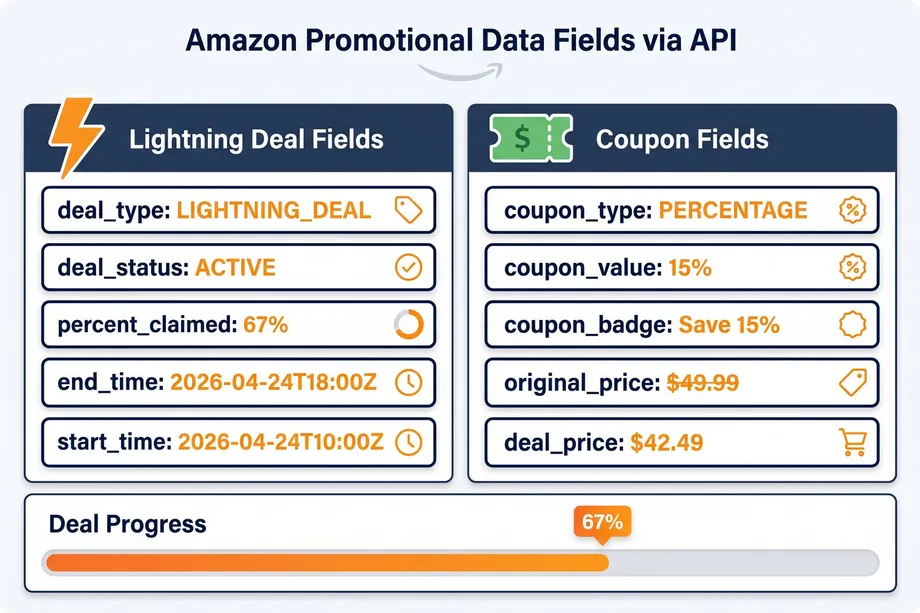
When you utilize an amazon lightning deals api or broader promotional data API, you can collect structured signals such as list price, current price, coupon availability, displayed savings, promotional badges, and offer changes. This allows for precise discount percentage calculation and more reliable competitor monitoring. Depending on the product page and marketplace, you may also see deal-related indicators such as limited-time messaging, savings labels, and countdown-style promotion copy.
Amazon Coupon Data Fields: Codes, Percentages, and Expiry
Coupons are a staple of Amazon promotions, offering either a fixed amount off or a percentage discount. Extracting coupon data involves identifying the presence of a coupon on a product listing and validating its terms. This data is crucial for understanding the true acquisition cost of a product and analyzing competitor pricing floors.
Key coupon data fields include the coupon percentage or fixed discount value, any specific eligibility requirements such as Prime membership, and the expiration date when it is visible. By systematically extracting and analyzing this data, sellers can determine the optimal discount levels needed to remain competitive without sacrificing margin unnecessarily.
How Lightning Deal Status Works: Tracking Progress & Countdown
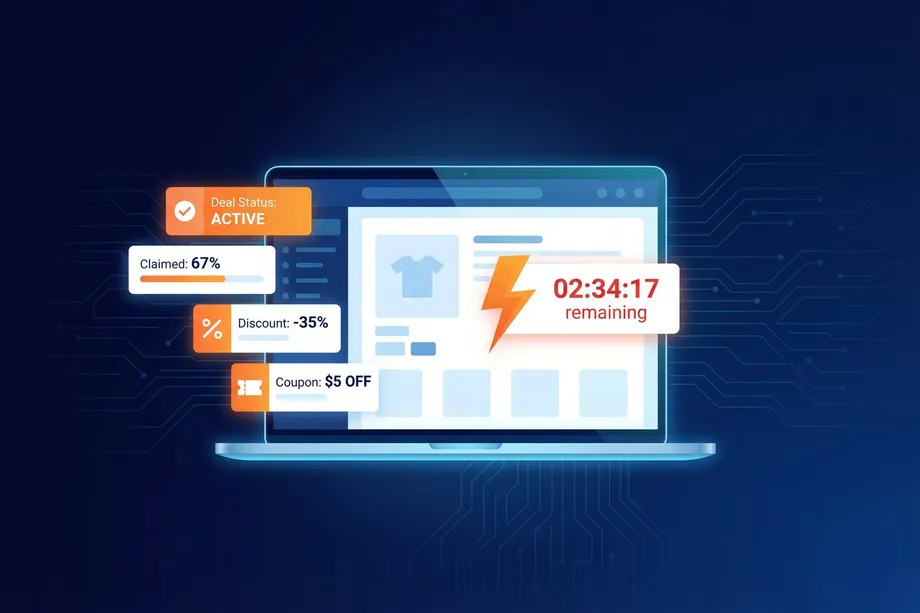
Lightning deals are uniquely time-sensitive and inventory-constrained. Monitoring these deals requires tracking two critical metrics: the time remaining and the percentage of inventory claimed when those fields are available on the page. This real-time tracking is where an amazon lightning deals api becomes valuable, as it provides the granular data needed to understand consumer demand velocity.
The countdown timer dictates the absolute window of opportunity, while deal progress can indicate the actual market response. A deal that reaches 100% claimed within the first hour demonstrates high demand and effective pricing, whereas a deal that expires with only 20% claimed suggests a misaligned promotional strategy. Tracking these metrics allows businesses to build sophisticated deal databases, pricing dashboards, and alert systems.
Real-Time Deal Monitoring: Polling Intervals and Webhooks
Real-time monitoring means checking the same ASINs repeatedly and comparing each new response against the previous snapshot. In practice, your system stores the last known price, coupon state, promotion text, and offer data, then runs another request after a defined interval. If the price drops, a coupon appears, or a limited-time promotion is detected, your application can trigger an alert. This scheduled checking is called polling.
Polling intervals should match how fast the decision needs to happen. For normal competitor promotion monitoring, polling every 30 to 60 minutes is usually enough and keeps API usage predictable. For active lightning deal watchlists, a 5 to 10 minute interval is more appropriate because the offer window can be short and inventory can move quickly. For high-value ASINs during Prime Day, Black Friday, Cyber Monday, or a known launch window, teams may temporarily poll every 1 to 3 minutes, then return to a slower schedule once the event ends.
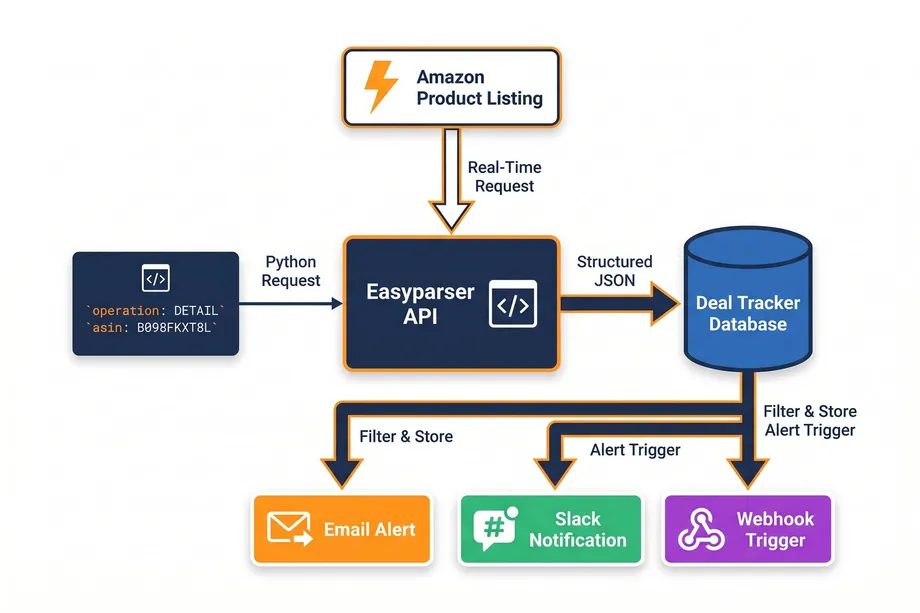
Webhooks solve the delivery side of the workflow. Instead of requiring a human to refresh a dashboard, your deal tracking API pipeline can post a JSON payload to your application whenever a rule is matched. For example, if a product drops below $25, a coupon above 15% appears, or a competitor discount changes by more than 10%, the system can send a webhook to your backend, Slack, Zapier, or an internal repricing service. In this architecture, Easyparser supplies the promotional data API response, while your application decides which changes are important enough to alert on.
For developers building an automated deal hunting platform, setting filter criteria such as category, minimum discount percentage, target ASIN list, seller identity, and price range is essential. By integrating an amazon lightning deals api with scheduled polling and webhook notifications, users can receive fast alerts via email, Slack, or a custom endpoint when a high-value deal is detected.
Competitor Promotion Analysis: Frequency, Timing, and Discount Patterns
Understanding your competitors' promotional strategies is just as important as managing your own. Competitor promotion analysis involves tracking how often rival brands run promotions, the timing of these campaigns such as weekends, weekdays, and holidays, and the discount patterns they employ. This historical data reveals their operational playbook.
By aggregating this data over time, you can identify whether a competitor relies on deep, infrequent discounts or shallow, continuous coupons. This intelligence allows you to optimize your own promotional timing, ensuring your deals launch when competitor activity is low or when market demand is historically highest.
Python Example: Build an Amazon Deal Tracker
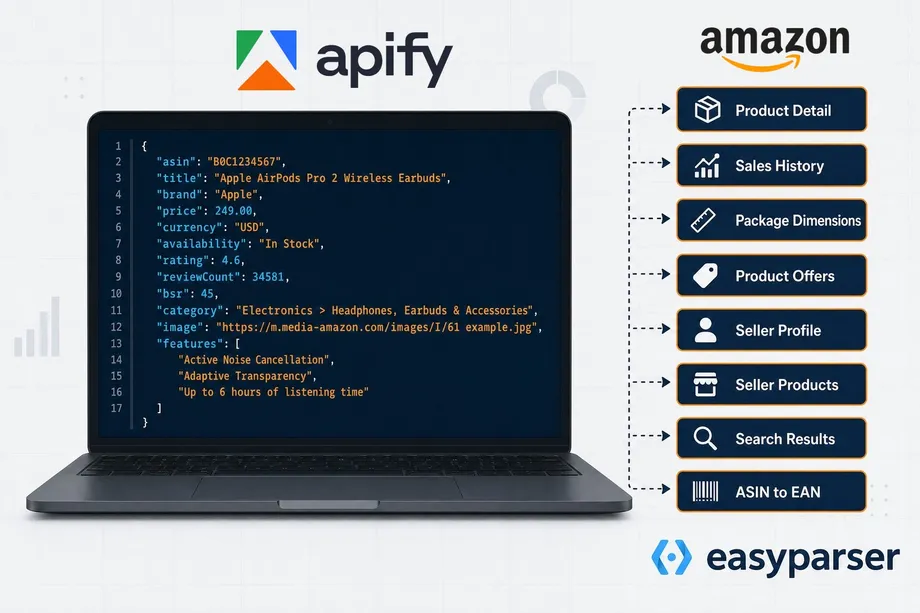
Building a custom deal tracker allows you to automate the monitoring process and integrate the data directly into your existing business intelligence tools. The Python example below uses Easyparser's DETAIL operation to fetch real-time product detail data for a specific ASIN. It is not a separate, consumer-facing Lightning Deals feed; instead, it retrieves the product detail response where current price, visible coupons, savings, and promotional signals can appear when Amazon exposes them on the product page.
import requests
API_KEY = "YOUR_API_KEY" # Get your key from app.easyparser.com
ASIN = "B098FKXT8L"
params = {
"api_key": API_KEY,
"platform": "AMZ",
"operation": "DETAIL",
"asin": ASIN,
"domain": ".com"
}
response = requests.get("https://realtime.easyparser.com/v1/request", params=params)
data = response.json()
detail = data.get("result", {}).get("detail", {})
buybox = detail.get("buybox_winner", {})
price_obj = buybox.get("price", {})
print(f"Title: {detail.get('title')}")
print(f"Price: {price_obj.get('raw')}")
print(f"Rating: {detail.get('rating')} stars")
For more comprehensive data, including all seller offers and potential promotional pricing across different merchants, you can explore the Amazon Product Offers API. Additionally, you can view the full suite of supported operations on the Easyparser Amazon Scraping API.
Seller Use Case: Optimizing Your Own Promotional Strategy with Data
For Amazon sellers, promotional data is not just about tracking others; it is about optimizing your own campaigns. By analyzing the performance of past deals, both yours and your competitors', you can determine the optimal discount levels required to trigger a surge in sales velocity without eroding profitability. This data-driven approach replaces guesswork with empirical strategy.
Sellers can use this data to evaluate the ROI of different promotional vehicles. Does a 15% off coupon generate more net profit than a 20% lightning deal when factoring in Amazon's deal fees? By systematically tracking these outcomes, sellers can allocate their promotional budgets more effectively and maximize their return on investment.
Automated Alert System: Email, Slack, and Webhook Notifications
The final component of a robust deal tracking architecture is the notification system. Data is only valuable if it can be acted upon promptly. By configuring automated alerts, you ensure that key stakeholders are notified the moment a significant price drop occurs or a competitor launches a major promotion.
These alerts can be routed through various channels depending on the urgency and the audience. Email notifications are suitable for daily summaries, while Slack integrations or direct webhooks are ideal for real-time alerts that require immediate action, such as adjusting a repricing algorithm or purchasing discounted inventory.
In conclusion, mastering promotional data extraction is a critical capability for modern e-commerce operations. By leveraging a dedicated amazon lightning deals api, businesses can transition from reactive observation to proactive strategy. Whether your goal is deal hunting automation to secure inventory at the lowest possible cost, or comprehensive competitor promotion analysis to refine your own pricing tactics, the ability to programmatically extract and analyze coupon data, lightning deal status, promotional pricing, and discount percentages provides a definitive competitive advantage. A well-designed deal tracking API and promotional data API workflow gives developers the raw material needed to build alerts, dashboards, and pricing intelligence systems around Amazon promotions.
Start extracting Amazon data for free
Start Your Free Trial100 free credits, no credit card required.