
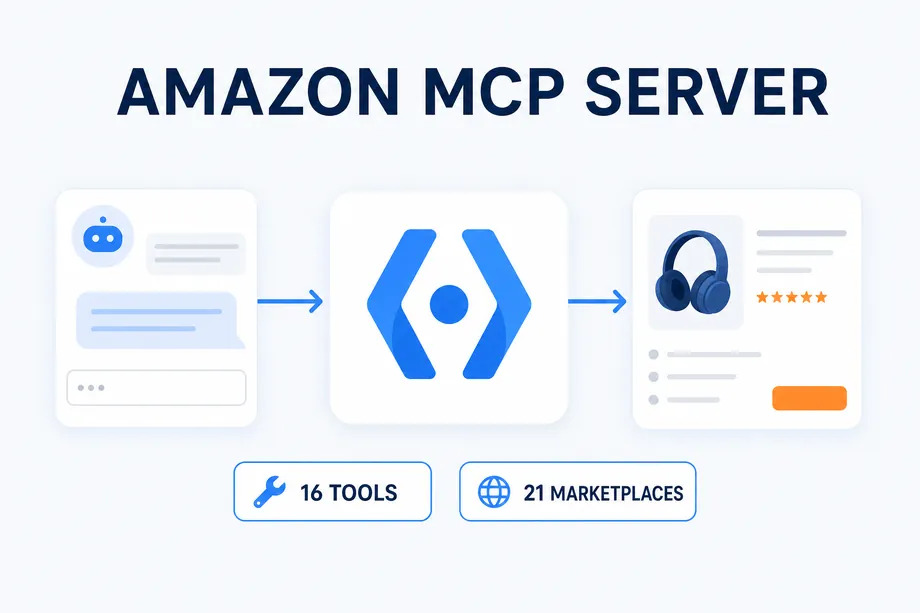
A seller opens Claude and asks, "What is the current price of this ASIN, how many merchants are competing for the Buy Box, and has demand improved during the last three months?" A normal language model can explain how to research those questions, but it cannot know the listing's current state. An amazon mcp server changes that boundary. It gives the assistant a controlled set of live data tools, so the answer can be grounded in current Amazon product, offer, rank, and history data instead of memory or guesswork.
Quick Answer: The Fastest Path to Live Amazon Data
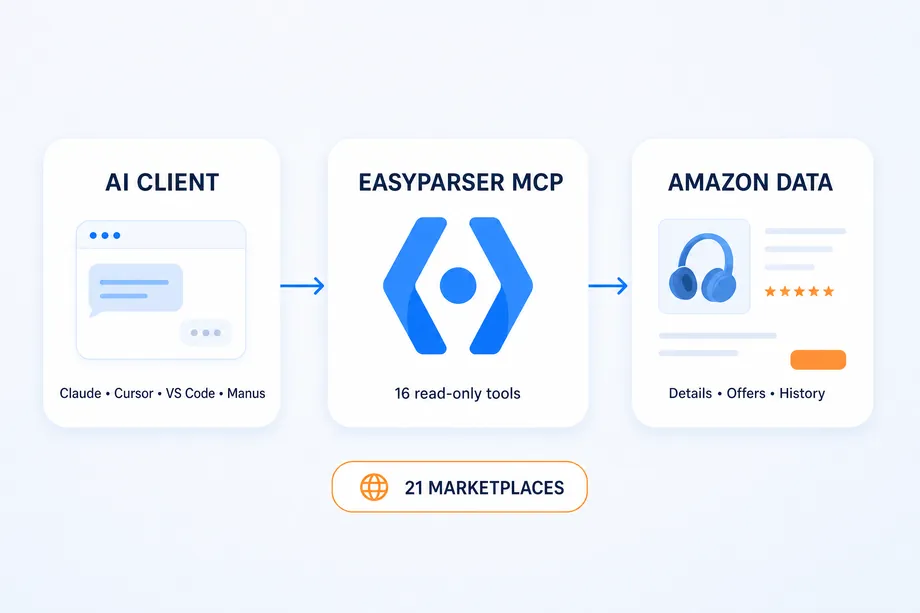
Easyparser MCP is a read-only bridge between MCP-compatible AI clients and the Easyparser Real-Time API. The current hosted server exposes 16 tools across 21 Amazon marketplaces. Ten tools retrieve live product or seller data, four inspect existing Bulk API jobs, one describes the available operations, and one checks account usage.
| Need | Best first tool |
|---|---|
| Product details | get_product_detail |
| Seller and Buy Box comparison | get_product_offers |
| Historical validation | get_sales_history |
| Bulk troubleshooting | list_bulk_jobs |
If you only want to test the connection, call list_operations. It works without an API key and lets the agent discover the server's data capabilities before it runs a data lookup.
What Is an Amazon MCP Server (and Why Should Sellers Care)?
The Model Context Protocol is an open standard for connecting AI applications to external systems. The easiest analogy is a universal port: an MCP client, such as Claude or Cursor, discovers tools published by a server, reads each tool's input schema, and calls the right tool when a request needs external data.
A language model and a data service solve different problems. The model interprets intent, plans steps, compares records, and explains results. The data service retrieves the evidence. Without the second part, a question about today's Amazon price is outside the model's reliable knowledge. With an amazon mcp server, the model can request a current product record and reason over the returned JSON.
That distinction matters because not every Amazon-focused MCP product serves the same data boundary. Some servers connect to a merchant's private Seller Central or Ads account through OAuth. They are useful for orders, inventory, campaigns, and account actions. Easyparser focuses on public marketplace intelligence: product pages, competing offers, search results, product history, seller identities, seller catalogs, and feedback. You do not need to own the listing or authorize a Seller Central account to research it.
| Question | Public marketplace MCP | Seller account MCP |
|---|---|---|
| Who sells a competitor ASIN and at what price? | Strong fit | Usually limited |
| What is my FBA inventory balance? | Not available | Strong fit |
| How has a public product's BSR changed? | Strong fit | Depends on stored account data |
| Can the agent edit a campaign or listing? | No, read-only | Possible with scoped write access |
The read-only boundary is intentional. An agent can research, compare, summarize, and monitor without being able to change a listing, price, campaign, or account setting. That makes the server suitable for exploratory analysis and shared research environments where destructive actions would create unnecessary risk.
What Can Your Agent Do with Easyparser MCP?
The live v1.3.1 server exposes 16 tools. Their descriptions tell the agent what each tool returns, when a narrower tool is the better choice, and which fields are required.
| Tool | Purpose | Credit status |
|---|---|---|
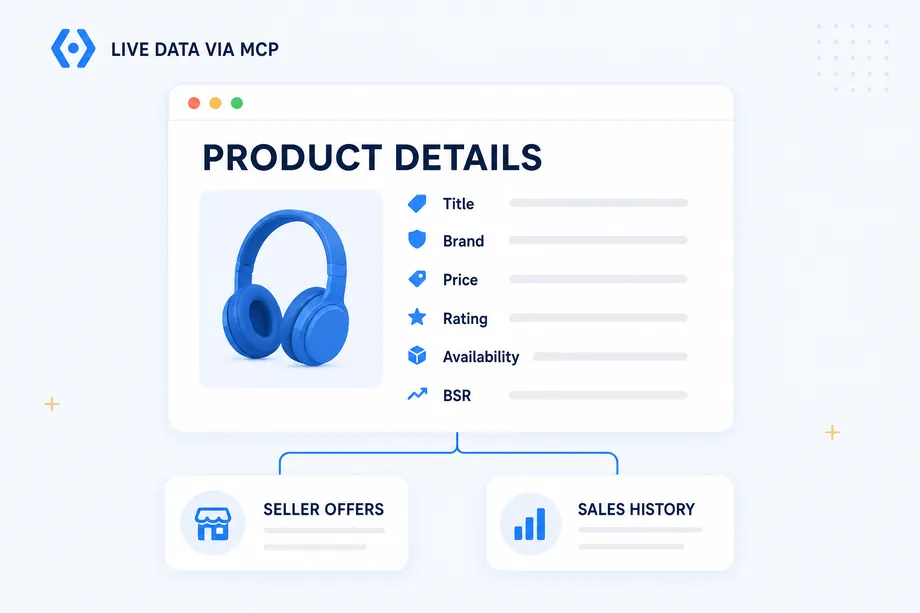
get_product_detail | Title, brand, images, features, Buy Box, rating, BSR, variants, specifications, and top reviews. | 1 credit; A+ content adds 1. |
get_product_offers | Seller prices, shipping, item condition, FBA or FBM, ratings, and Buy Box winner. | 1 credit per page. |
search_products | Keyword or category results with ASIN, price, rating, Prime status, badges, and refinements. | 1 credit per page. |
lookup_product | Maps UPC, EAN, GTIN, ISBN, JAN, or MINSAN codes to an Amazon ASIN. | 1 credit. |
get_sales_history | Weekly estimated views, purchases, price, offer count, and BSR for up to 12 months. | 5 credits plus 1 per history month. |
get_bestseller_rank | Current BSR in main and subcategories. | 1 credit. |
get_package_dimensions | Structured dimensions, weight, and Amazon fee category. | 1 credit. |
get_seller_profile | Legal business identity, address, and 30, 90, 365-day and lifetime feedback trends. | 1 credit. |
get_seller_products | Seller catalog with ASINs, prices, brands, categories, Prime status, variants, and ratings. | 1 credit per page. |
get_seller_feedback | Individual seller feedback with date and rating filters. | 1 credit per page. |
list_operations | Discovers operations, parameters, supported domains, costs, and examples. | Free, no key required. |
list_bulk_jobs | Lists Bulk API jobs, progress, operation, marketplace, success, and failure counts. | Free. |
get_bulk_job_items | Inspects individual items and errors inside a bulk job. | Free. |
get_bulk_item_result | Fetches the parsed result for one bulk item while retained. | Free. |
get_bulk_webhook_logs | Checks whether completion webhooks were delivered successfully. | Free. |
check_credits | Returns plan, balance, reset date, rate limits, and daily usage by operation. | Free. |
Coverage spans 21 marketplace domains, including the United States, United Kingdom, Germany, France, Italy, Spain, Canada, Mexico, Brazil, Japan, India, Australia, the United Arab Emirates, Saudi Arabia, the Netherlands, Poland, Sweden, Belgium, Turkey, Singapore, and Ireland. Always tell the agent which marketplace matters. Results can differ by domain.
Setting Up Claude, Cursor, VS Code, and Manus
You can use the hosted Streamable HTTP endpoint or run the package locally over stdio. Hosted setup is the fastest route because there is nothing to install or keep running. Local setup is useful when your client prefers stdio, your team manages dependencies centrally, or you want to self-host the HTTP process.
1. Create and Protect the API Key
Create an Easyparser account, copy the key from Account > Plan, and store it in the client configuration or environment variables. Do not paste a production key into a chat message, commit it to a repository, or place it in a screenshot. The discovery tool works without a key, so you can validate basic connectivity first.
2. Hosted Setup for Claude Code
claude mcp add --scope user --transport http easyparser
https://mcp.easyparser.com/mcp
--header "Authorization: Bearer YOUR_API_KEY"
After adding the server, ask Claude to list the Easyparser tools. A successful connection should show 16 names. If the client reports an authentication error, confirm the header uses the Bearer prefix and that the key has no extra spaces.
3. Hosted Setup for Cursor or Any HTTP MCP Client
{
"mcpServers": {
"easyparser": {
"type": "http",
"url": "https://mcp.easyparser.com/mcp",
"headers": { "Authorization": "Bearer YOUR_API_KEY" }
}
}
}
4. Local Setup for Claude Desktop, Cursor, or VS Code
{
"mcpServers": {
"easyparser": {
"command": "npx",
"args": ["-y", "easyparser-mcp"],
"env": { "EASYPARSER_API_KEY": "YOUR_API_KEY" }
}
}
}
For VS Code, use the same command, arguments, and environment values under the editor's servers object. For Manus, create a custom MCP connection with the hosted URL and the Authorization header. The hosted approach is preferable in an agent workspace because it avoids a local Node.js process and keeps upgrades on the server side.
5. Run a Safe Connection Test
Start with: "List the Easyparser operations and supported Amazon domains. Do not run a data lookup." Then test one known ASIN with get_product_detail. This two-step sequence confirms discovery, authentication, marketplace selection, and response parsing before you ask for multi-page or historical work.
Real-World Use Cases: From Price Checks to Seller Research
The best prompts define the entity, marketplace, decision, and required fields. Ask for a specific ASIN on a specific domain and name the exact output you need.
Current Price and Seller Count
For the opening scenario, the agent should call product detail once and offers once. The Amazon Product Detail API supplies the listing snapshot; the Amazon Product Offer API supplies merchant-level competition. Ask the model to distinguish item price from shipping, count only active offers, label FBA and FBM sellers, and identify the Buy Box winner rather than returning an unstructured list.
"For ASIN B0F25371FH on amazon.com, show the current product price and rating, then fetch the first page of offers. Report the Buy Box seller, total offers returned, lowest delivered price, and the FBA versus FBM split. Stop after these two calls."
Product Discovery for Buyers and Analysts
A buyer can ask for organic search results, remove sponsored listings, and compare price, rating, review count, Prime eligibility, and badges. An analyst can use the same response to find crowded price bands or brands that dominate the first page. One page usually provides enough candidates for a first pass; extra pages should be requested only if the sample is too narrow.
Historical Validation Before a Sourcing Decision
A current price can be a promotion, stockout artifact, or temporary Buy Box move. For deeper due diligence, use the Sales Analysis and History API. It can return weekly trends for estimated views, purchases, price, offer count, and BSR for up to 12 months, so the agent should match the history window to the decision.
Seller Due Diligence
Start with offers to discover a seller ID, then call seller profile for legal identity and aggregate reputation. Use seller feedback only when individual comments are needed, and filter to one to three stars to reduce pages. Seller products can then reveal the merchant's catalog shape, price positioning, and category concentration.
Bulk Monitoring Without Rebuilding the Job
The MCP server does not submit new Bulk API jobs, but it can inspect jobs already started through Easyparser. An agent can list jobs, filter failed items, retrieve retained results, and inspect webhook delivery logs through the same state shown in the web app.
Hosted vs Local: Choosing Your Setup
| Factor | Hosted Streamable HTTP | Local stdio or self-hosted HTTP |
|---|---|---|
| Setup time | Fastest; add one URL and header. | Requires Node.js, npx, or Docker. |
| Updates | Managed on the hosted service. | You control package and container updates. |
| Client fit | Best for clients that accept remote MCP endpoints and headers. | Best for desktop and editor clients that prefer local commands. |
| Operations | No local process to monitor. | You manage runtime, logs, ports, and availability. |
| Customization | Standard production behavior. | Useful for inspecting or extending the open-source adapter. |
Choose hosted for the shortest path to a working agent. Choose local when policy requires a locally managed process, when a client supports stdio more cleanly than remote HTTP, or when your engineering team wants to audit and pin a specific package version. Both modes still call Easyparser for the Amazon data itself; local mode does not turn the service into an offline scraper.
What Makes a Good Amazon MCP Server?
Compatibility alone is not enough. A useful server needs precise tool boundaries, predictable schemas, actionable errors, explicit safety annotations, and a clear data boundary. Easyparser's tools are marked read-only and non-destructive. They also include decision guidance such as using BSR instead of full history when rank is the only requirement, or applying seller feedback filters instead of paging through every review.
Freshness also needs an honest definition. Product details, offers, searches, and seller data are retrieved through the Real-Time API when called. Historical data is weekly aggregated and can span up to 12 months. Bulk item results are retained for 24 hours after completion, so an expired result should be regenerated with the matching real-time tool if the user still needs it.
Easyparser reads public marketplace information. It does not expose private orders, inventory, ad campaigns, or settlement reports, and it cannot modify an Amazon account. Those jobs require a Seller Central or Ads integration with scoped authorization.
Start with One Question, Then Build the Workflow
Start with one repeatable question and a known answer format. List the tools, run a product detail lookup, and compare it with the live Amazon page. Add offers, history, or seller data only when the decision needs that evidence.
Once the pattern works, save it as a team template with a marketplace, required fields, output table, and a rule that separates returned facts from interpretation. The same amazon mcp server can then support product research, seller due diligence, monitoring, catalog matching, and bulk-job diagnostics.
Easyparser combines a standard MCP connection with live public Amazon data, 16 discoverable tools, read-only operation guidance, and coverage across 21 marketplaces. Create a free API key, connect the hosted endpoint or local package, and start with one ASIN. Your AI agent will still do the reasoning, but it will finally have current marketplace evidence to reason from.