What is a parent child ASIN?
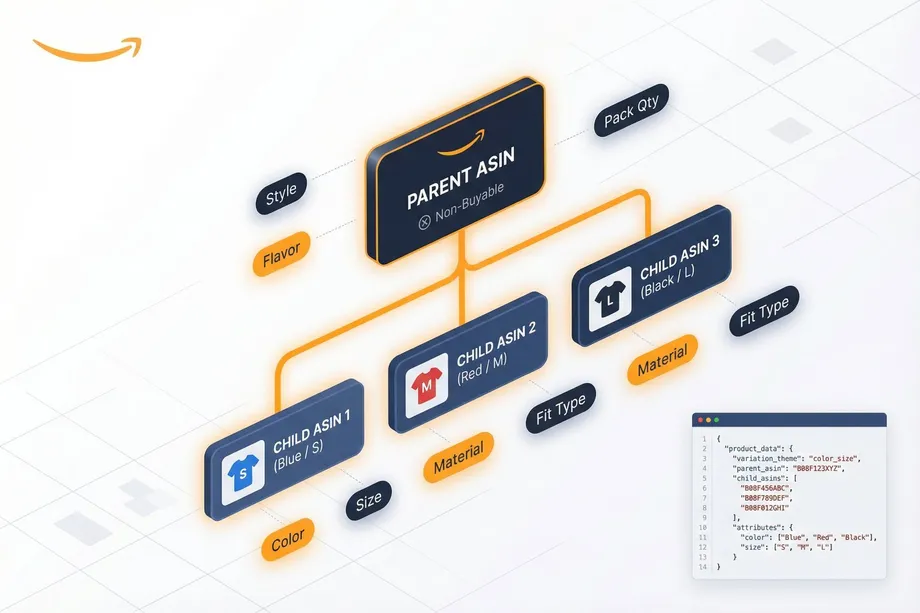
If you have ever shopped for a t-shirt on Amazon and selected a different color or size from a dropdown menu, you have interacted with an amazon parent child asin relationship. But what is a parent child ASIN? In simple terms, it is Amazon's method for grouping related products together on a single product detail page. The "Parent ASIN" acts as an invisible container that holds the product family together, while the "Child ASINs" are the actual, buyable variations-like a small blue shirt or a large red shirt.
For sellers, brands, and data analysts, mastering the amazon parent child asin structure is critical. Proper variation management consolidates product reviews, boosts search visibility, and improves conversion rates by keeping shoppers on a single page. Conversely, extracting and analyzing this variation data provides a significant competitive advantage. By understanding how competitors structure their product families, which variations drive the most sales, and how they manage pricing across different child ASINs, you can optimize your own multi-variant listings.
This comprehensive guide will explain the mechanics of Amazon's variation system, how to extract parent-child ASIN relationships programmatically, and strategies for leveraging this data to maximize your catalog's performance.
Understanding the Amazon Variation Structure
Before diving into data extraction, it is essential to understand the components that make up a variation family on Amazon. The system relies on three interconnected elements: the Parent ASIN, the Child ASINs, and the Variation Theme.
The Parent ASIN (The Container)
The Parent ASIN is a non-buyable entity. It does not have inventory, a price, or a buy box. Its sole purpose is to establish a relationship between the child products. Think of the Parent ASIN as a folder on your computer; you cannot wear or use the folder itself, but it keeps related files organized in one place.
The Child ASINs (The Buyable Variants)
Child ASINs are the actual products that customers purchase. Each child represents a unique combination of attributes within the product family. If a parent product is a "Stainless Steel Water Bottle," the child ASINs would be the specific variations, such as "20oz - Matte Black" or "32oz - Ocean Blue." Each Child ASIN has its own unique barcode, inventory level, price, and sales history.
The Variation Theme
The Variation Theme defines exactly how the child products differ from one another. Amazon enforces strict rules regarding which themes are allowed in specific product categories. Common variation themes include:
- Size: Small, Medium, Large
- Color: Red, Blue, Green
- SizeColor: Small Red, Medium Blue
- Style: V-Neck, Crew Neck
- Flavor: Vanilla, Chocolate, Strawberry
Why Extract Amazon Parent Child ASIN Data?
Extracting variation data is not just an academic exercise; it is a fundamental requirement for modern e-commerce intelligence. When you scrape and analyze amazon parent child asin relationships, you unlock several powerful use cases.
Multi-Variant Listing Optimization
By analyzing top-performing product families in your niche, you can identify the optimal variation structure. Should you group your products by SizeColor, or separate them into different parent listings? Data extraction reveals how the market leaders organize their catalogs, helping you choose the most effective variation theme and prioritize the variants that matter most to consumers.
Competitor Variation Analysis
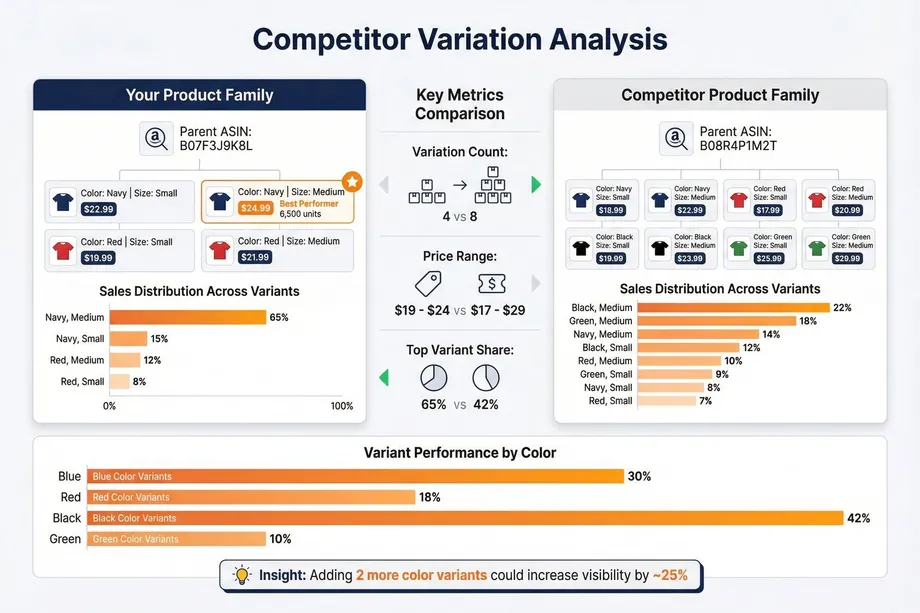
Not all variations are created equal. In any product family, a small number of child ASINs typically drive the majority of sales. By extracting variation data and correlating it with estimated sales metrics or review counts, you can identify which specific colors, sizes, or flavors are the most popular. This intelligence allows you to optimize your inventory purchasing and avoid tying up capital in slow-moving variants.
E-commerce Catalog Building
For aggregators, dropshippers, or marketplace platforms, building a comprehensive product catalog requires accurate variation data. If you only extract the parent ASIN, your catalog will lack the specific, buyable items. Conversely, if you extract child ASINs without their parent relationships, your catalog will be disorganized and difficult to navigate. Extracting the full amazon parent child asin hierarchy ensures your database accurately reflects the complete product families, complete with variant attributes and pricing matrices.
Challenges in Variation Data Extraction
Extracting variation data from Amazon presents unique technical challenges. Traditional web scraping methods often struggle with the complexity of multi-variant listings.
First, variation data is often deeply nested within the page's HTML or loaded dynamically via JavaScript. A simple HTML parser like BeautifulSoup might only see the default child ASIN that loads initially, completely missing the other available variations.
Second, navigating product families programmatically requires mapping the relationships accurately. You must identify the parent ASIN, discover all associated child ASINs, and accurately map the specific attributes (e.g., Color: Red, Size: Large) to each individual child ASIN. Doing this reliably at scale across thousands of product families is exceptionally difficult using homegrown scraping scripts.
Extracting Variation Data with Easyparser
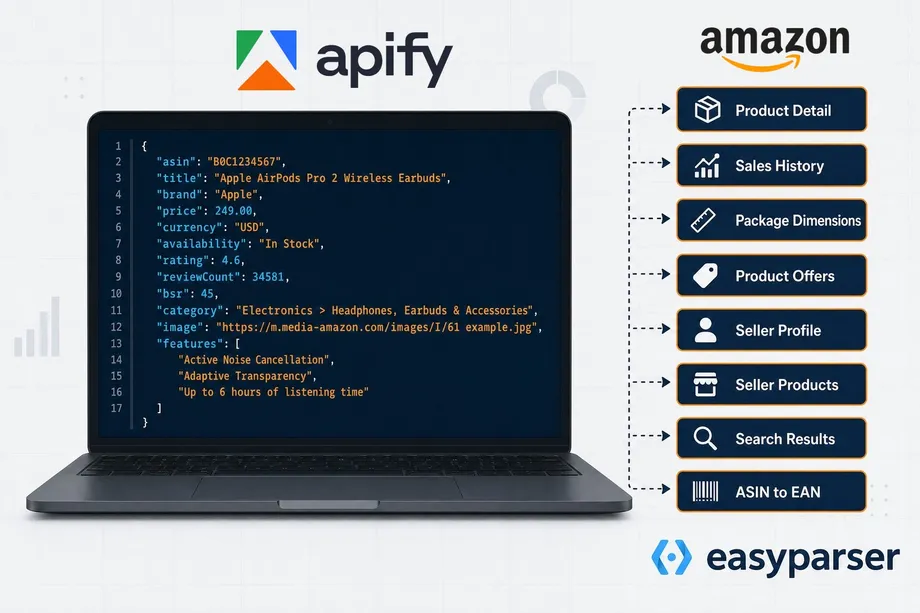
To overcome the challenges of manual scraping, data teams and developers rely on dedicated APIs. Easyparser provides a robust, real-time solution for extracting complete amazon parent child asin relationships and variation data through its DETAIL operation.
Unlike generic scraping tools, Easyparser is purpose-built for Amazon's data structures. When you request a product detail page using the DETAIL operation, Easyparser automatically navigates the variation family and returns a clean, structured JSON response containing the parent ASIN, the variation theme, and a complete array of all child ASINs along with their specific attributes.
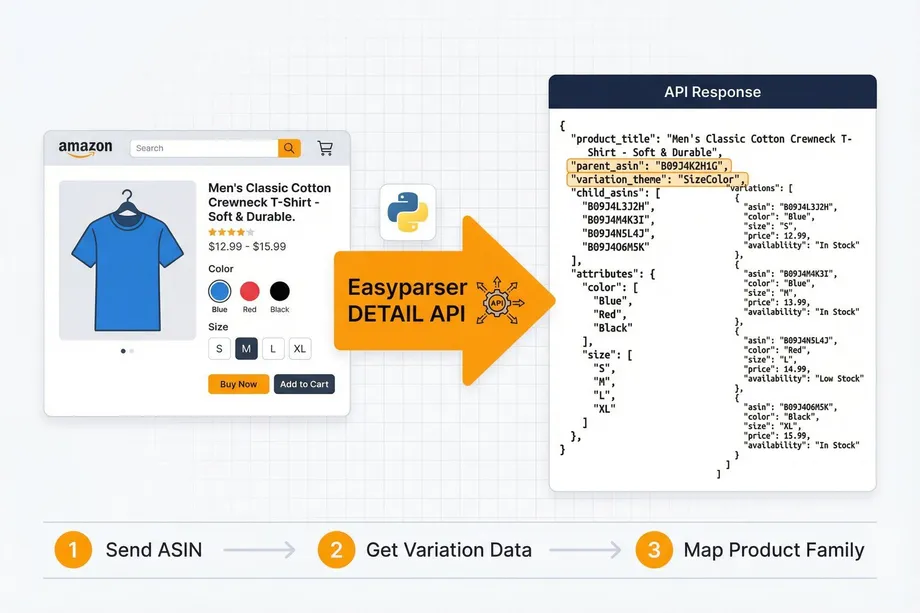
Python Example: Fetching Variation Data
The following Python code demonstrates how to use the Easyparser API to extract variation data for a specific product. This example uses the Real-Time API to fetch the data instantly.
import requests
API_KEY = "YOUR_API_KEY" # Get your key from app.easyparser.com
ASIN = "B09J4K2H1G" # Can be a Parent or Child ASIN
params = {
"api_key": API_KEY,
"platform": "AMZ",
"operation": "DETAIL",
"asin": ASIN,
"domain": ".com"
}
response = requests.get("https://realtime.easyparser.com/v1/request", params=params)
data = response.json()
product = data.get("product", {})
variation_data = product.get("variations", {})
print(f"Parent ASIN: {product.get('parent_asin')}")
print(f"Variation Theme: {variation_data.get('variation_theme')}")
print(f"Total Child ASINs: {len(variation_data.get('child_asins', []))}")
By leveraging the Easyparser Amazon Scraping API, you eliminate the need to build complex parsing logic for nested variations. The API handles the heavy lifting, delivering analysis-ready data directly to your application.
Advanced Strategies: Pricing and Availability Across Variants
Once you have extracted the amazon parent child asin data, you can begin applying advanced analytical strategies. One critical area is pricing strategy across variants.
It is common for different child ASINs within the same family to have different prices. For example, a highly popular "Black" t-shirt might be priced at $24.99, while the slower-moving "Neon Green" version is discounted to $19.99. By continuously extracting variation data, you can track these pricing matrices over time, identifying when competitors adjust prices based on variant popularity or inventory levels.
Furthermore, tracking the availability (in-stock status) of individual child ASINs provides deep insights into competitor supply chains. If a competitor's top-selling size frequently goes out of stock, it presents an opportunity for you to capture that demand with your own properly stocked variations.
Conclusion
Understanding and extracting amazon parent child asin relationships is essential for anyone serious about e-commerce data analysis. The variation structure-comprising the parent ASIN, child ASINs, and variation themes-dictates how products are displayed, how reviews are shared, and ultimately, how consumers shop.
While manual extraction is fraught with technical hurdles, utilizing a dedicated solution like Easyparser simplifies the process entirely. By programmatically accessing clean variation data, you can optimize your multi-variant listings, conduct granular competitor analysis, and build comprehensive e-commerce catalogs that drive strategic decision-making.
Start extracting Amazon data for free
Start Your Free Trial100 free credits, no credit card required.