For Amazon sellers, Prime Day is not just a sales event; it is a high-stakes battleground where preparation dictates profitability. With Amazon Prime Day 2026 officially scheduled for June 23-26 - earlier than in recent years - the window for strategic planning is rapidly closing. Relying on intuition or last year's static spreadsheets is a guaranteed recipe for stockouts, lost Buy Box share, and squeezed margins. The sellers who will dominate this year's event are not the ones scrambling in the final week; they are the ones who started building their amazon prime day data strategy months ago.
The most successful sellers treat Prime Day preparation as a rigorous data science exercise. They do not guess what prices will win; they analyze competitor patterns. They do not estimate inventory; they forecast demand using historical Best Sellers Rank (BSR) and sales data. This guide will walk you through a comprehensive amazon prime day data strategy, demonstrating how to use real-time competitive intelligence to prepare for and profit from Prime Day 2026. Whether you are a first-time Prime Day participant or a seasoned seller looking to sharpen your edge, the principles here apply at every scale.
Why Data Preparation Is the Key to Prime Day Success
The scale of Prime Day creates unique challenges that simply cannot be managed without data. Traffic spikes are massive but unpredictable, competitor pricing becomes highly volatile, and Amazon's algorithm heavily favors listings with optimized conversion rates and flawless fulfillment histories. A robust amazon prime day data strategy addresses these challenges head-on, converting uncertainty into calculated, defensible decisions.
- Precision Inventory Planning: Overstocking ties up capital in FBA fees, while understocking means missing out on the biggest sales days of the year. Data-driven forecasting minimizes both risks by anchoring your order quantities in historical velocity data rather than optimistic projections.
- Dynamic Pricing Agility: Competitors will adjust prices rapidly throughout the four-day event. If you are not monitoring the Buy Box in real-time, you will lose sales to temporary discounts you never saw coming. The difference between winning and losing the Buy Box can be as little as $0.01.
- Optimized Deal Submissions: Understanding historical deal performance helps you determine which products warrant the investment of a Lightning Deal or Prime-Exclusive Discount. Not every product benefits equally from promotional pricing, and the data tells you which ones do.
- Post-Event Ranking Gains: A well-executed Prime Day campaign can improve your organic BSR for weeks afterward, generating a compounding return on your preparation investment. This halo effect is one of the most underestimated benefits of a data-driven approach.
To execute this strategy effectively, you need reliable, structured data. This is where a solution like Easyparser becomes indispensable, allowing you to extract and analyze Amazon's vast ecosystem without dealing with proxies, CAPTCHAs, or HTML parsing headaches. The API returns clean JSON that feeds directly into your analysis pipelines.
Step 1: Analyze Last Year's BSR Spikes with Sales History
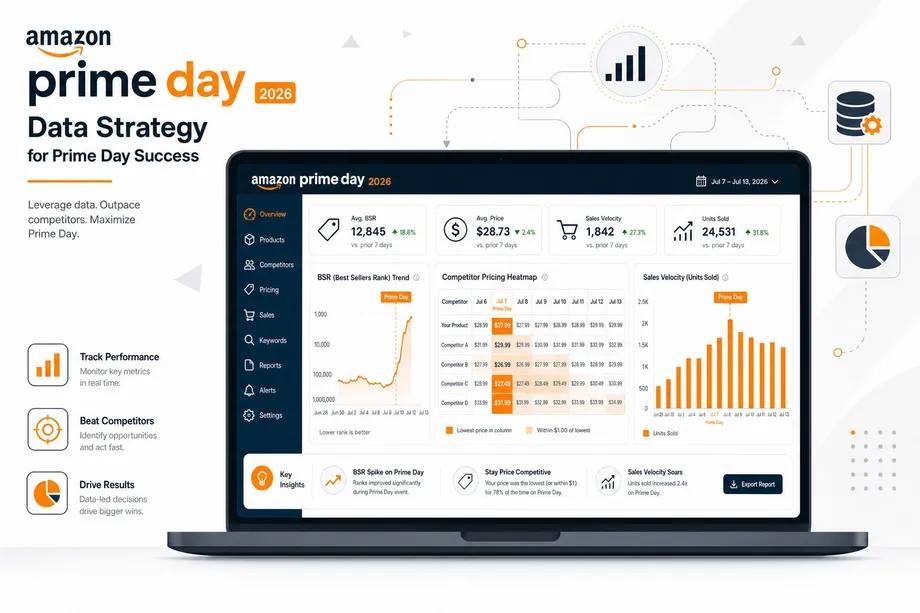
Your first step in any serious prime day preparation data workflow is looking backward. Historical data is the most reliable predictor of future performance. You need to identify which products experienced the most significant BSR improvements during previous Prime Days or similar seasonal events like Black Friday and Cyber Monday. The patterns from 2024 and 2025 are your most valuable planning inputs for 2026.
By analyzing the prime day sales history analysis for your top ASINs, you can pinpoint the exact moment demand surged. Did sales peak on day one, or was there a sustained tail in the days following the event? Understanding this demand curve allows you to time your inventory arrivals and advertising budget scaling perfectly. A product that peaks on day two, for example, requires a different advertising ramp-up strategy than one that explodes immediately at midnight on June 23rd.
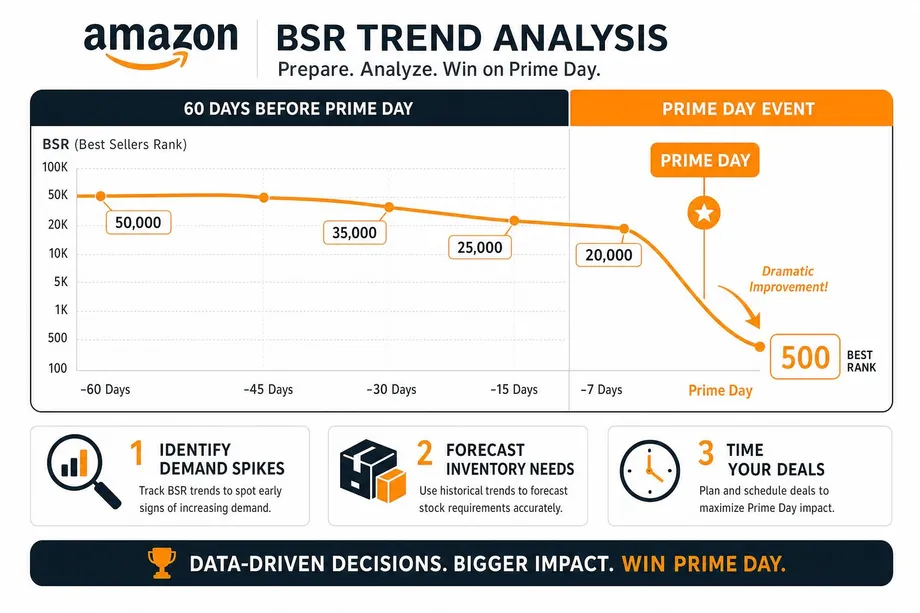
Instead of manually checking historical charts, you can automate this extraction using Easyparser's Sales Analysis operation. Pull the historical performance of your top 20-30 ASINs and build a predictive model for 2026. Look specifically for products where the BSR improved by more than 80% during the Prime Day window - these are your highest-priority candidates for deal submissions and inventory investment. This data-driven approach transforms guesswork into a quantifiable, defensible forecast that you can share with your supply chain partners.
Step 2: Monitor Competitor Deal Patterns 60 Days Before
Competitor analysis should not start on Prime Day; it must begin weeks in advance. Sellers often test pricing strategies or gradually raise prices before Prime Day to make their eventual discounts appear more substantial to shoppers. By tracking your main competitors 60 days out, you can reverse-engineer their promotional playbook before the event even begins, giving you a significant strategic advantage.
Set up a tracking system to monitor the daily pricing and Buy Box ownership of your top 10 competitors for each core ASIN. Are they aggressively trying to liquidate inventory now, or are they holding steady? If a competitor suddenly drops their price significantly in May, they might be trying to boost their organic ranking ahead of the June event. Conversely, a price increase in early June is a classic setup for a dramatic Prime Day discount that looks more impressive to shoppers. Understanding these patterns is the foundation of effective prime day competitive intelligence.
Using an Amazon Product Offer API, you can collect this competitive intelligence automatically, ensuring you are never blindsided by a rival's pricing strategy. The data you collect in this phase directly informs your own deal submission decisions and pricing floor calculations. Schedule automated data pulls every 6-12 hours to capture intraday pricing movements that a daily check would miss entirely.
Step 3: Optimize Pricing with Real-Time Offer Data
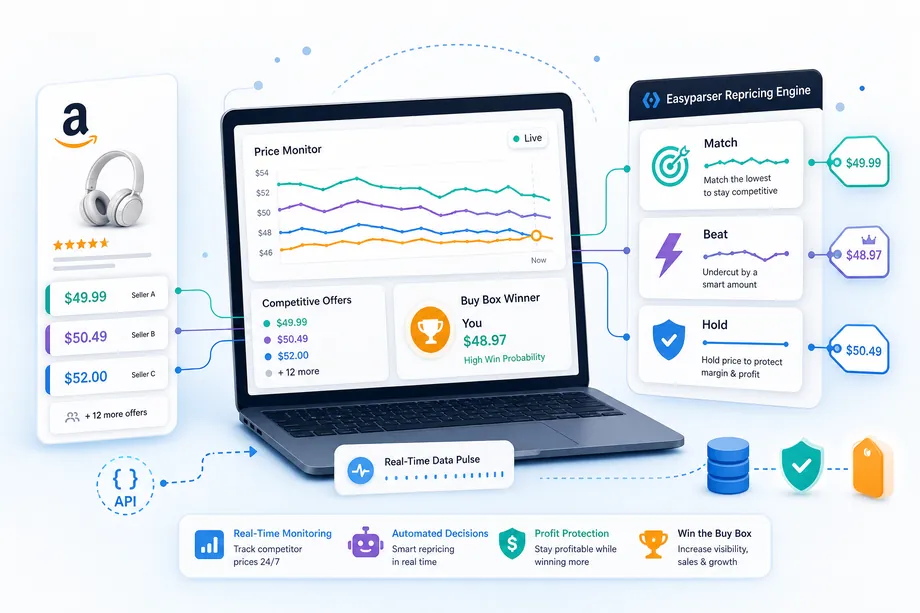
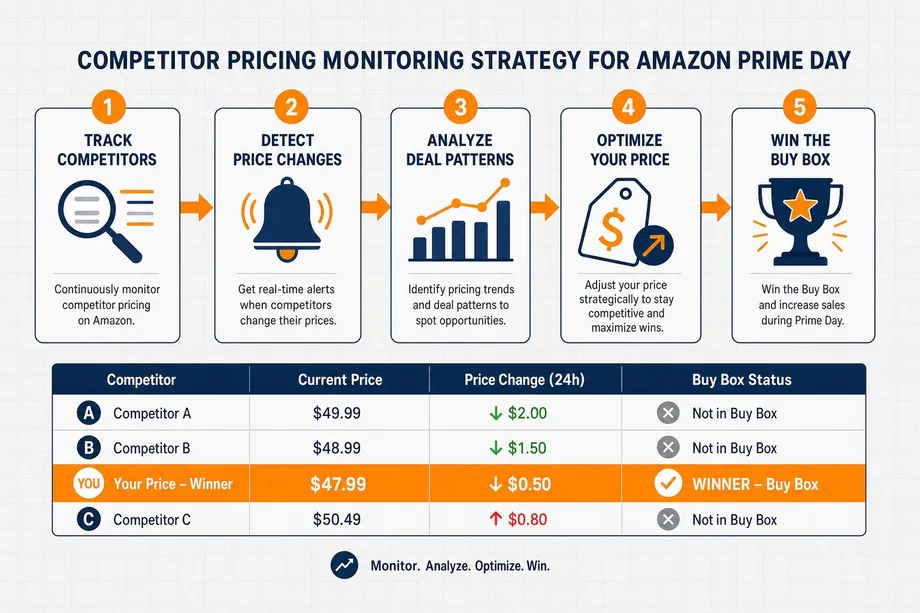
When June 23rd arrives, static pricing is a liability. The Buy Box will change hands frequently as sellers deploy automated repricers and Lightning Deals go live. Your amazon prime day data strategy must include a mechanism for real-time price optimization to stay competitive throughout the four-day event. This is not optional; it is the difference between a profitable Prime Day and a missed opportunity.
You need to know exactly who holds the Buy Box at any given moment, whether they are FBA or FBM, and what their shipping times are. If a competitor wins the Buy Box but has a two-week delivery time, you might not need to match their artificially low price if you offer Prime-eligible next-day delivery. The data tells you when to compete aggressively on price and when to hold your margin and compete on fulfillment speed instead. This nuanced approach is only possible with real-time prime day pricing strategy data.
Here is an example of how you can use Easyparser to fetch real-time offer data to inform your repricing logic:
import requests
API_KEY = "YOUR_API_KEY" # Get your key from app.easyparser.com
ASIN = "B098FKXT8L"
params = {
"api_key": API_KEY,
"platform": "AMZ",
"operation": "OFFER",
"asin": ASIN,
"domain": "com"
}
response = requests.get("https://realtime.easyparser.com/v1/request", params=params)
data = response.json()
offers = data.get("offers", [])
for offer in offers:
print(f"Seller: {offer.get('seller_name')}, Price: ${offer.get('price')}, FBA: {offer.get('is_fba')}")
Step 4: Plan Inventory Using Demand Forecasting
Inventory management is the tightrope walk of Prime Day. A general industry guideline is to have 4-5 days of high-volume inventory specifically allocated for the event. However, "high volume" is entirely subjective without data to anchor the calculation. You must determine your expected Prime Day sales velocity based on your historical BSR data and current market trajectory, not on gut feeling or last year's rough estimates.
Review your product detail data and track how your BSR correlates with actual sales velocity across different time periods. If a BSR of 5,000 in your category translates to approximately 100 units per day normally, but spikes to 400 units per day during Prime Day based on last year's data, you need to ensure your FBA shipments are checked in well before Amazon's cutoff dates for the event. The math is straightforward once you have the data; without it, you are flying blind.
Remember, Amazon's fulfillment centers become severely congested in the weeks leading up to Prime Day. Relying on just-in-time inventory is a critical mistake that costs sellers millions of dollars in missed sales every year. The data should dictate your shipment schedule, not your optimism. Build in a buffer of at least 10-14 days for FBA check-in processing during peak periods, and track your inbound shipment status daily as the event approaches.
Step 5: Track Lightning Deal Opportunities
Lightning Deals and Prime-Exclusive Discounts are powerful visibility drivers, but they require careful margin analysis before submission. You must evaluate whether the required discount - often 20% or more below your recent average selling price - will be offset by the increased sales volume and the subsequent organic ranking boost that follows a high-velocity sales period. This is where prime day bsr analysis from Step 1 becomes directly actionable.
Use data to track which of your competitors are running deals and how those deals impact their BSR. If a competitor consistently runs Lightning Deals on a specific ASIN and their BSR improves dramatically each time, it is a strong indicator that the strategy is profitable for that niche. Conversely, if you see deals failing to move the BSR needle despite heavy discounting, you can preserve your margin and focus on aggressive Sponsored Products bidding instead. The data makes this decision objective rather than emotional.
One often-overlooked tactic is tracking which ASINs your competitors are NOT running deals on. If a strong competitor skips a Lightning Deal on a product you both sell, it might signal that their margins are too thin to absorb the discount - giving you an opportunity to run a deal and capture their market share at a price point they cannot match.
Building a Prime Day Dashboard with Easyparser
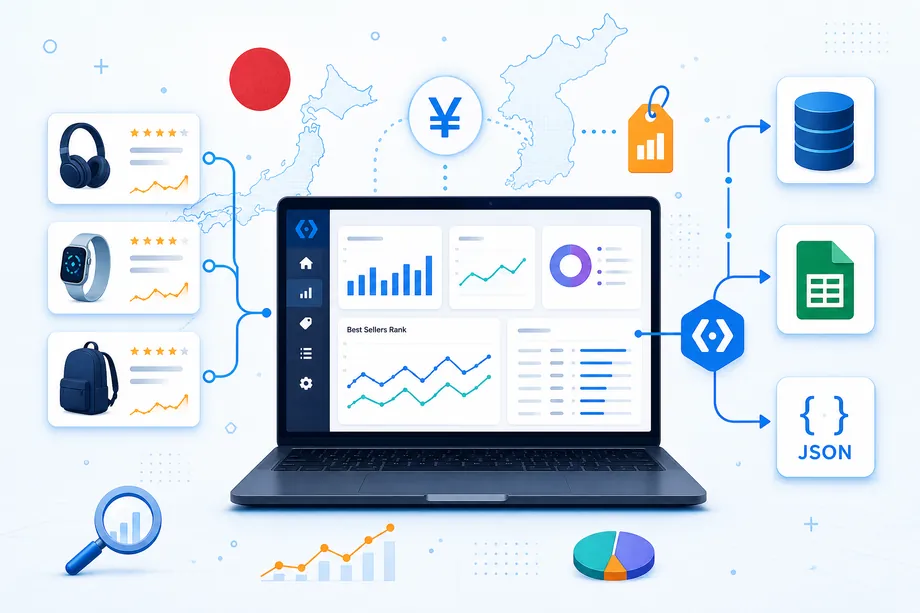
To synthesize all this information into actionable intelligence, successful sellers build centralized dashboards that surface the most critical metrics in one place. Instead of logging into Seller Central and checking multiple disconnected reports, they use APIs to feed data directly into Google Sheets, Tableau, or custom BI tools. This operational efficiency is itself a competitive advantage during the fast-moving Prime Day event.
With Easyparser, you can automate the extraction of BSR, pricing, and competitor data on a scheduled basis, creating a single source of truth for your entire amazon prime day data strategy. This allows your team to make split-second decisions during the event itself, rather than wasting critical minutes gathering data manually while your competitors are already reacting. You can set up automated alerts that notify you the moment a competitor drops below your price threshold or when your own BSR breaks into a new performance tier.
The combination of Easyparser's product lookup capabilities with a simple scheduling tool like n8n or Python cron jobs creates a powerful, low-cost intelligence system that rivals the capabilities of enterprise-grade repricing software at a fraction of the cost. A single developer can build this infrastructure in a weekend, and it will pay for itself many times over during Prime Day alone.
Post-Prime Day: Analyzing What Worked
The amazon prime day data strategy does not end when Prime Day concludes on June 26th. The post-event analysis is just as critical as the preparation phase, and sellers who skip it are leaving significant value on the table. You must evaluate the "halo effect" - the sustained increase in sales velocity that often follows a successful Prime Day campaign - and document which strategies generated the best return on investment.
Analyze which ASINs retained their improved BSR after the event, which pricing strategies yielded the highest net profit (not just gross revenue), and where stockouts cost you measurable sales. Calculate the true cost of each stockout by estimating the sales you missed and the organic ranking you lost as a result. A single day of being out of stock on a top-performing ASIN during Prime Day can cost you weeks of organic ranking recovery time. Documenting these data points immediately after the event forms the foundation of your strategy for the Q4 holiday season and Prime Day 2027.
The sellers who consistently win Prime Day are not the ones who react fastest on June 23rd; they are the ones who built a systematic amazon prime day data strategy months earlier and executed it with discipline. By treating Prime Day as a data-driven operation rather than a marketing gamble, you position your brand for sustainable, scalable success. The tools and APIs available today - including Easyparser's real-time Amazon data infrastructure - make this level of preparation accessible to sellers of every size. Start gathering your data today; June 23rd is closer than it appears.
Start scaling your e-commerce business today
Start Your Free Trial100 free credits, no credit card required.