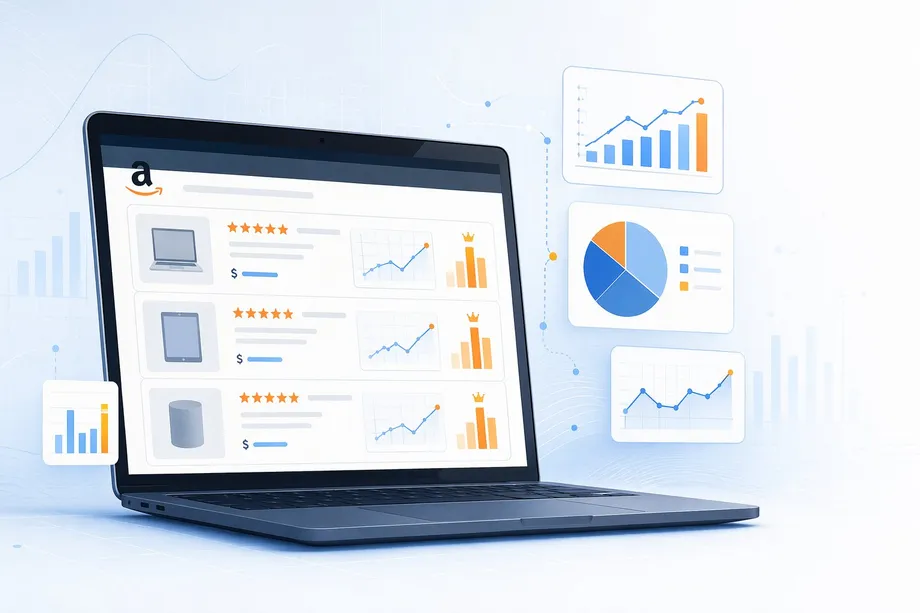
In the highly competitive e-commerce landscape, customer feedback is the most valuable and underutilized asset a brand possesses. Millions of shoppers leave detailed reviews on Amazon every day, describing exactly what they love, what frustrates them, and what they wish a product included. Yet most brands only look at the aggregate star rating, missing the rich, granular intelligence buried in the review text itself.
This is where amazon review sentiment analysis becomes a transformative capability. By leveraging Natural Language Processing (NLP), data scientists and product managers can automate the extraction of deep insights from raw review text at scale. Instead of guessing why a product's rating dropped from 4.3 to 3.9 stars, an NLP pipeline can instantly surface the fact that 48% of recent negative reviews specifically mention "battery life" or "connection drops." This level of precision enables targeted product improvements, sharper marketing messaging, and a genuine competitive edge.
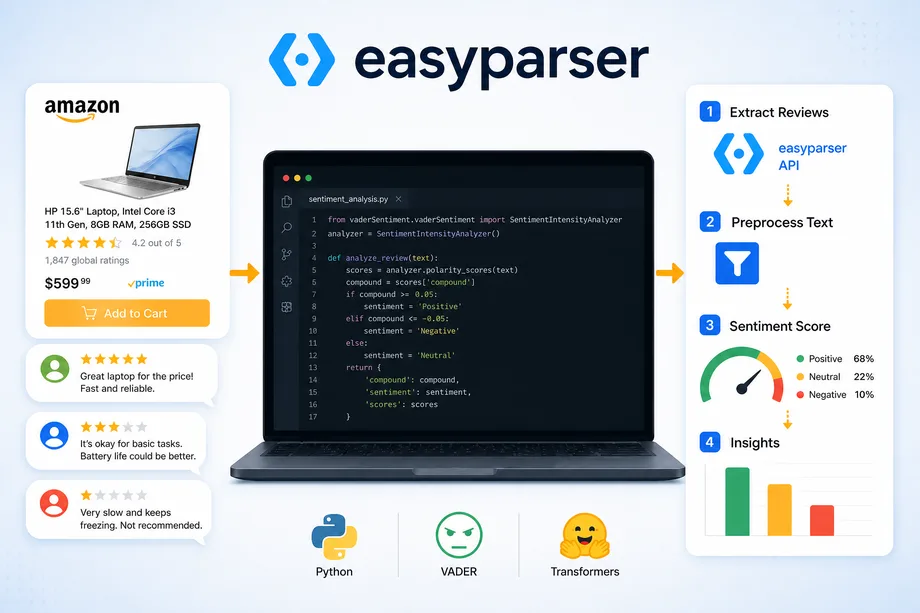
This guide walks you through building a complete, production-ready amazon review nlp python pipeline from start to finish: extracting data reliably with Easyparser, cleaning and preprocessing text, running both rule-based and deep learning sentiment models, performing aspect-based analysis to find specific pain points, comparing competitor sentiment, and finally automating the entire workflow for continuous monitoring.
Why Amazon Reviews Are a Rich Data Source
Amazon reviews are more than just a star rating. They are a form of unsolicited, real-world feedback that captures the authentic voice of the customer. When you conduct amazon product review analysis, you are tapping into a dataset that no survey or focus group can replicate. Customers write these reviews in their own words, without leading questions, and often with a level of emotional honesty that is rare in formal research settings.
Consider the scale: a popular product in a competitive category like wireless headphones or kitchen appliances can accumulate thousands of reviews within months of launch. Each review is a data point containing information about product quality, customer expectations, use cases, and even competitor comparisons. Manually reading even a fraction of this data is impossible for a product team. NLP makes it tractable.
The key insight that makes this data so valuable is its specificity. A customer who writes "The sound quality is fantastic but the ear cups start to hurt after an hour" has given you two distinct pieces of information: a positive signal on audio performance and a negative signal on physical comfort. A simple star rating of 3 stars would have obscured both of these signals. Amazon review data nlp techniques, specifically aspect-based sentiment analysis, are designed to extract exactly this kind of granular intelligence.
For a product manager, this data answers critical strategic questions. What specific features are driving 5-star ratings? Why are customers returning the product? What are the recurring complaints that a competitor's customers express, and how can your product address those gaps? To answer these questions at scale, you need a well-structured pipeline that handles the volume, variety, and inherent noise of user-generated text.
Extracting Review Data with Easyparser API
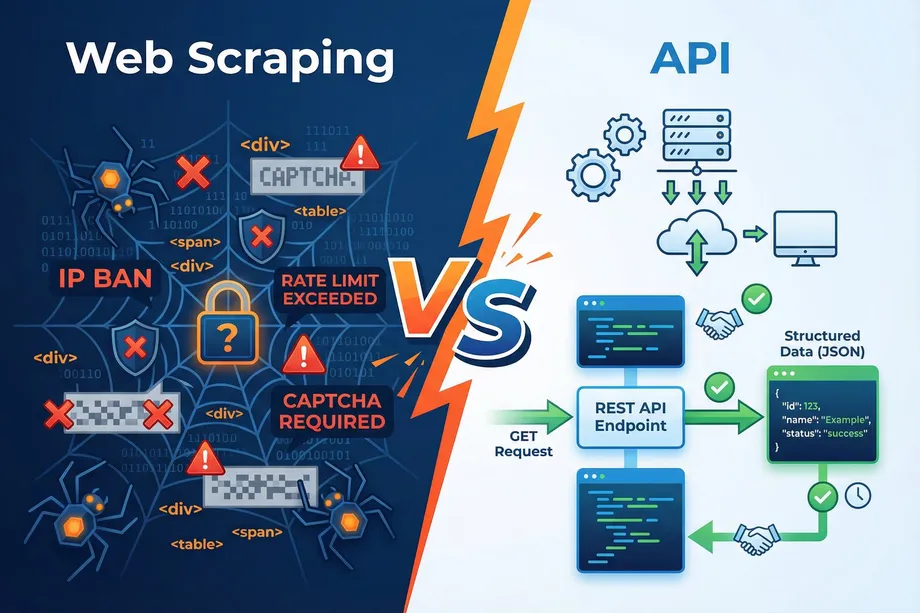
The first and most critical hurdle in any amazon review data extraction nlp project is acquiring clean, reliable data. Writing a custom scraper for Amazon is notoriously difficult. Amazon's infrastructure is designed to detect and block automated traffic through dynamic HTML structures that change frequently, aggressive CAPTCHA challenges, IP-based rate limiting, and behavioral fingerprinting. A custom scraper that works today may be completely broken tomorrow after an Amazon front-end update.
Instead of fighting these anti-bot systems, the modern approach uses a structured data API. Easyparser provides a reliable, production-grade interface to Amazon's product data. Its infrastructure handles proxy rotation, CAPTCHA solving, and HTML parsing automatically, returning clean JSON responses that are immediately ready for your NLP pipeline. You never have to worry about your data source breaking; you simply make API calls and receive structured data.
The Product Detail API is the primary entry point for product-level data, including review counts, star rating distributions, and product descriptions. For a sentiment analysis amazon reviews api workflow, you would typically start by fetching product details to understand the overall review landscape before diving into individual review text.
import requests
API_KEY = "YOUR_API_KEY" # Get your key from app.easyparser.com
ASIN = "B098FKXT8L"
params = {
"api_key": API_KEY,
"platform": "AMZ",
"operation": "DETAIL",
"asin": ASIN,
"domain": ".com"
}
response = requests.get("https://realtime.easyparser.com/v1/request", params=params)
data = response.json()
product = data.get("product", {})
print(f"Title: {product.get('title')}")
print(f"Rating: {product.get('rating')} stars")
print(f"Review Count: {product.get('reviewCount')}")
Seller Feedback: A Distinct and Complementary Signal
Beyond product-level reviews, Easyparser's SELLER_FEEDBACK operation provides access to a distinct and equally valuable data source: seller feedback. While product reviews reflect the customer's experience with the item itself, seller feedback captures the fulfillment and service experience, covering shipping speed, packaging quality, and seller communication. For marketplace sellers and brands managing their own storefronts, this is a critical second dimension of sentiment that product reviews alone cannot reveal.
The SELLER_FEEDBACK operation accepts a seller_id parameter along with optional filters for history_range (1, 3, 12 months, or "all") and star rating bounds via min_rating and max_rating. This allows you to retrieve precisely scoped datasets, for example, only 1-star and 2-star feedback from the last three months, which is exactly the subset most relevant for identifying operational problems.
import requests
API_KEY = "YOUR_API_KEY"
SELLER_ID = "A2L77EE7U53NWQ" # Amazon Seller ID
params = {
"api_key": API_KEY,
"platform": "AMZ",
"operation": "SELLER_FEEDBACK",
"seller_id": SELLER_ID,
"domain": ".com",
"history_range": 3, # Last 3 months
"min_rating": 1,
"max_rating": 2 # Only negative feedback
}
response = requests.get("https://realtime.easyparser.com/v1/request", params=params)
feedbacks = response.json().get("feedbacks", [])
for fb in feedbacks:
print(f"Rating: {fb.get('rating')} | Comment: {fb.get('comment')}")
Running the same NLP preprocessing and VADER/Transformer pipeline on seller feedback text reveals patterns that are invisible in product reviews. Recurring phrases like "arrived damaged", "wrong item sent", or "never received" in low-rated seller feedback point to fulfillment failures, not product defects. This distinction is critical: it allows operations teams to act on logistics issues independently of the product team's roadmap. You can explore the full range of available data endpoints on the Amazon Scraping API page. By automating both data streams with Easyparser, you ensure that your amazon review data nlp pipeline captures the complete picture of customer sentiment, allowing your team to focus entirely on the analysis layer.
Preprocessing: Cleaning and Normalizing Review Text
Raw Amazon reviews are inherently messy. They contain a mixture of typos, excessive punctuation, HTML artifacts like <br> tags, emojis, informal abbreviations, and highly variable sentence structures. Before feeding this text into any sentiment model, it must be cleaned and normalized. This preprocessing stage is often the most impactful step in the entire amazon review text analysis pipeline, as the quality of your input data directly determines the quality of your model's output.
A standard NLP preprocessing pipeline for Amazon reviews involves the following sequential stages:
- HTML Stripping: Remove any residual HTML tags using a library like BeautifulSoup. Amazon's review API can sometimes return text with embedded markup.
- Tokenization: Split the cleaned text into individual words or tokens using a library like NLTK or spaCy. This converts the string into a list of processable units.
- Noise Removal: Strip out URLs, special characters, and irrelevant punctuation. Decide whether to keep or convert emojis - they can carry strong sentiment signals (a fire emoji often indicates enthusiasm).
- Stopword Removal: Remove common, low-information words like "the", "is", "at", and "which" that do not contribute to sentiment. NLTK provides a comprehensive English stopword list.
- Normalization: Convert all text to lowercase to ensure that "Battery" and "battery" are treated as the same token. Apply stemming (reducing words to their root form, e.g., "running" to "run") or lemmatization (reducing to the dictionary form) depending on your accuracy requirements.
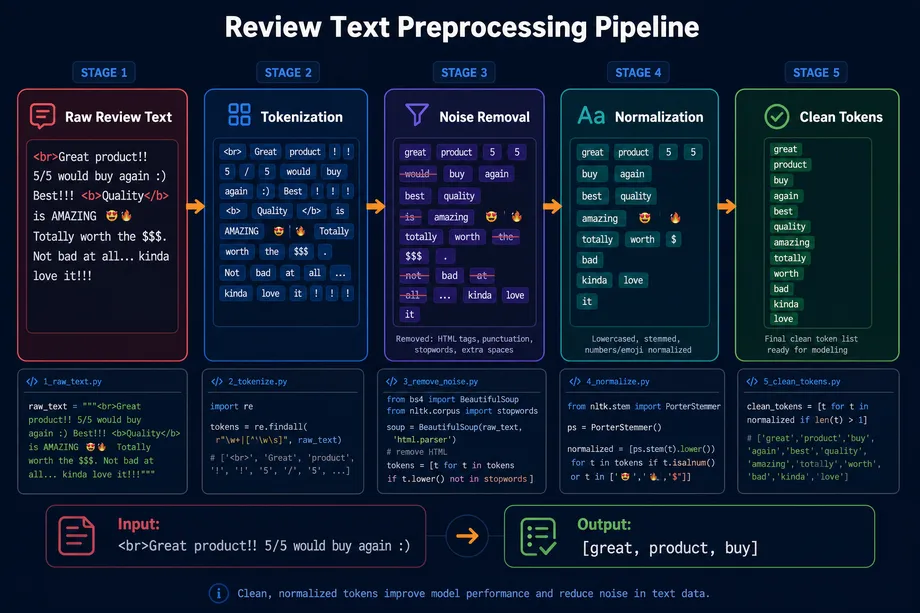
The following Python snippet demonstrates a complete preprocessing function that handles the most common noise patterns found in Amazon review data:
import re
from bs4 import BeautifulSoup
from nltk.corpus import stopwords
from nltk.stem import WordNetLemmatizer
stop_words = set(stopwords.words('english'))
lemmatizer = WordNetLemmatizer()
def preprocess_review(text):
text = BeautifulSoup(text, 'html.parser').get_text()
text = re.sub(r'http\S+', '', text)
text = re.sub(r'[^\w\s]', '', text)
tokens = text.lower().split()
tokens = [lemmatizer.lemmatize(t) for t in tokens
if t not in stop_words and len(t) > 2]
return ' '.join(tokens)
Once the text passes through this pipeline, the resulting clean tokens provide a solid foundation for accurate sentiment scoring. Research consistently shows that proper preprocessing can improve model accuracy by 15-30% on noisy e-commerce text, making this step a non-negotiable part of any serious amazon review mining python project.
Sentiment Analysis with VADER and Transformers
With clean, preprocessed data in hand, the next step is to apply a sentiment analysis model. For amazon review sentiment analysis, there are two primary approaches that complement each other well, each suited for different scales and analytical requirements.
The Rule-Based Approach: VADER
VADER (Valence Aware Dictionary and sEntiment Reasoner) is a lexicon and rule-based sentiment analysis tool that was specifically designed for social media and short, informal texts. It is an excellent choice for Amazon reviews because it is fast, requires no training data, and handles the informal language patterns common in user-generated content.
VADER works by looking up each word in a sentiment dictionary where every entry has a pre-assigned polarity score. It then applies a set of grammatical and syntactical rules to adjust these scores based on context. Critically, VADER understands that "GREAT!!!" is more intensely positive than "great", that "not good" is negative despite containing the positive word "good", and that capitalization signals emphasis. For batch processing tens of thousands of reviews, VADER is the go-to choice for initial sentiment scoring.
from vaderSentiment.vaderSentiment import SentimentIntensityAnalyzer
analyzer = SentimentIntensityAnalyzer()
def get_vader_sentiment(text):
scores = analyzer.polarity_scores(text)
compound = scores['compound']
if compound >= 0.05:
return 'positive'
elif compound <= -0.05:
return 'negative'
else:
return 'neutral'
The Deep Learning Approach: Transformers (BERT/RoBERTa)
While VADER is fast and practical, it has inherent limitations. It can struggle with sarcasm ("Oh great, another product that breaks in a week"), complex negations, and reviews where the overall sentiment is mixed across multiple sentences. For state-of-the-art accuracy, data scientists turn to Transformer models like BERT or RoBERTa, available via the Hugging Face transformers library.
Transformer models understand the context of a word based on its relationship to all other words in the sentence simultaneously. This bidirectional context allows them to correctly interpret subtle language patterns. For example, a Transformer model can correctly identify that "The battery life is not as bad as I expected" is actually a mildly positive statement, whereas a simpler model might flag it as negative due to the presence of "not" and "bad". For high-stakes decisions like identifying critical product defects or validating a new product feature, Transformers provide the nuanced understanding that rule-based systems cannot match.
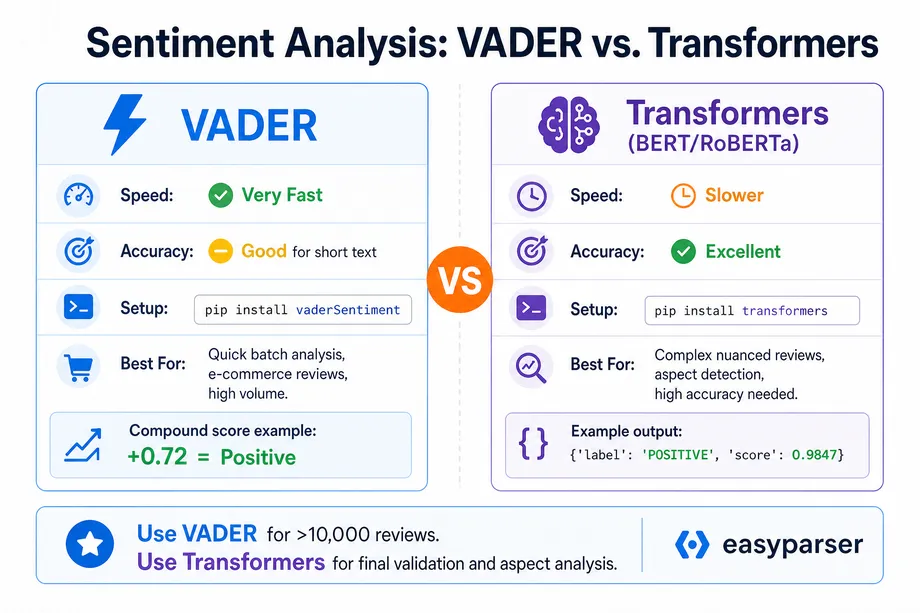
A practical production strategy is to use both models in a tiered approach: run VADER on the full dataset for initial categorization and trend monitoring, then apply a Transformer model to the subset of reviews that VADER classifies as borderline (compound scores between -0.3 and 0.3) to get more reliable labels for the ambiguous cases that matter most.
Aspect-Based Sentiment: Finding Specific Pain Points
A simple overall "positive" or "negative" score for an entire review is often insufficient for actionable product decisions. Consider a review that says: "The sound quality is absolutely incredible, but the battery drains in just 4 hours and the ear cups are uncomfortably tight after 30 minutes." An overall sentiment score might classify this as neutral or slightly negative, completely obscuring the fact that the audio performance is a genuine strength while battery life and comfort are critical weaknesses.
This is precisely where aspect based sentiment amazon analysis becomes indispensable. Aspect-Based Sentiment Analysis (ABSA) breaks the review down into specific product components, known as aspects, and assigns an independent sentiment score to each. For consumer electronics, typical aspects might include sound quality, battery life, build quality, comfort, ease of use, and value for money. For kitchen appliances, they might be performance, ease of cleaning, noise level, and durability.
The implementation of ABSA typically involves two steps. First, aspect extraction identifies which aspects are mentioned in a given review sentence. This can be done using keyword matching for a simple approach, or using a Named Entity Recognition (NER) model for more sophisticated extraction. Second, sentiment classification determines the polarity of the opinion expressed about each identified aspect.
ASPECT_KEYWORDS = {
'battery': ['battery', 'charge', 'charging', 'power', 'drain'],
'sound': ['sound', 'audio', 'bass', 'treble', 'volume'],
'comfort': ['comfort', 'fit', 'ear', 'cushion', 'tight'],
'price': ['price', 'value', 'cost', 'worth', 'expensive']
}
def extract_aspect_sentiments(review_text, analyzer):
results = {}
sentences = review_text.split('.')
for aspect, keywords in ASPECT_KEYWORDS.items():
relevant = [s for s in sentences
if any(kw in s.lower() for kw in keywords)]
if relevant:
scores = [analyzer.polarity_scores(s)['compound']
for s in relevant]
results[aspect] = sum(scores) / len(scores)
return results
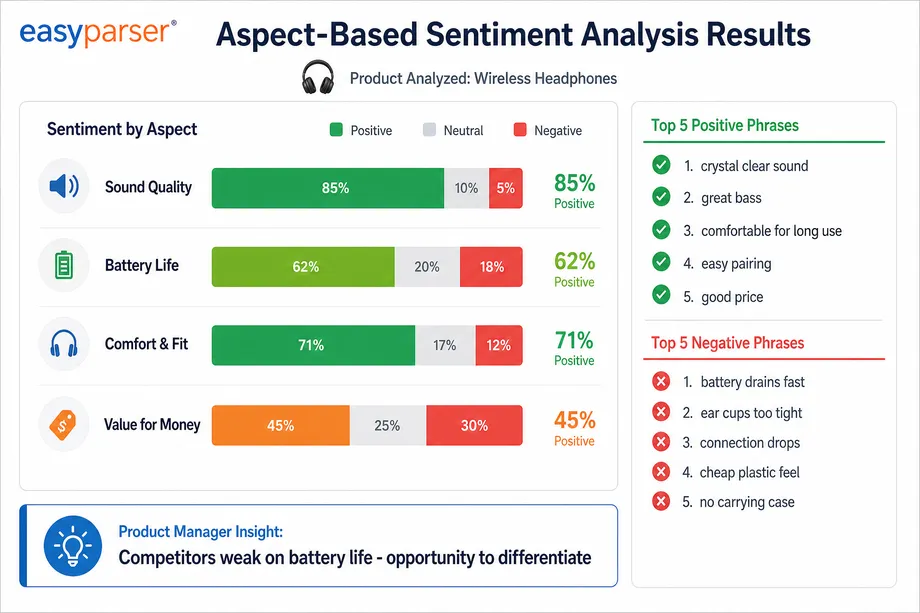
By aggregating these aspect scores across hundreds of reviews, product managers can pinpoint exactly what needs improvement with statistical confidence. If 80% of the negative sentiment in a dataset is driven by the "battery" aspect, the engineering team has a clear, data-backed mandate for where to focus their efforts in the next product iteration.
Competitor Sentiment Comparison
One of the most strategically valuable applications of amazon review sentiment analysis is competitive intelligence. By running the identical NLP pipeline on your competitors' review datasets, you can build a comprehensive map of the competitive landscape based on actual customer perception rather than marketing claims or price points.
The workflow is straightforward. First, identify the ASINs of your top 3-5 competitors. You can use the Product Lookup API to find competitor ASINs by searching for relevant keywords in your category. Next, extract product data for each ASIN using Easyparser. Then, run the same preprocessing and aspect-based sentiment pipeline on each competitor's review dataset. Finally, aggregate the results into a comparative dashboard.
The insights this generates can be transformative. Imagine analyzing three competing wireless headphones and discovering that while Competitor A dominates on sound quality sentiment (85% positive), their battery life sentiment is the lowest in the category (only 58% positive). Competitor B has the worst build quality sentiment (66% positive). No competitor scores above 70% on price sentiment. These are not guesses; they are statistically grounded findings from thousands of real customer reviews.
This kind of analysis directly informs product roadmap decisions, advertising copy, and listing optimization. If you know that the market collectively complains about battery life, and your product genuinely addresses this, that becomes your primary differentiator in your listing title, bullet points, and A+ content. This is the difference between marketing based on assumptions and marketing based on evidence.
Visualizing Insights: Word Clouds and Trend Charts
Raw sentiment scores stored in a database are only useful if they are presented in a format that product managers, marketers, and executives can quickly interpret. Visualization is the final translation layer that converts NLP output into business decisions.
Several visualization types are particularly effective for amazon review insights api workflows. Word clouds offer an immediate visual summary of the most frequent terms in positive versus negative reviews, making it instantly clear what customers are talking about. Generating separate word clouds for 1-star and 5-star reviews often reveals strikingly different vocabularies that directly inform product improvement priorities.
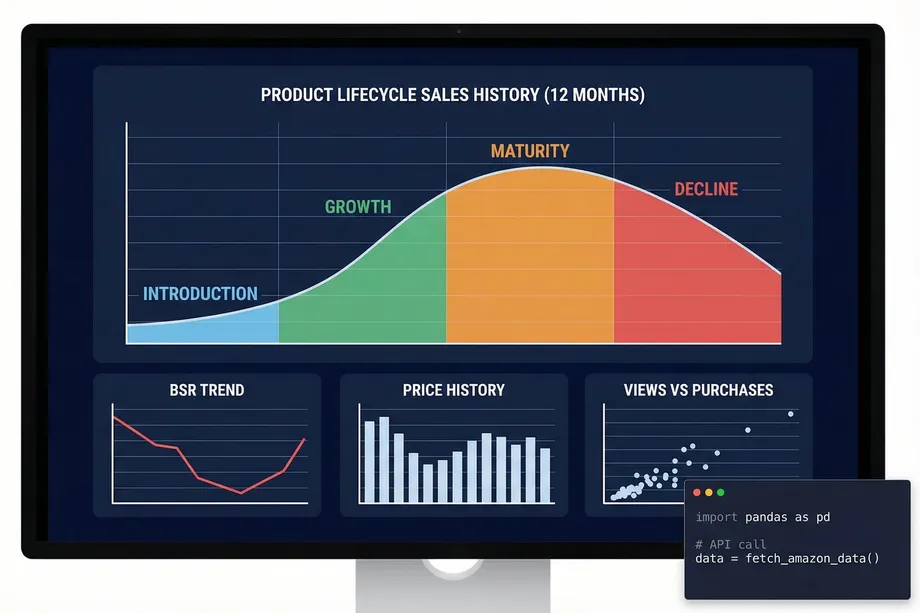
Time-series sentiment charts are invaluable for tracking the impact of product changes over time. By plotting the average sentiment score of reviews by week or month, you can clearly see whether a firmware update improved battery sentiment, or whether a change in packaging materials affected durability perception. This kind of before-and-after analysis provides direct feedback on product decisions.
Aspect radar charts, which plot multiple aspect sentiment scores on a single radial chart, allow for intuitive multi-dimensional comparison between your product and competitors. A quick glance at the radar chart immediately shows which aspects your product leads on and which represent opportunities for improvement.
Automating the Pipeline for Continuous Monitoring
A one-time sentiment analysis is valuable, but the real power of this approach comes from continuous, automated monitoring. Customer sentiment is not static; it shifts in response to product updates, competitor launches, seasonal trends, and even viral social media posts. Building an automated pipeline ensures your team always has current intelligence.
The architecture of an automated amazon review mining python pipeline typically involves a scheduler (such as a cron job or Apache Airflow) that triggers the pipeline on a defined schedule, perhaps weekly for standard monitoring or daily for high-priority products. The pipeline fetches fresh data from Easyparser's Bulk API, which allows you to queue hundreds of product requests in a single asynchronous job, making it highly efficient for monitoring large product portfolios.
The fetched data passes through the preprocessing and sentiment scoring modules, and the results are written to a database such as PostgreSQL or BigQuery. A dashboard tool like Metabase, Tableau, or a custom Plotly Dash application then reads from this database to display up-to-date sentiment trends. Alerting logic can be added to send Slack or email notifications when a product's sentiment score drops below a defined threshold, enabling rapid response to emerging issues before they escalate into significant rating damage.
This continuous monitoring approach transforms amazon review sentiment analysis from a periodic research exercise into an always-on competitive intelligence system. Combined with Easyparser's reliable data infrastructure, it gives data-driven teams a genuine and sustainable advantage in the Amazon marketplace. The result is a scalable, automated intelligence layer that continuously converts raw customer language into strategic product decisions - the kind of capability that separates market leaders from reactive competitors in 2026 and beyond.
Start analyzing Amazon data for free
Start Your Free Trial100 free credits, no credit card required.