In the highly competitive ecosystem of Amazon, simply listing a product is no longer enough. If shoppers cannot see your product when they search, they cannot buy it. This makes visibility the most critical currency for e-commerce success. But how do you measure visibility accurately when search engine results pages (SERPs) are constantly changing and heavily influenced by both organic rankings and paid advertisements? The answer lies in tracking your amazon share of voice.
Amazon Share of Voice (SOV) is a powerful metric that quantifies your brand's presence in search results compared to your competitors. Unlike simple keyword rank tracking, which only tells you where one product sits, SOV provides a holistic view of your market share in terms of visibility across an entire keyword set or product category. This comprehensive guide will walk you through the methodology behind measuring SOV, the crucial differences between organic and sponsored visibility, how to collect keyword-level data using the Easyparser API, and how to build automated dashboards that turn raw data into strategic decisions.
What Is Amazon Share of Voice (SOV) and Why It Matters
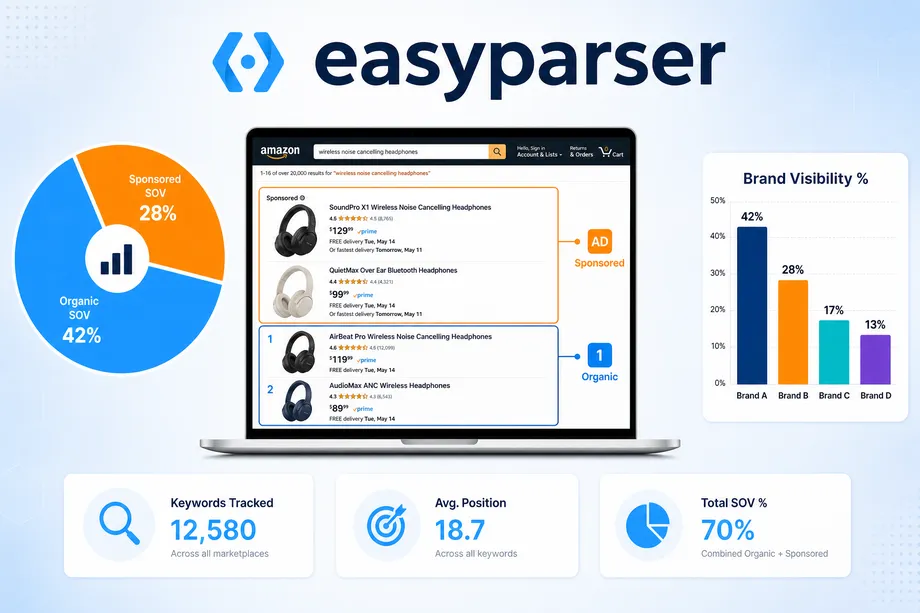
At its core, amazon share of voice tracking measures the percentage of the available "real estate" on an Amazon search results page that your brand occupies for a specific keyword or category. If a shopper searches for "wireless headphones" and your brand appears in 3 out of the top 10 results, your SOV for that top-10 segment is 30%. But this number becomes truly powerful when you compare it against your competitors and track it over time.
Think of the Amazon SERP as a billboard highway. Every position on that highway is a potential customer touchpoint. SOV tells you what percentage of those billboards your brand owns. A competitor with 40% SOV is capturing nearly half of all the attention in that search context, while a brand with 5% SOV is nearly invisible. Understanding this dynamic is the first step toward building a strategy that meaningfully improves your amazon search visibility.
Tracking SOV is essential for several strategic reasons. First, it enables competitive benchmarking by revealing exactly who is winning the battle for attention and where specific competitors are vulnerable. Second, it provides PPC efficiency insights by showing whether your ad spend is translating into a dominant presence or simply blending in with the competition. Third, it validates your SEO efforts by demonstrating whether your listing optimization is successfully improving your amazon organic rankings over time. Finally, and most importantly, visibility is a leading indicator of sales - a growing SOV typically precedes an increase in market share and revenue.
Organic vs Sponsored SOV: Key Differences
To truly understand your amazon search visibility, you must segment your Share of Voice into two distinct categories: Organic and Sponsored. Combining them gives you Total SOV, but analyzing them separately is where the most actionable insights are found.
Organic Share of Voice
Organic SOV measures your presence in the natural, unpaid search results. These rankings are determined by Amazon's A9 algorithm, which favors products with high sales velocity, strong conversion rates, positive reviews, relevant keyword integration, and competitive pricing. High organic SOV is highly desirable because it represents traffic that does not require ongoing ad spend. It is a direct reflection of your product's health, relevance, and overall quality in Amazon's eyes. Building organic SOV is a long-term investment - it takes time to accumulate sales history and reviews, but once established, it provides a stable and cost-efficient foundation for your business.
Sponsored Share of Voice
Sponsored SOV measures your visibility through paid placements, including Sponsored Products, Sponsored Brands, and Sponsored Display ads. This is a direct reflection of your advertising budget and campaign strategy. A high amazon sponsored visibility means you are aggressively paying to be seen, which is often necessary for product launches, seasonal pushes, or highly competitive keywords where organic rankings are difficult to achieve quickly. Sponsored placements typically appear at the top of the page, above the fold, and command a disproportionate share of shopper attention.
The Strategic Interplay Between Organic and Sponsored SOV
Analyzing the interplay between organic and sponsored SOV is where the most nuanced strategic insights emerge. Consider these common scenarios:
- High Sponsored SOV, Low Organic SOV: You are heavily reliant on ad spend to drive visibility. This is common for new products or brands entering a competitive category. The risk is that if you reduce your ad budget, your visibility will collapse. The goal should be to use sponsored visibility to drive sales velocity, which in turn improves organic rankings over time.
- High Organic SOV, Low Sponsored SOV: Your product has strong organic rankings, but you may be leaving sponsored real estate on the table. Competitors could be occupying sponsored positions above your organic listings, intercepting shoppers before they reach your product.
- High Total SOV (Both Organic and Sponsored): This is the ideal state. You own multiple positions on the SERP, both paid and unpaid, maximizing your brand's exposure and making it very difficult for competitors to gain a foothold.
Key Metrics to Track Alongside SOV
Share of Voice does not exist in a vacuum. To build a complete picture of your competitive position, you should track it alongside several complementary metrics. Understanding these relationships allows you to diagnose why your SOV is changing, not just that it is changing.
- Conversion Rate: A high SOV with a low conversion rate suggests that while you are visible, your listing is not compelling enough to convert shoppers. This points to issues with your images, bullet points, pricing, or reviews.
- Click-Through Rate (CTR): Even if you rank highly, a low CTR means shoppers are seeing your listing but choosing a competitor's. This often indicates a weak main image or an uncompetitive price point.
- Buy Box Win Rate: If you are not winning the Buy Box, your sponsored ads may be driving traffic to a competitor's offer on your own listing. Monitoring Buy Box win rate alongside sponsored SOV is critical for accurate performance measurement.
- Review Count and Rating: Products with more reviews and higher ratings tend to have better organic SOV. Tracking these alongside your organic rankings helps you understand the long-term trajectory of your product's visibility.
How to Collect Keyword-Level Ranking Data with the Search API
Calculating accurate amazon visibility analysis requires consistent, daily data collection across hundreds or thousands of keywords. Attempting to do this manually or by building your own scraper is inefficient and prone to failure due to Amazon's frequent layout changes and sophisticated anti-bot measures. The optimal solution is to use a dedicated data extraction API.
The Amazon search results api allows you to programmatically query Amazon search results and receive structured JSON data containing exact rankings, clearly distinguishing between organic and sponsored placements. This is the foundational data source for any serious amazon keyword tracking and SOV calculation system.
Here is an example of how you can use Python to request search result data for the keyword "wireless headphones":
import requests
API_KEY = "YOUR_API_KEY" # Get your key from app.easyparser.com
KEYWORD = "wireless headphones"
params = {
"api_key": API_KEY,
"platform": "AMZ",
"operation": "SEARCH",
"query": KEYWORD,
"domain": "com"
}
response = requests.get("https://realtime.easyparser.com/v1/request", params=params)
data = response.json()
results = data.get("search_results", [])
for item in results[:10]:
title = item.get("title")
is_sponsored = item.get("is_sponsored")
position = item.get("position")
brand = item.get("brand")
print(f"Pos: {position} | Brand: {brand} | Sponsored: {is_sponsored}")
The JSON response from Easyparser clearly flags whether a listing is sponsored and provides its exact position on the page. This structured data is the foundation for building an automated SOV tracking system. By running this request daily for your entire keyword list, you can build a time-series dataset that powers your competitive intelligence dashboard.
Calculating SOV: Formula and Methodology
With your raw keyword-level ranking data in hand, you can now calculate your amazon search presence using several methodologies, each offering a different level of precision.
Basic Unweighted SOV
The simplest method counts the number of times your brand appears and divides it by the total number of products on the page. If your brand appears 3 times in a 10-result page, your SOV is 30%. While easy to calculate, this method treats a position #1 ranking the same as a position #10 ranking, which does not accurately reflect true visibility differences.
Position-Weighted SOV
A more accurate approach assigns a higher weight to top positions. For the top 10 results, you might assign position 1 a weight of 10, position 2 a weight of 9, and so on down to position 10 with a weight of 1. The total available weight is 55. If your brand holds positions 2 (9 points) and 5 (6 points), your weighted SOV would be (15/55) * 100 = 27.2%. This better reflects the reality that higher positions receive exponentially more clicks and impressions.
Real Estate/Fold-Weighted SOV
The most advanced models account for the physical space different placements occupy on the page. A Sponsored Brands banner at the very top of the page commands significantly more attention than a standard organic listing. In this model, you assign specific point values to different module types, such as a Sponsored Brands banner receiving 15 points, a Top of Search Sponsored Product receiving 12 points, and a standard organic result receiving 8 points. This provides the most accurate measure of your brand's true visual dominance on the SERP.
The key principle across all methodologies is consistency. Pick a model, document it clearly, and apply it uniformly across all your keywords and time periods. Inconsistent calculation methods make trend analysis meaningless.
Competitor SOV Analysis
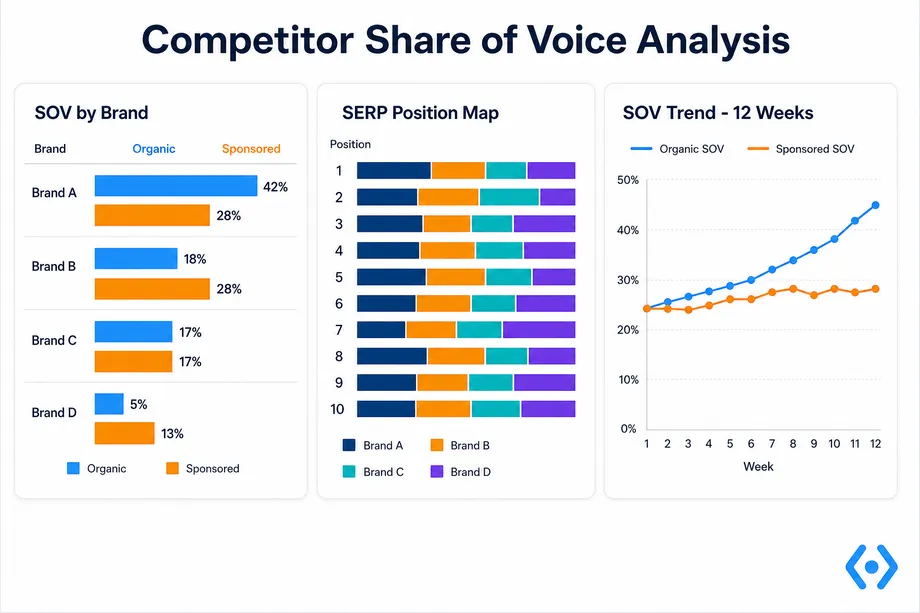
The true power of amazon brand visibility tracking is revealed when you analyze your competitors. By collecting SERP data for your target keywords and identifying which brands appear in each position, you can build a comprehensive competitive SOV matrix.
A competitive SOV analysis should answer these questions: Which competitor dominates organic results for your most important keywords? Which brands are investing heavily in sponsored placements? Are there keywords where no single brand dominates, representing an opportunity for you to gain market share? Are competitors increasing their SOV over time, signaling a more aggressive strategy?
To perform this analysis at scale, extend your data collection script to capture the brand for every result in the SERP, not just your own products. Then aggregate this data across your entire keyword list to produce a category-level SOV report showing the total visibility share for every major brand in your competitive set.
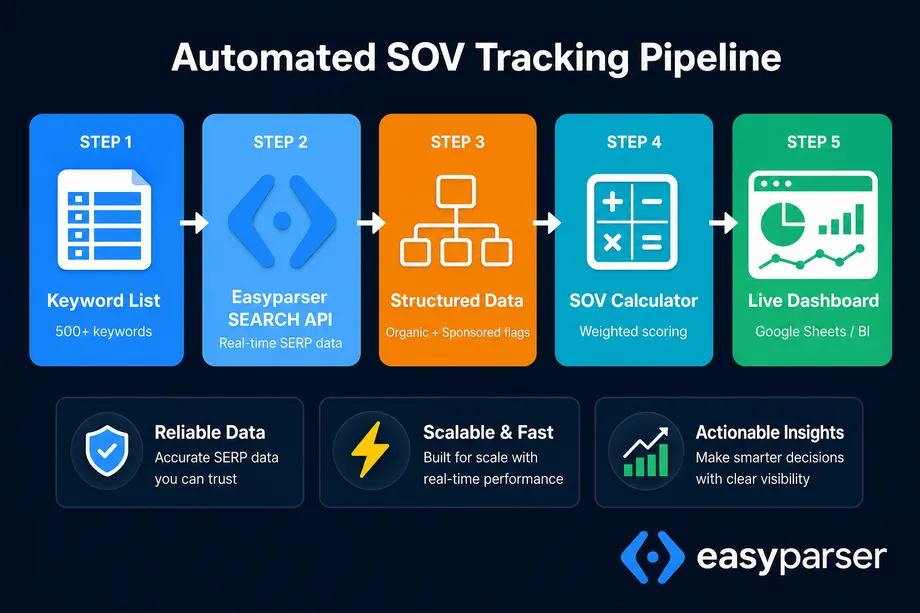
Building an Automated SOV Dashboard in Python or Google Sheets
Once you have a reliable data collection process in place, the next step is to build an automated dashboard that makes your amazon keyword ranking analysis accessible and actionable for your entire team.
Python-Based SOV Calculator
The following script demonstrates how to process raw SERP data from Easyparser and calculate weighted SOV for each brand in the results:
from collections import defaultdict
def calculate_weighted_sov(search_results, top_n=10):
# Calculate position-weighted SOV for each brand.
brand_points = defaultdict(int)
total_points = sum(range(1, top_n + 1))
for item in search_results[:top_n]:
position = item.get("position", top_n)
brand = item.get("brand", "Unknown")
weight = top_n - position + 1
brand_points[brand] += weight
sov_results = {
brand: round((points / total_points) * 100, 1)
for brand, points in brand_points.items()
}
return sorted(sov_results.items(), key=lambda x: x[1], reverse=True)
Google Sheets Integration
For teams that prefer a no-code dashboard, you can push your calculated SOV data directly into Google Sheets using the Google Sheets API. Set up a daily automated run of your Python script that appends a new row to your spreadsheet with the date, keyword, brand, organic SOV, and sponsored SOV. From there, you can use Google Sheets' built-in chart tools to create time-series visualizations that automatically update as new data flows in.
Using SOV Data to Prioritize PPC and SEO Spend
The ultimate goal of amazon search result monitoring is to make smarter business decisions. Here is how to translate your SOV data into concrete strategic actions.
Identify Wasted Ad Spend
If your organic SOV for a specific keyword is consistently above 40% and you are also dominating the sponsored placements, you may be cannibalizing your own organic sales. Try gradually reducing your PPC bids on those terms and monitor whether total sales remain stable. The budget you free up can be redirected to keywords where your organic presence is weak.
Target Competitor Weaknesses
Use your competitive SOV dashboard to find high-volume keywords where a major competitor has a low sponsored SOV. This represents an opportunity to launch aggressive Sponsored Products campaigns to steal market share. Conversely, identify keywords where a competitor has a high sponsored SOV but a low organic SOV - this signals they are spending heavily to compensate for poor organic rankings, which is an expensive and unsustainable position.
Measure Campaign Launch Success
When launching a new product or a new PPC campaign, track your SOV daily. A successful launch should show a rapid increase in sponsored SOV within the first week, followed by a gradual increase in organic SOV over the following weeks as the product accumulates sales history and reviews. If sponsored SOV is high but organic SOV is not growing, it may indicate issues with your listing conversion rate that need to be addressed.
Defend Branded Keywords
One of the most critical applications of SOV tracking is monitoring your branded keywords. If competitors are running Sponsored Products ads targeting your brand name, their sponsored SOV on your branded terms will increase. By tracking this metric, you can detect competitive conquesting early and respond with defensive campaigns before significant traffic is lost.
Ways to Improve Your Share of Voice
Improving your amazon share of voice requires a coordinated effort across both your organic and paid strategies. Simply increasing your ad budget is not enough - you need to ensure that the traffic you drive actually converts, which in turn improves your organic rankings.
Start by auditing your listing quality. Strong main images, compelling titles with relevant keywords, detailed bullet points, and A+ Content all contribute to higher conversion rates, which directly improve your organic rankings and SOV over time. Next, ensure your pricing is competitive. Amazon's algorithm favors products that convert well, and price is one of the primary factors shoppers consider. Regularly analyze your competitors' pricing using the product data api to ensure you remain competitive without sacrificing margin.
On the paid side, focus your Sponsored Products campaigns on the keywords where your organic SOV is weakest. Use broad match campaigns to discover new keyword opportunities, then move high-performing terms to exact match campaigns for more precise control. Sponsored Brands campaigns are particularly effective for increasing above-the-fold visibility and brand awareness, which can improve your overall SOV even for keywords where your individual product rankings are not top-10.
Finally, invest in review generation. Products with more reviews and higher ratings consistently achieve better organic rankings and higher click-through rates. A systematic approach to requesting reviews from verified purchasers is one of the highest-ROI activities for improving long-term organic SOV.
By combining programmatic data collection through Easyparser's SEARCH operation with a disciplined analytical framework, you can transform amazon share of voice from a vague concept into a precise, actionable metric that drives measurable improvements in your market position and revenue. The brands that invest in systematic visibility tracking today are building a significant competitive advantage that will compound over time.
Start monitoring your competitors for free
Start Your Free Trial100 free credits, no credit card required.