For a developer building Amazon software, the first API choice can determine the entire architecture. A repricing dashboard, for example, may need a seller's own inventory and fees, but it may also need public offer prices, competitor sellers, search placement and localized availability. Calling every requirement "Amazon data" hides the important distinction. The real question behind amazon sp api vs easyparser is which source matches the boundary of the data and the action your product must perform.
This guide compares Amazon's Selling Partner API (SP-API) with Easyparser for developers and Amazon sellers. It covers capabilities, limitations, access requirements, data scope, rate limits, pricing, code patterns, Real-Time versus Bulk processing, and the cases where both APIs should be used together. The short answer is not that one replaces the other. They are designed for different sides of the Amazon data boundary.
Amazon SP-API vs Easyparser: Quick Answer
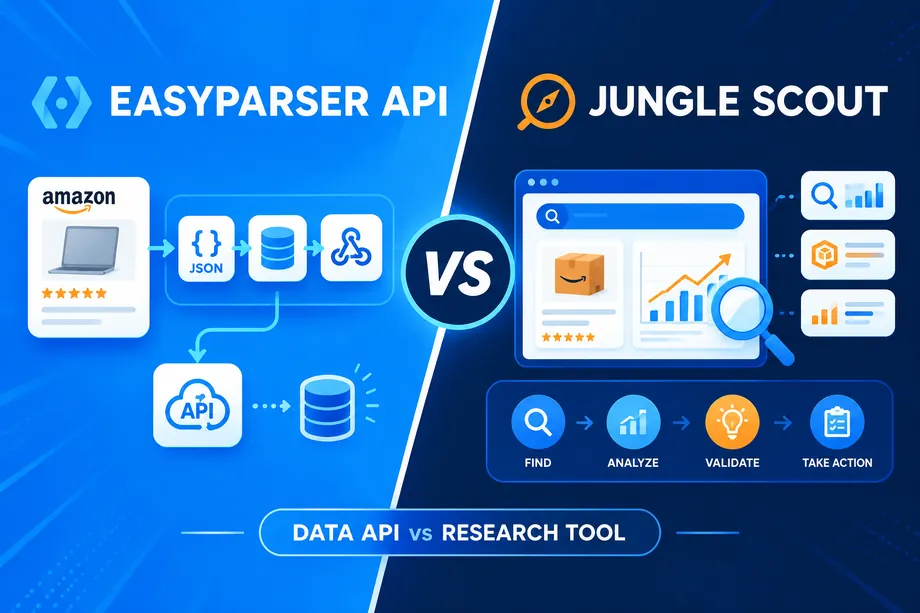
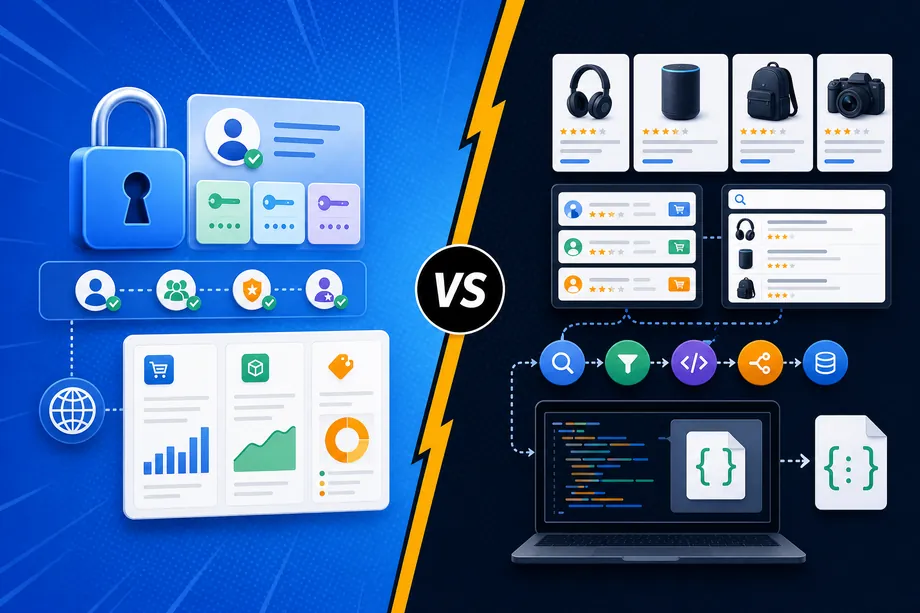
Choose SP-API when your application must read or change an authorized seller or vendor account. Choose Easyparser when it must observe public Amazon pages at product, keyword, offer or seller level. Use both when the product needs private operational truth and public market context.
| Question | SP-API | Easyparser |
|---|---|---|
| What does it serve? | Authorized account operations and reports | Public product and market data |
| How do you start? | Registration, roles and authorization | API key and operation parameters |
| Best scale pattern | Reports, feeds and notifications | Real-Time or Bulk JSON jobs |
| Best fit | Account management | Competitive intelligence and enrichment |
Amazon describes SP-API as a REST-based interface that helps selling partners access data about orders, shipments, payments and more [1]. Easyparser has a different role: it extracts public storefront signals and returns them through Amazon-focused operations. The overlap is real, especially around known ASIN pricing, but the authorization, breadth and developer workflow are not the same.
What Is Amazon SP-API?
SP-API is Amazon's official application interface for selling partners. It is designed around a seller or vendor relationship, a marketplace and a set of approved roles. That makes it the correct foundation for workflows such as reading orders, managing inventory, updating listings, creating feeds, retrieving reports and consuming account notifications.
The SP-API is a REST-based API that helps Amazon selling partners programmatically access their data on orders, shipments, payments, and much more.
Amazon developer documentation. [1]
What SP-API does well
SP-API is strongest when the data belongs to an authorized account or the application must write back to Amazon. A seller operating system can use it to synchronize orders and inventory, submit listing changes, retrieve financial reports, or respond to operational events. These actions require Amazon's permission model because they affect account state, fulfillment or sensitive data.
SP-API can also return competitive pricing information for seller offer listings. Amazon's getCompetitivePricing operation accepts ASIN or seller SKU inputs, allows up to 20 ASINs or SKUs per request, and documents a default usage plan of 0.5 requests per second with a burst of 1 [2]. This is valuable for an authorized pricing workflow, but it is not the same as a broad, public storefront feed for every search result, seller page, promotion or historical market signal.
SP-API limitations developers must plan for
SP-API access is not just an API key. Developers must register, configure an application, request the roles required by its operations and obtain seller or vendor authorization. Public apps add OAuth and Appstore requirements; private seller apps require a professional selling account [3]. Restricted data may require extra roles and security controls.
Rate limits are also architectural constraints. Amazon uses a token-bucket model, with limits shaped by the operation, selling partner/application pair, region, store and sometimes business context. Some limits are dynamic. A production client needs 429 backoff, header inspection, batching, notifications and careful retry control instead of a simple loop [4].
What Is Easyparser?
Easyparser is a purpose-built Amazon data extraction API for developers, sellers and analysts. It turns public product and marketplace pages into structured JSON without requiring every team to maintain Amazon-specific parsers, proxy infrastructure, CAPTCHA handling and page-change fixes.
Its operation model maps closely to common e-commerce questions. Product Detail is suited to title, brand, price, stock, ratings, reviews, categories and product enrichment. Product Offer focuses on sellers, offer prices, fulfillment, shipping and Buy Box context. Product Lookup connects external identifiers such as UPC, EAN or GTIN to Amazon product data.
Other documented operations include SEARCH, SALES_ANALYSIS_HISTORY, BEST_SELLERS_RANK, PACKAGE_DIMENSION, SELLER_PROFILE and SELLER_PRODUCTS. Together, they support a path from keyword discovery to ASIN enrichment, offer monitoring, rank tracking, historical analysis and logistics planning.
The domain parameter uses only a top-level extension such as .com, .co.uk or .de. Address Targeting can add a delivery location so the returned price, availability and shipping context better reflect a target customer. This is important when a decision depends on what a shopper sees in a particular market.
SP-API and Easyparser: What Each Can Access
The most useful way to compare amazon sp api vs easyparser is to classify the question before comparing an endpoint. The same ASIN may appear in both systems, but the record has a different meaning because one system is account-authorized and the other observes a public storefront.
| Requirement | Best source | Why |
|---|---|---|
| Orders, inventory and listing updates | SP-API | Authorized account operations. |
| Public product and offer data | Easyparser | Consumer-facing storefront signals. |
| Known-ASIN competitive pricing | Either, by scope | SP-API is authorized and rate-limited; Easyparser is built for public extraction. |
| Keyword discovery, rank and history | Easyparser | Catalog and market-intelligence operations. |
| Write actions in Seller Central | SP-API | Easyparser is not a write-back replacement. |
One correction matters for technical accuracy: it is too absolute to say SP-API can never return competitor-related pricing. Amazon documents pricing operations for seller offer listings. The better limitation is that SP-API is not a low-friction, catalog-wide replacement for observing public search pages, seller storefronts, localized product pages, historical signals or every consumer-facing promotion.
Authentication: SP-API Setup vs Easyparser API Key
SP-API authentication connects a developer, application, Amazon authorization and selling partner. Registration, roles and application configuration come before production access; public apps also use the relevant seller or vendor authorization flow. A missing role can cause a 403 response [5].
Easyparser uses an account API key plus platform, operation and marketplace parameters. That shorter path is useful for prototyping public data, while secure key storage and responsible data use remain essential. In the amazon sp api vs easyparser decision, choose the authentication model that matches ownership: SP-API for account control, Easyparser for public market observation.
Use Case Matrix: Which API Fits Which Job?
For account questions such as orders, inventory, listing updates and fulfillment, use SP-API. For public questions such as competitor price changes, keyword visibility, rank movement, seller offers and market signals, use Easyparser. For daily catalog refreshes, use Easyparser Bulk, or combine it with SP-API reports and notifications when owned-account data is also required.
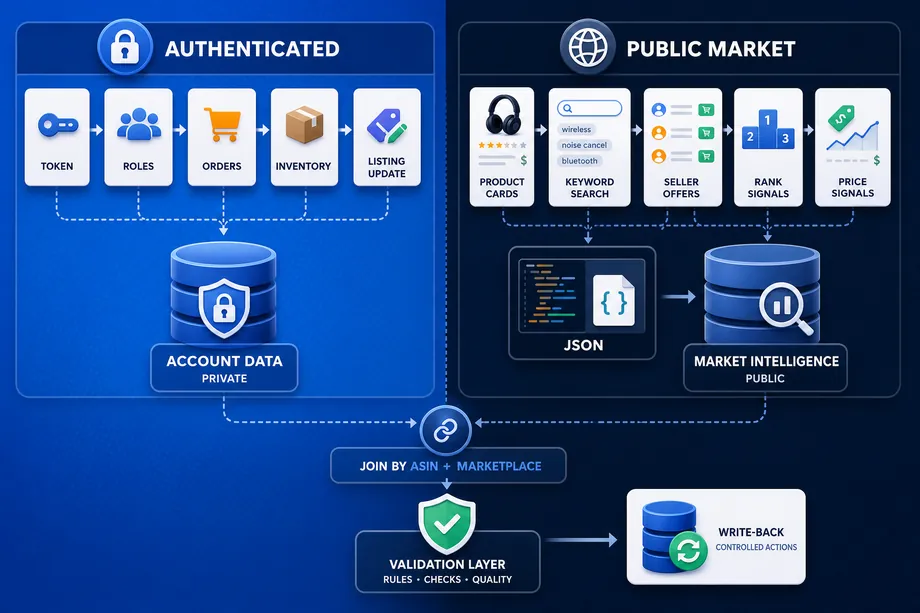
This matrix also explains why many seller tools should split their architecture into an account service and a market-intelligence service. The first owns SP-API credentials and account actions. The second owns public-data ingestion, Easyparser jobs, caching and market analytics. Joining them by ASIN or SKU is useful; pretending they are the same source is not.
Combining SP-API and Easyparser in One Pipeline
A hybrid pipeline is often the most practical answer to amazon sp api vs easyparser. A repricing system can take the seller's own SKU, inventory, fees and account constraints from SP-API, then add public offer prices, competitor sellers, search visibility and localized availability from Easyparser. A decision service can join the records by ASIN while preserving source, timestamp and marketplace.
Separate observation from action. Store raw responses with a request ID and source. Normalize price, currency, seller, fulfillment and availability into a common schema. Apply business rules such as margin floors and minimum stock. Then put validation or human approval before any high-impact write-back to Seller Central. A failed market-data request should not automatically change a seller account.
Real-Time API vs Bulk API
Easyparser Real-Time is synchronous: the client sends a request and receives structured JSON in the same transaction. It suits dashboards, trigger-based checks, product pages, testing and any feature that needs one answer now. The documentation describes a 15-second maximum response timeout and plan-specific rate limits.
Easyparser Bulk is asynchronous: the client submits a batch, receives result IDs, waits for processing, receives a webhook notification and retrieves the parsed data through the Data Service. One bulk request can contain up to 5,000 items. The webhook confirms readiness; it does not carry the full parsed payload. This is a strong pattern for daily catalog refreshes and large competitor scans.
Easyparser Real-Time Python example
import requests
params = {
"api_key": "YOUR_API_KEY",
"platform": "AMZ",
"operation": "DETAIL",
"domain": ".com",
"asin": "B098FKXT8L",
"output": "json"
}
response = requests.get("https://realtime.easyparser.com/v1/request", params=params, timeout=20)
response.raise_for_status()
print(response.json())
Easyparser Bulk Python example
import requests
batch = [{
"platform": "AMZ",
"operation": "DETAIL",
"domain": ".com",
"payload": {
"asins": ["B098FKXT8L", "B0F25371FH"]
},
"callback_url": "https://yourdomain.com/webhook"
}]
response = requests.post("https://bulk.easyparser.com/v1/bulk",
headers={"api-key": "YOUR_API_KEY"}, json=batch, timeout=30)
response.raise_for_status()
print(response.json()["data"]["accepted"])
Use Real-Time when latency is the feature. Use Bulk when throughput and background processing matter. The two modes can feed the same normalized schema.
Cost Comparison: Current Fees and Credit Economics
Do not compare only the advertised request price. Add authentication work, AWS or proxy infrastructure, retries, parser maintenance, data normalization, storage and monitoring. These are part of total cost of ownership.
Amazon's current official announcement says it will not move forward with the previously announced third-party SP-API annual and usage fees at this time [6]. The old proposal should therefore not be presented as a current charge. SP-API still has engineering and operational costs because teams must implement permissions, rate-limit handling, retries and account security.
Easyparser publishes a credit model in which 1 credit equals 1 successful product result. Its pricing page lists a free monthly allocation and paid tiers such as $49 for 100,000 credits, $150 for 350,000 and $300 for 750,000, with Real-Time and Bulk access on the listed plans. That makes the budget question concrete: how many successful results does the workflow need, and how much engineering would an in-house alternative consume?
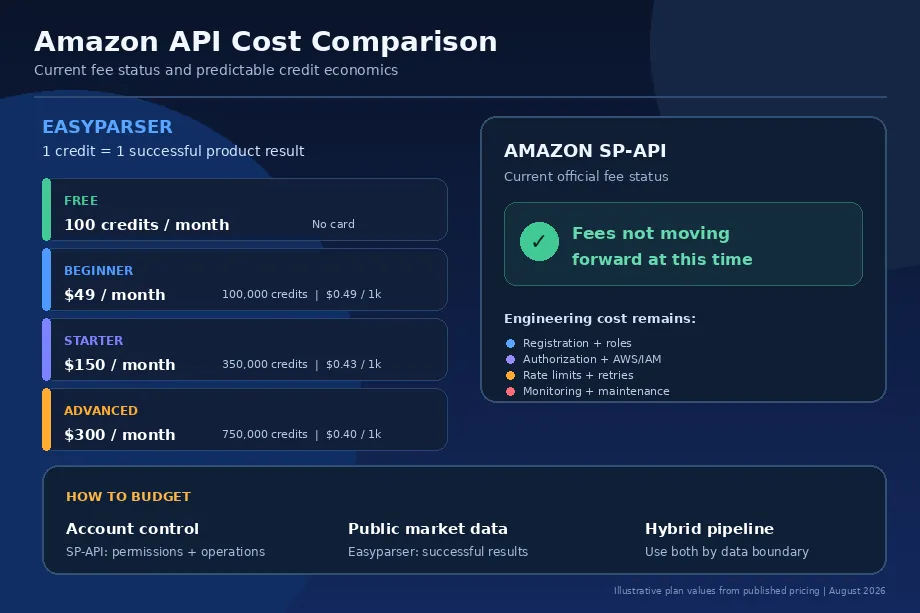
SP-API cost: Amazon says the previously announced third-party annual and usage fees will not move forward at this time, but registration, authorization, AWS, retries, rate-limit handling and maintenance still have engineering cost. Easyparser cost: published plans use a simple credit model, where 1 credit equals 1 successful product result, so teams can budget by expected output volume and compare it with the cost of building and maintaining extraction infrastructure.
Decision Guide by Persona
Use SP-API first for orders, inventory, listings, fees, reports, feeds or any action that changes an authorized seller or vendor account.
Use Easyparser first for public keywords, ASINs, product URLs, seller storefronts, offers, rank signals, sales-history signals and logistics research.
Use both when a seller operating system needs private account truth and public market context. Keep credentials and source fields separate, then join records only after normalizing ASIN, marketplace, currency and timestamp.
How to Test Before Committing
Run a small, representative test before committing. Define whether the feature reads an account, changes an account, observes public data, or combines all three. Then test an owned ASIN, a competitor ASIN, a keyword and one batch, recording fields, latency, failures, retries, output cost and engineering effort. The result should assign account actions to SP-API and public market intelligence to Easyparser.
Conclusion
The best answer to amazon sp api vs easyparser depends on what your application is allowed to know and what it must be able to do. SP-API is the official, authenticated route for seller and vendor operations, account data, reports, feeds, notifications and authorized pricing workflows. Easyparser is the direct route for public product, offer, search, seller and market signals returned as developer-friendly JSON.
Choose SP-API when the system must operate on an Amazon account. Choose Easyparser when it must understand the public marketplace at product or catalog scale. Choose both when the product needs both responsibilities. Clear source ownership, timestamps, validation and responsible data handling will make that architecture easier to maintain than a single API forced to cover every use case.
Try the best-rated Amazon API for free
Start Your Free Trial100 free credits, no credit card required.