When you need Amazon product data at scale, the tool you choose defines not just your costs, but your entire development workflow. Two names come up frequently in this space: Apify, a powerful general-purpose web scraping platform, and Easyparser, a dedicated Amazon scraping API. At first glance, both promise to deliver structured Amazon data. But the underlying architectures are fundamentally different, and those differences have real consequences for developers, sellers, and data teams who depend on reliable, predictable pipelines.
This comparison of easyparser vs apify cuts through the marketing to examine what each platform actually delivers for Amazon-specific use cases in 2026: how they work, what they cost, how long they take to set up, and where each one is likely to let you down.
How Apify Works: The Actor Marketplace Model
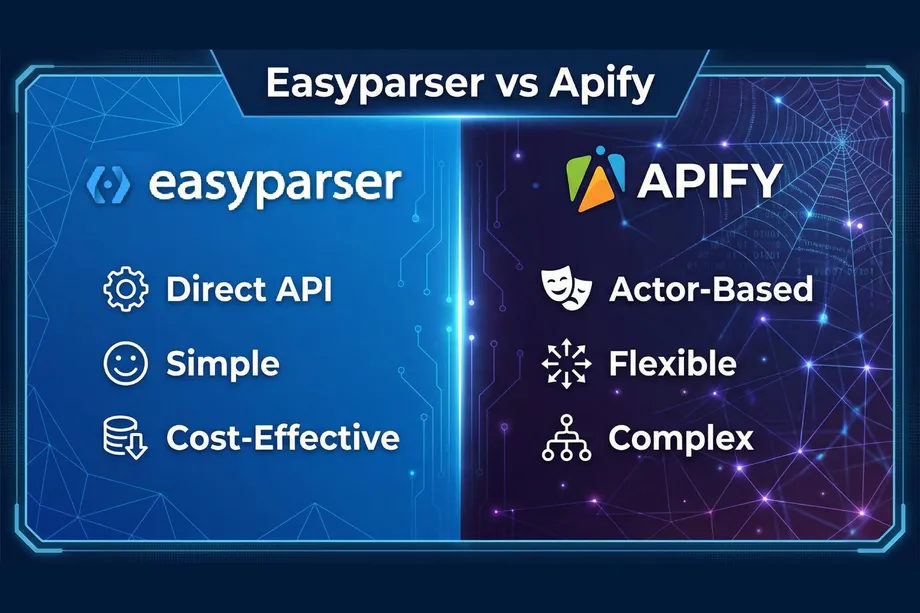
Apify is built around a concept called Actors, small, containerized programs that run in the cloud and perform specific scraping or automation tasks. Apify hosts a marketplace of over 1,500 of these Actors, many of which are created and maintained by third-party developers from the community. When you want to scrape Amazon data, you browse this marketplace, find an Actor that seems to match your needs, configure it, and run it.
On paper, this model is appealing. The breadth of available Actors is genuinely impressive, and the platform infrastructure is robust. Apify handles proxy management, scheduling, and result storage. For a developer who needs to scrape dozens of different websites, having one platform with pre-built tools for each is a compelling proposition.

The Practical Reality of Using Apify for Amazon
The Actor marketplace model introduces a set of challenges that become apparent as soon as you move beyond a simple proof-of-concept. The first challenge is Actor selection paralysis. A search for "Amazon" in the Apify Store returns dozens of results: Amazon Product Scraper, Free Amazon Product Scraper, All-in-One Amazon Scraper, Amazon ASINs Scraper, Amazon Reviews Scraper, Amazon Seller Scraper, and many more. Each has a different developer, a different pricing model, a different data schema, and a different maintenance history. Choosing the right one requires significant research, and there is no guarantee the one you choose will still be actively maintained six months from now.
The second challenge is data inconsistency. Because each Actor is an independent project, the JSON structure of the data it returns is not standardized across the platform. If you switch from one Amazon Actor to another (perhaps because your first choice became unreliable), you may need to rewrite significant portions of your data pipeline to accommodate the new schema. Users on Apify's own issue tracker have reported problems ranging from inaccurate data to Actors that silently return fewer results than requested, with no error message to indicate something went wrong.
The third challenge is the learning curve. To use Apify effectively for Amazon scraping, you need to understand not just the Actor's input parameters, but also Apify's Compute Unit (CU) pricing model, proxy configuration options, dataset storage, and the Actor's specific quirks. This is a significant time investment before you can even make your first reliable production request.
Apify's Pricing: A Multi-Layer Cost Structure
Understanding what Apify will actually cost you for Amazon scraping is genuinely difficult. The platform uses a layered pricing model with several independent cost components that stack on top of each other.
The first layer is the platform subscription. Apify's paid plans start at $29/month for the Starter tier and go up to $499/month for the Business tier. Each plan includes a certain amount of platform credits, but these credits are consumed by Compute Units, not by the number of results you receive.
The second layer is the Actor fee. Many of the most capable Amazon Actors in the marketplace charge a separate per-result fee on top of the platform subscription. The popular "Free Amazon Product Scraper" by Junglee, despite its name, charges from $6.20 per 1,000 results. Another well-regarded Actor charges $3.00 per 1,000 results for detailed product data. These fees are paid directly to the Actor developer and are separate from your Apify subscription.
The third layer is the Compute Unit cost. Even after paying the Actor fee, your platform credits are consumed based on the computational resources the Actor uses: memory, CPU, and time. Scraping 1,000 Amazon products typically consumes between 2 and 5 Compute Units, which at the Starter plan rate of $0.30/CU adds another $0.60 to $1.50 to your cost. This number varies significantly based on the Actor's efficiency and Amazon's anti-bot responses on any given day.
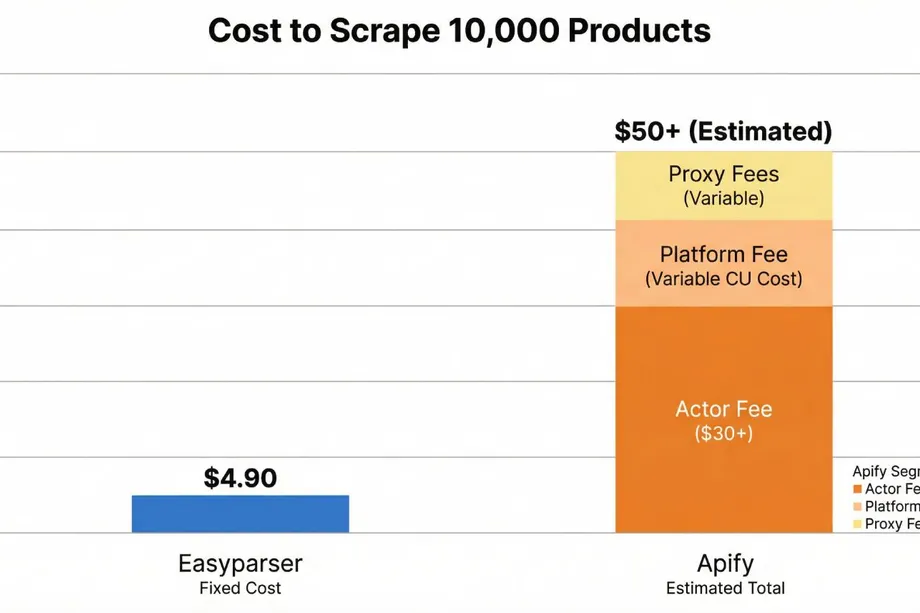
The result is a cost structure that is nearly impossible to predict in advance. A team trying to budget for scraping 50,000 Amazon products per month faces a calculation with multiple unknown variables. This unpredictability is one of the most common complaints from developers who have evaluated Apify as an apify alternative for dedicated Amazon work.
How Easyparser Works: A Dedicated Amazon API
Easyparser takes a fundamentally different approach. Rather than a general-purpose platform with community-built tools, Easyparser is a single, purpose-built API designed exclusively for Amazon data extraction. There is no Actor marketplace to navigate, no community developers to trust, and no schema inconsistencies between different tools. There is one API, one team maintaining it, and one consistent JSON response format across all operations.
The API covers the full spectrum of Amazon data needs through a set of named operations: DETAIL for product pages, OFFER for seller and pricing data, SEARCH for keyword and category listings, SALES_ANALYSIS for historical sales data, BSR for Best Sellers Rank tracking, PACKAGE_DIMENSION for FBA logistics data, PRODUCT_LOOKUP for UPC/EAN to ASIN conversion, SELLER_PROFILE for seller information, and more. Each operation is called through the same endpoint with the same authentication pattern.
Easyparser's Pricing: 1 Credit = 1 Result
Easyparser's pricing model is the direct opposite of Apify's complexity. The principle is stated plainly on their pricing page: 1 credit = 1 product result. There are no Compute Units, no Actor fees, no proxy surcharges, and no hidden multipliers. If you need 10,000 product details, you use 10,000 credits. The cost of those 10,000 credits is fixed and known before you make a single request.
Easyparser's plans start at $49/month for 100,000 credits (approximately $0.49 per 1,000 results), scaling to $150/month for 350,000 credits ($0.43/1,000) and $300/month for 750,000 credits ($0.40/1,000). A free demo plan provides 100 credits per month with no credit card required, making it straightforward to test the API before committing.
Comparing these numbers directly to Apify's layered costs is instructive. To scrape 10,000 Amazon products with detailed data using a mid-tier Apify Actor, you might pay $30 in Actor fees alone (at $3.00/1,000), plus $3-7.50 in Compute Unit costs, plus a portion of your monthly subscription. With Easyparser, the same 10,000 results cost $4.90 at the Beginner plan rate, a total cost that is fixed, predictable, and significantly lower.
Feature-by-Feature Comparison
| Feature | Easyparser | Apify |
|---|---|---|
| Platform Type | ✅ Dedicated Amazon API | âš ï¸ General-purpose scraping platform |
| Setup Time | ✅ Minutes (single API key) | âš ï¸ Hours to days (Actor selection + config) |
| Pricing Model | ✅ 1 credit = 1 result (transparent) | âš ï¸ Subscription + CU + Actor fee (complex) |
| Cost for 10,000 results | ✅ ~$4.90 (fixed) | âš ï¸ $33–$50+ (variable, estimated) |
| Data Schema Consistency | ✅ Unified JSON across all operations | âš ï¸ Varies by Actor and developer |
| Amazon-Specific Operations | ✅ Sales History, BSR, Package Dimensions | ⌠General scraping only |
| Bulk API | ✅ Up to 5,000 URLs per request | ✅ Yes (via Actor runs) |
| Anti-Bot Handling | ✅ Built-in, managed by Easyparser | âš ï¸ Depends on Actor quality |
| Cost Predictability | ✅ Fully predictable | ⌠Difficult to predict |
| Free Trial | ✅ 100 credits/month, no card required | ✅ $5 platform credit |
Use Case Analysis: Who Benefits from Each Platform?
For Amazon Sellers: Competitive Intelligence and Inventory Management
Amazon sellers who need to monitor competitor pricing, track Buy Box winners, or analyze sales velocity have very specific data requirements. They need the OFFER operation to see all active sellers and their prices, the SALES_ANALYSIS operation to understand historical demand patterns, and the PACKAGE_DIMENSION operation to calculate FBA fees accurately. These are not generic web scraping tasks; they are Amazon-specific data products that require deep knowledge of Amazon's data structures.
Easyparser's dedicated operations for each of these use cases mean a seller can build a complete competitive intelligence system with a single API integration. With Apify, a seller would need to find, evaluate, and potentially combine multiple Actors, and accept that the data schemas between them will not be consistent.
For sellers monitoring hundreds or thousands of ASINs daily, the cost difference is also significant. A seller tracking 5,000 products twice daily (10,000 requests/day, ~300,000/month) would pay $150/month with Easyparser's Starter plan. The equivalent Apify setup, accounting for Actor fees and Compute Units, would likely cost several times more.
For Developers: Integration Speed and Maintenance Burden
Developers integrating Amazon data into applications, dashboards, or automated workflows care about two things above all else: how quickly they can get a working integration, and how much ongoing maintenance it requires. On both counts, a dedicated API has a structural advantage over a platform-based approach.
With Easyparser, the integration path is straightforward: obtain an API key, read the documentation for the specific operation you need, and make a request. The response schema is documented, consistent, and will not change without notice. There are no Actor-specific quirks to learn, no community forum posts to read to understand undocumented behavior, and no risk that the tool you depend on will be deprecated by its third-party developer.
The following example demonstrates how simple a product detail request looks with Easyparser:
import requests
params = {
"api_key": "YOUR_API_KEY",
"platform": "AMZ",
"operation": "DETAIL",
"domain": ".com",
"asin": "B0CJB6V2L5"
}
response = requests.get("https://realtime.easyparser.com/v1/request", params=params)
data = response.json()
For bulk operations, Easyparser's Bulk API accepts up to 5,000 ASINs in a single request and supports webhook callbacks so your system is notified automatically when the job completes, rather than requiring polling:
import requests
HEADERS = {"api-key": "YOUR_API_KEY", "Content-Type": "application/json"}
payload = {
"platform": "AMZ",
"operation": "DETAIL",
"domain": ".com",
"payload": {
"asins": [
"B0DQY6J9TL",
"B0CF3VGQFL"
]
},
"callback_url": "https://example.com/webhook"
}
response = requests.post(
"https://bulk.easyparser.com/v1/bulk",
headers=HEADERS,
json=payload
)
When Apify Makes Sense
This comparison is not meant to suggest that Apify has no legitimate use cases. For teams that need to scrape a wide variety of websites beyond Amazon (social media platforms, job boards, real estate listings, news sites), Apify's Actor marketplace provides genuine value. The breadth of pre-built tools for diverse scraping tasks is unmatched, and the platform infrastructure is mature and reliable.
Apify is also a reasonable choice for developers who need to build custom scraping logic and want a managed cloud environment to run it in. The platform's SDK (Crawlee) is well-regarded in the developer community, and the ability to publish and monetize your own Actors is a unique feature. If Amazon data is only a small part of a broader, multi-site scraping operation, Apify's general-purpose capabilities may justify its complexity and cost.
The case for Apify weakens considerably, however, when Amazon data is the primary or exclusive use case. In that scenario, the platform's generality becomes a liability rather than an asset, and the cost and complexity overhead is difficult to justify against a dedicated alternative.
Try the best-rated Amazon API for free
Start Your Free Trial100 free credits, no credit card required.