Introduction: The Quest for Reliable Amazon Data
In the sprawling, hyper-competitive marketplace of Amazon, data is the lifeblood of success. Whether you're a seller optimizing listings, a brand tracking competitor performance, or an analyst forecasting market trends, your decisions are only as good as the data that fuels them. However, accessing accurate, real-time, and comprehensive Amazon data at scale is a significant technical challenge. This is where Amazon scraping APIs come into play, promising to handle the complexities of data extraction. Two prominent names in this space are Easyparser and ScraperAPI, but they offer vastly different approaches. This 2026 comparison will dissect every facet of the easyparser vs scraperapi debate, from features and pricing to performance and data quality, to reveal which solution truly delivers for businesses focused on Amazon.
Feature Comparison: Easyparser vs ScraperAPI Head-to-Head
At first glance, both Easyparser and ScraperAPI seem to solve the same problem, but a deeper look reveals fundamental differences in their core philosophy and capabilities. When evaluating easyparser vs scraperapi, the most important distinction is this: Easyparser is a purpose-built, Amazon-first data extraction engine, whereas ScraperAPI is a general-purpose web scraper that can be pointed at any website, including Amazon.
| Feature | Easyparser | ScraperAPI |
|---|---|---|
| Core Functionality | Amazon-Specific Data API | General Web Scraper |
| Exclusive Data Endpoints | ✅ Sales Analysis & History, Package Dimension | ⌠None |
| Real-Time API | ✅ (~7.5s response) | ✅ (Variable, ~40s+) |
| Bulk (Async) API | ✅ | ✅ |
| Success Rate | ~98.2% | ~97% (Varies) |
| JS Rendering | Handled Automatically | ✅ (Costs extra credits) |
| Proxy Management | Automatic & Included | Automatic & Included |
| Geotargeting | ✅ (Country, City, ZIP) | ✅ (Country-level only on Business+) |
| Structured Data Output | JSON | JSON |
The Decisive Factor: Pricing and Credit System Transparency
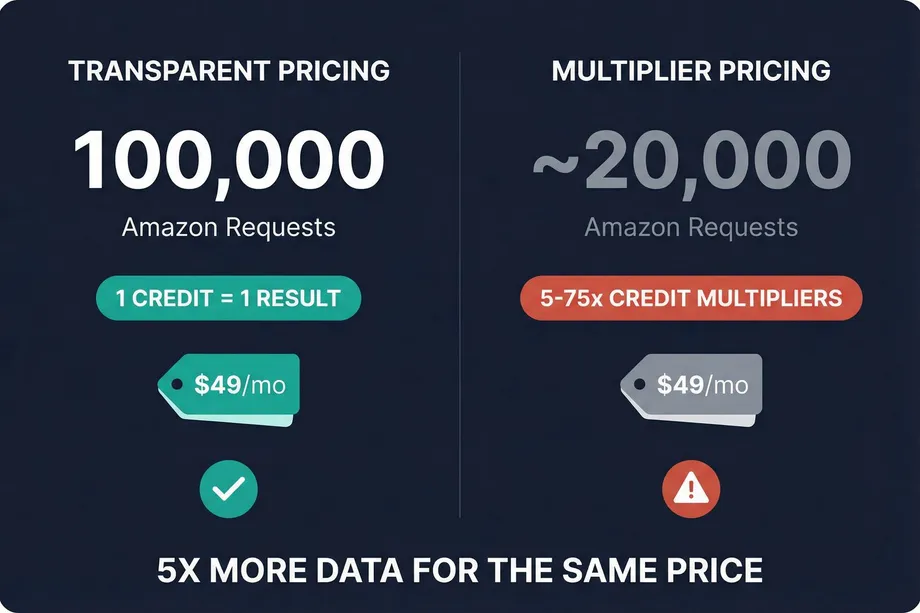
Perhaps the most significant differentiator in the easyparser vs scraperapi comparison lies in their pricing models. ScraperAPI employs a complex, multi-layered credit system that can be opaque and lead to unpredictable costs. A single request to Amazon consumes a base of 5 credits, but this can quickly escalate to 25, 30, or even 75 credits if you need to render JavaScript or use their premium proxies to bypass blocks. This makes accurate cost forecasting a significant challenge.
Easyparser, in stark contrast, operates on a simple, transparent, and honest 1:1 credit model. One credit equals one successful product data extraction. There are no hidden multipliers or confusing surcharges for essential features. This straightforward approach means you know exactly what you're paying for and can scale your data operations with predictable costs.
Let's break down the real-world impact with a direct comparison of their entry-level paid plans, both priced at $49 per month:
| Plan | Price | API Credits | ScraperAPI (Effective Amazon Requests) | Easyparser (Effective Amazon Requests) |
|---|---|---|---|---|
| Hobby / Beginner | $49/mo | 100,000 | ~20,000 (at 5 credits/req) | 100,000 |
The numbers speak for themselves. For the exact same price, Easyparser delivers 5 times more Amazon data than ScraperAPI. For businesses where data volume is critical, this is not just a minor difference-it's a game-changer.
Technical Deep Dive: API Performance and Developer Experience
Beyond pricing, the developer experience and API performance are critical factors in any easyparser vs scraperapi evaluation. Here, the specialized nature of Easyparser provides a distinct advantage.
Easyparser: Built for Amazon, Built for Speed
Because Easyparser is engineered exclusively for Amazon, its infrastructure is highly optimized for the platform's unique architecture. This results in consistently faster response times, averaging around 7.5 seconds for real-time requests. The API is intuitive, with clear documentation and predictable JSON outputs tailored to Amazon data structures. Here’s how simple it is to fetch product data with Python:
import requests
import json
# Set up the request parameters
params = {
"api_key": "YOUR_API_KEY",
"platform": "AMZ",
"operation": "DETAIL",
"domain": ".com",
"asin": "B0CJB6V2L5"
}
# Make the http GET request to Easyparser API
api_result = requests.get("https://realtime.easyparser.com/v1/request", params)
# Print the JSON response
print(json.dumps(api_result.json(), indent=2))
ScraperAPI: A Generalist's Approach
ScraperAPI’s one-size-fits-all approach means it must contend with the anti-bot measures of countless websites, not just Amazon. This can lead to slower and more variable performance. Benchmarks have shown average response times for Amazon requests hovering around a sluggish 40 seconds. While functional, the code is slightly more verbose, requiring you to construct the target URL yourself.
import requests
# Set up the request parameters
payload = {
"api_key": "YOUR_API_KEY",
"url": "https://www.amazon.com/dp/B0CJB6V2L5"
}
# Make the http GET request to ScraperAPI
response = requests.get("http://api.scraperapi.com", params=payload)
# Print the HTML response
print(response.text)
The Unfair Advantage: Easyparser’s Exclusive Amazon Data Channels
The discussion of easyparser vs scraperapi becomes truly one-sided when you consider the data channels that Easyparser offers exclusively. These are not just minor features; they are powerful tools for strategic decision-making that general-purpose scrapers simply cannot replicate.
- Sales Analysis & History: This is Easyparser’s crown jewel. Gain access to historical sales data, traffic metrics, and conversion rates for products. This allows you to analyze seasonality, track launch performance, and understand a product's true market velocity-insights that are impossible to get from a simple product page scrape.
- Package Dimension: For FBA sellers, shipping costs are a major factor. Easyparser provides verified package dimensions and weight, enabling precise FBA fee calculations and preventing costly logistical errors.
These Amazon-centric endpoints demonstrate a deep understanding of what Amazon sellers and brands actually need, moving beyond basic data scraping into the realm of actionable business intelligence.
Easyparser offers many more specialized operations beyond the ones highlighted here, each with structured JSON responses tailored for Amazon data. To explore the full list of available endpoints, see detailed parameter descriptions, and review real response examples, visit the Easyparser Amazon scraper page.
Conclusion: The Clear Winner for Amazon Data Extraction
While ScraperAPI is a functional tool for general web scraping, it falls short when pitted against a specialized, Amazon-focused solution. In the easyparser vs scraperapi matchup, Easyparser emerges as the undisputed winner for any business that relies on Amazon data. The easyparser vs scraperapi decision becomes straightforward once you consider the full picture. Its transparent 1:1 credit system provides up to 5x more data for the same price, its performance is faster and more reliable, and its exclusive data channels like Sales Analysis & History offer strategic insights that ScraperAPI cannot touch. If you need to scrape data from a dozen different websites, a generalist tool might suffice. But if your focus is Amazon, the choice is clear: Easyparser is the smarter, faster, and more cost-effective solution for serious Amazon data extraction.
Experience the Clear Winner in Amazon Data Extraction
Stop overpaying for incomplete data. Get 5x more requests, access exclusive analytics, and enjoy faster, more reliable performance with Easyparser. Make the switch today.
Try the best-rated Amazon API for free
Start Your Free Trial100 free credits, no credit card required.