When businesses need to extract product data at scale, finding the best amazon scraper api is often the most critical technical decision they make. In 2026, the landscape of data extraction has shifted significantly. General-purpose scraping tools are struggling to keep up with complex anti-bot measures, while dedicated solutions are offering deeper, more structured insights.
Whether you are an Amazon seller monitoring competitor pricing, a developer building a market intelligence dashboard, or a data analyst forecasting trends, the tool you choose will dictate your infrastructure costs and data reliability. This comprehensive guide compares the top seven Amazon scraping APIs available today, analyzing their true pricing models, data quality, and specific feature sets to help you make an informed decision.
What Makes the Best Amazon Scraper API in 2026?
Before diving into the comparison, it is essential to understand what separates a capable API from a basic proxy wrapper. The best amazon scraper api must deliver on three core fronts: reliable anti-bot evasion, predictable pricing, and structured data output.
For developers and data teams (the buyers of these tools), the priority is integration speed and maintenance. A good API should return clean JSON without requiring custom HTML parsing on the client side. For e-commerce businesses (the sellers using the data), the priority is depth of information. Basic tools might scrape the title and price, but advanced operations require historical sales data, Best Sellers Rank (BSR) tracking, and logistical details like package dimensions.
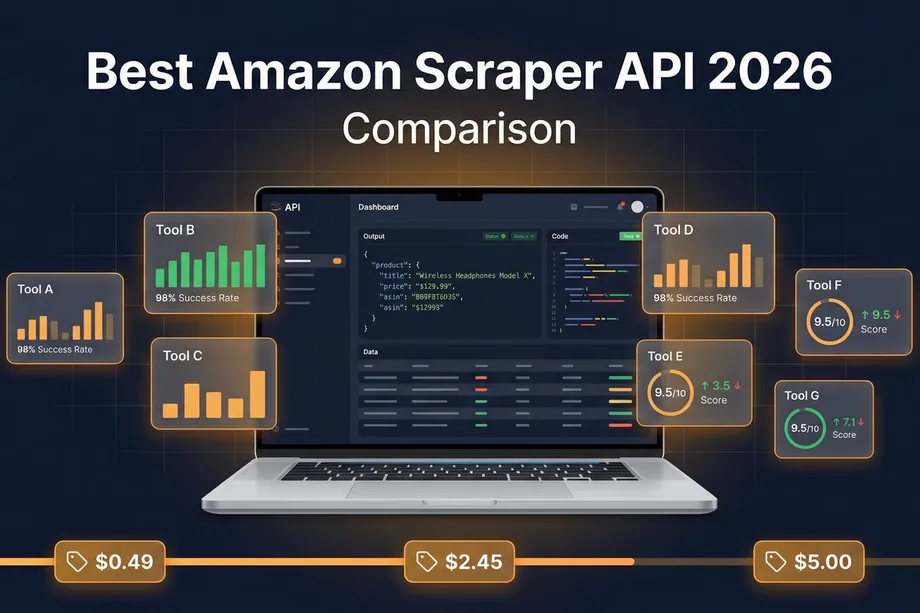
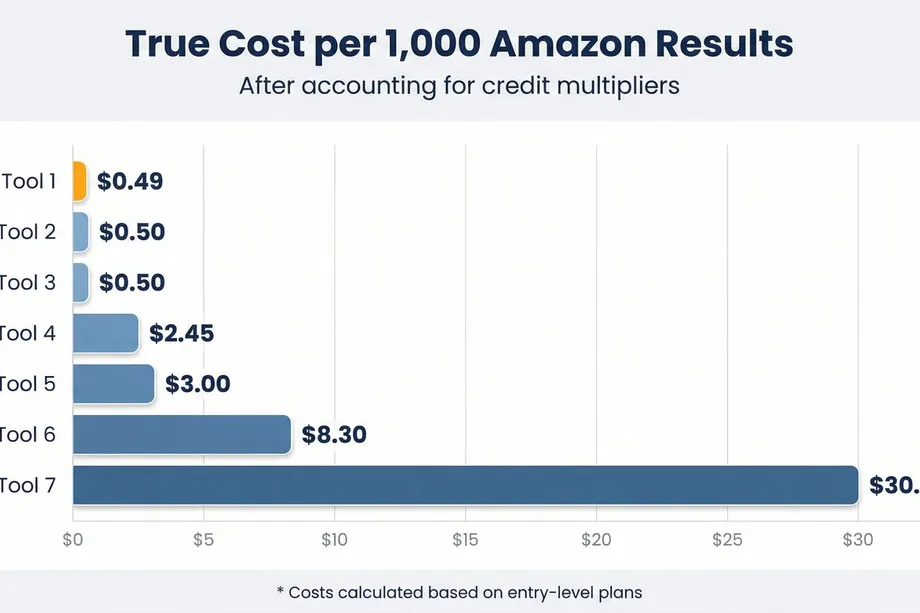
Many providers advertise low costs per request, but hide complex credit multiplier systems in their documentation. A request that costs 1 credit on a basic site might cost 25 credits on Amazon when JavaScript rendering and premium residential proxies are required. This guide focuses on the actual cost to extract 1,000 Amazon product details.
Top 7 Amazon Scraper APIs Compared
1. Easyparser: The Dedicated Amazon Data Powerhouse
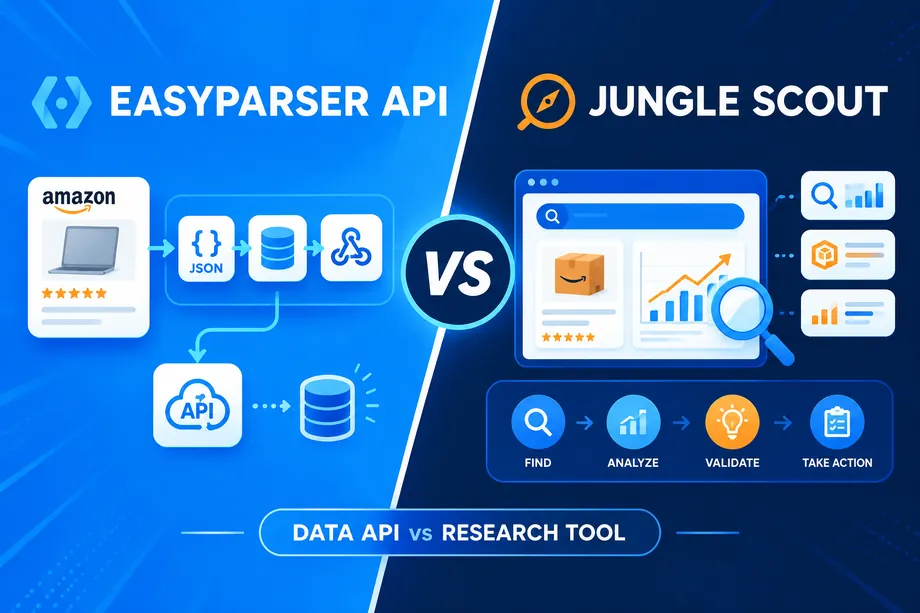
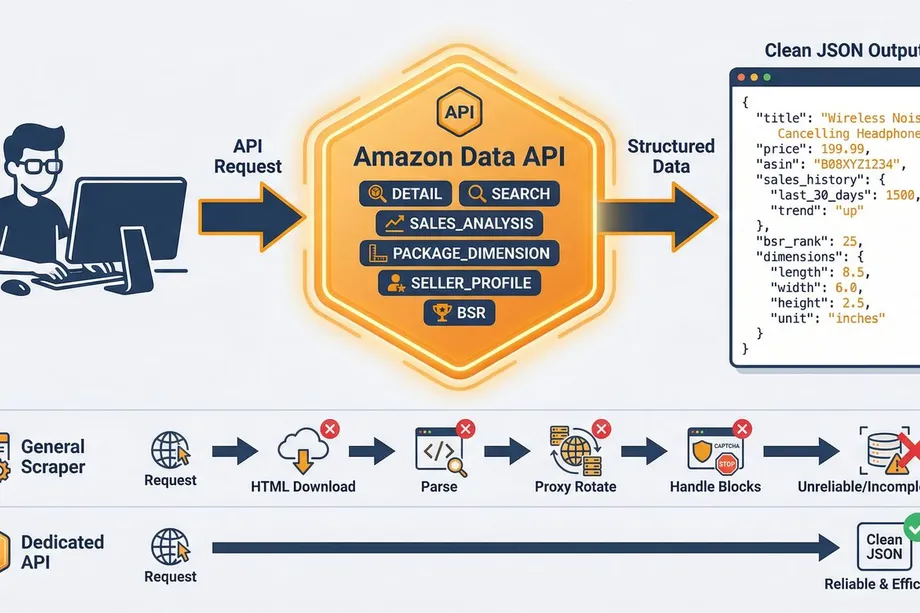
Easyparser takes a fundamentally different approach from general-purpose web scrapers. It is a dedicated, purpose-built API designed exclusively for Amazon data extraction. Because it focuses on one platform, it offers data points that general scrapers simply cannot access.
While most tools act as a proxy layer that returns raw HTML or basic parsed fields, Easyparser provides specialized operations. For Amazon sellers, the unique Sales Analysis & History operation provides historical demand patterns, and the Package Dimension operation is crucial for calculating FBA logistics fees accurately. These are operational differences that directly impact a seller's bottom line.
The pricing model is the most transparent in the industry: 1 credit equals 1 product result. There are no hidden multipliers for JavaScript rendering or residential proxies. The Beginner plan starts at $49 per month for 100,000 credits, making the effective cost just $0.49 per 1,000 results. The API also boasts an impressive average response time of around 7.5 seconds for real-time requests.
2. ScraperAPI: The General-Purpose Giant
ScraperAPI is one of the most well-known names in the web scraping industry. It handles proxy rotation, CAPTCHAs, and headless browser rendering across millions of websites. For teams that need to scrape dozens of different e-commerce platforms alongside Amazon, it is a solid choice.
However, when used specifically for Amazon, the pricing becomes complex. ScraperAPI uses a credit multiplier system. While a standard request costs 1 credit, scraping an Amazon page is classified as an E-Commerce request, costing 5 credits. If you need JavaScript rendering or premium proxies to bypass strict blocks, the cost can jump to 10 or 25 credits per request. On their $49 per month Hobby plan (100,000 credits), the effective cost for Amazon data is roughly $2.45 per 1,000 results.
3. Bright Data: Enterprise Scale and Infrastructure
Bright Data offers an enterprise-grade infrastructure with a massive network of over 150 million residential proxies. Their Web Scraper API provides structured data for Amazon products, search results, and seller profiles.
The platform is built for massive scale, making it suitable for large corporations processing millions of records daily. Their pricing is record-based, starting at $1.50 per 1,000 records on a pay-as-you-go model, or scaling down to $0.40-$0.50 per 1,000 results on their higher-tier monthly plans (starting at $49 to $249 per month). While powerful, the platform can be complex to set up and may be overkill for smaller teams or independent sellers.
4. Oxylabs: High Success Rates and Reliability
Similar to Bright Data, Oxylabs is a premium proxy and scraping provider. Their Web Scraper API supports parsing for various Amazon pages, including products, search, and pricing, returning up to 129 data points per product.
Oxylabs boasts a 98.42% success rate and a fast average response time of 4.31 seconds. Their pricing is straightforward for the Web Scraper API, with Amazon results costing $0.50 per 1,000 on their $49 per month Micro plan. However, like other general scrapers, they lack deep Amazon-specific features like historical sales data or package dimensions.
5. Apify: The Actor Marketplace
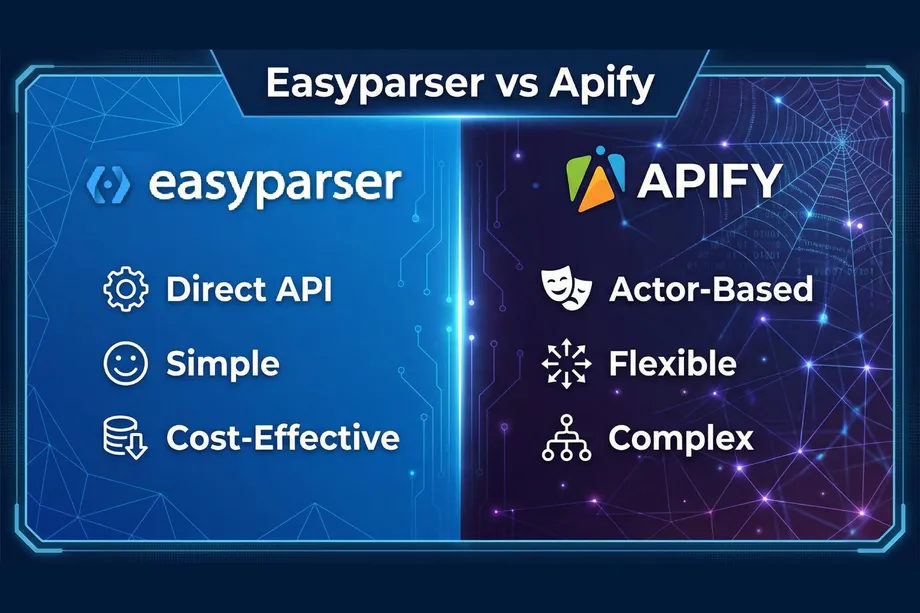
Apify operates on a unique model: it is a cloud platform that hosts "Actors" (containerized scraping programs) built by the community or the Apify team. You can find dozens of Amazon-specific Actors in their store.
The challenge with Apify is predictability. You pay a platform subscription, plus a fee to the Actor developer (often $1.00 to $6.20 per 1,000 results), plus Compute Unit costs based on how much memory and CPU the Actor uses. This multi-layered pricing makes budgeting difficult. Additionally, because different developers build different Actors, the JSON output schemas are inconsistent, making it hard to switch tools if one breaks.
6. Rainforest API (Traject Data): The Premium Dedicated Option
Rainforest API is another dedicated Amazon data solution, recently acquired by Traject Data. It provides highly accurate, structured data across all major Amazon marketplaces, with strong support for reviews, pricing, and Buy Box monitoring.
The service is enterprise-focused, which is reflected in its pricing. Their Starter plan begins at $83 per month for 10,000 credits, equating to $8.30 per 1,000 results. While the data quality is excellent and they offer features like webhook delivery to S3 or GCS, the high entry cost makes it less accessible for smaller operations compared to other dedicated tools.
7. Scrape.do: Fast and Cost-Effective General Scraping
Scrape.do has gained popularity for its impressive speed and cost-effectiveness. They offer an Amazon Ready API that returns structured JSON data for product pages and search results. They claim a very fast response time of around 2.5 seconds.
Their base pricing is very attractive, starting at $29 per month for 250,000 credits. However, they also use a credit multiplier system. Using residential proxies and JavaScript rendering can cost up to 25 credits per request, though their specialized endpoints handle much of this automatically. It is a great option for developers who need fast, general-purpose scraping with built-in Amazon parsing.
Feature Matrix: Finding the Right Fit
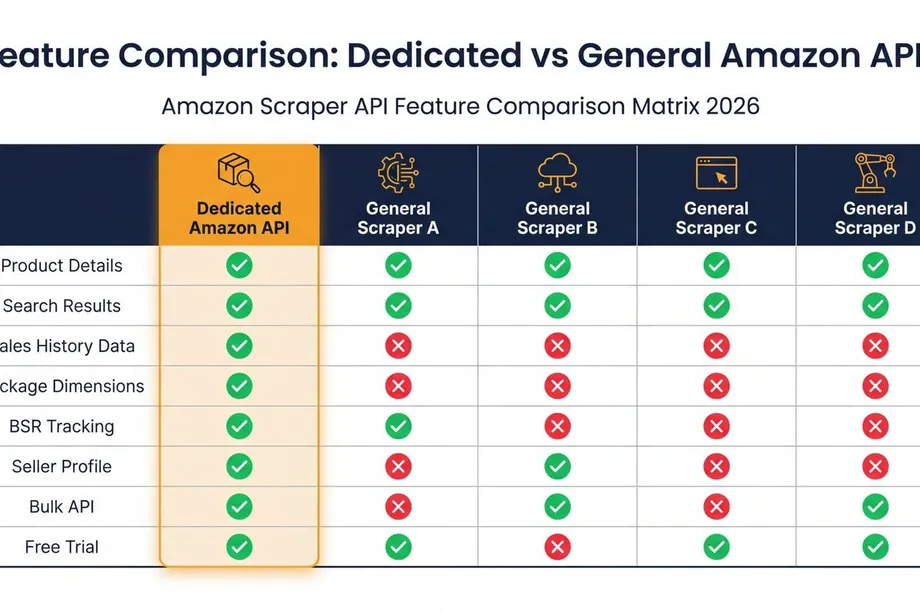
To summarize the differences, here is a breakdown of how these tools compare on critical factors:
| Feature | Easyparser | ScraperAPI | Bright Data | Oxylabs | Rainforest API |
|---|---|---|---|---|---|
| Focus | Dedicated Amazon | General Web | General Web | General Web | Dedicated Amazon |
| Pricing Model | 1 Credit = 1 Result | Multipliers (5x-25x) | Per Record | Per Record | 1 Credit = 1 Result |
| Cost per 10K Results | $4.90 | ~$24.50 | ~$5.00 | ~$5.00 | $83.00 |
| Sales History Data | Yes | No | No | No | No |
| Package Dimensions | Yes | No | No | No | No |
Why Easyparser Stands Out for Amazon Operations
When evaluating the best amazon scraper api, the distinction between a general web scraper and a dedicated platform becomes clear. General scrapers treat Amazon as just another HTML page to download. Easyparser treats Amazon as a complex data ecosystem.
For developers, integrating Easyparser is seamless. You do not need to worry about which proxy pool to select or whether you need headless browsers. You simply call the API with an ASIN, and it returns structured data. You can explore the full list of supported endpoints on the Easyparser Amazon scraping API.
Real-Time API Integration Example
For applications that require immediate data, such as live pricing dashboards or stock checkers, the Real-Time API delivers results in seconds. Here is how simple it is to retrieve a product detail using Python:
import requests
API_KEY = "YOUR_API_KEY" # Get your key from app.easyparser.com
ASIN = "B098FKXT8L"
params = {
"api_key": API_KEY,
"platform": "AMZ",
"operation": "DETAIL",
"asin": ASIN,
"domain": ".com"
}
response = requests.get("https://realtime.easyparser.com/v1/request", params=params)
data = response.json()
product = data.get("product", {})
print(f"Title: {product.get('title')}")
print(f"Price: ${product.get('price')}")
Bulk API Integration Example
When you need to update thousands of products daily, maintaining open HTTP connections is inefficient. Easyparser's Bulk API allows you to submit up to 5,000 URLs in a single request. The system processes them asynchronously and sends the results to your server via a webhook. You can learn more about these capabilities on the Easyparser Amazon scraping API page.
import requests
HEADERS = {"api-key": "YOUR_API_KEY", "Content-Type": "application/json"}
payload = {
"platform": "AMZ",
"operation": "DETAIL",
"domain": ".com",
"payload": {
"asins": [
"B0DQY6J9TL",
"B0CF3VGQFL"
]
},
"webhook_url": "https://your-server.com/webhook"
}
response = requests.post("https://bulk.easyparser.com/v1/jobs", json=payload, headers=HEADERS)
print(response.json())
Conclusion
Choosing the best amazon scraper api depends entirely on your specific needs. If you are a developer building a general web scraper that occasionally hits Amazon, tools like ScraperAPI or Bright Data provide excellent infrastructure. However, if your business relies specifically on Amazon data, a dedicated solution is far superior.
Easyparser stands out by offering a transparent 1:1 credit pricing model, eliminating the unpredictable costs associated with credit multipliers. More importantly, it provides specialized data endpoints like Sales Analysis and Package Dimensions that general scrapers miss. By focusing entirely on the Amazon ecosystem, it delivers the structured, reliable data that modern e-commerce businesses and data teams require to stay competitive.
Try the best-rated Amazon API for free
Start Your Free Trial100 free credits, no credit card required.