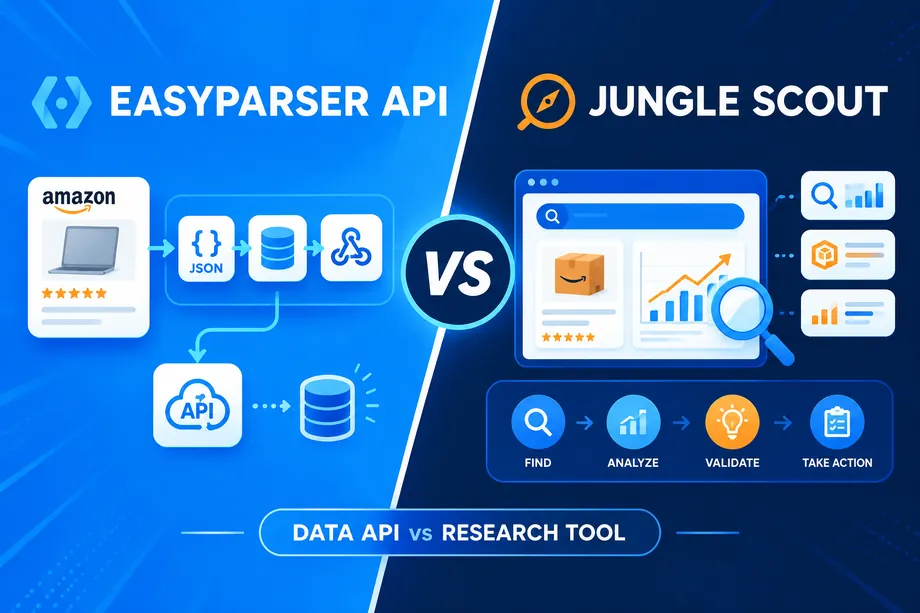
A team that needs ten product ideas and a team that needs 100,000 structured product records are not shopping for the same capability. That difference explains most confusion around Easyparser vs Jungle Scout. Jungle Scout is primarily a guided research and seller-operations suite. Easyparser is primarily an Amazon data extraction platform for teams that want page-level data in their own systems. Both offer API paths, but the data, access rules, and operating work are different.
Easyparser vs Jungle Scout: At a Glance
| Decision factor | Easyparser | Jungle Scout |
|---|---|---|
| Primary job | Extract current public Amazon page data into structured workflows | Guide product, keyword, listing, and seller research |
| Best default user | Developer, data team, agency, or technical seller | Seller who wants an interpreted research interface |
| Core data type | Observed page and offer fields returned as JSON | Research intelligence, historical views, and modeled estimates |
| API access | Real-Time and Bulk access are shown on paid plans | Current plan material places API access on eligible Growth and Brand Owner plans, with a separate add-on |
| Public entry price | $49/month for 100,000 credits | $49 month-to-month for Catalyst Starter, or $29/month when billed annually |
| Free access | 100 monthly demo credits, no card stated | Seven-day money-back guarantee for Catalyst; first 100 API requests stated separately |
| Strongest advantage | Flexible extraction, localized requests, Real-Time and Bulk workflows | Guided discovery, keyword tools, estimates, extension, and post-launch features |
| Main limitation | You must build interpretation, storage, monitoring, and business logic | Developers face plan gates, response-page billing, and a narrower exposed API model |
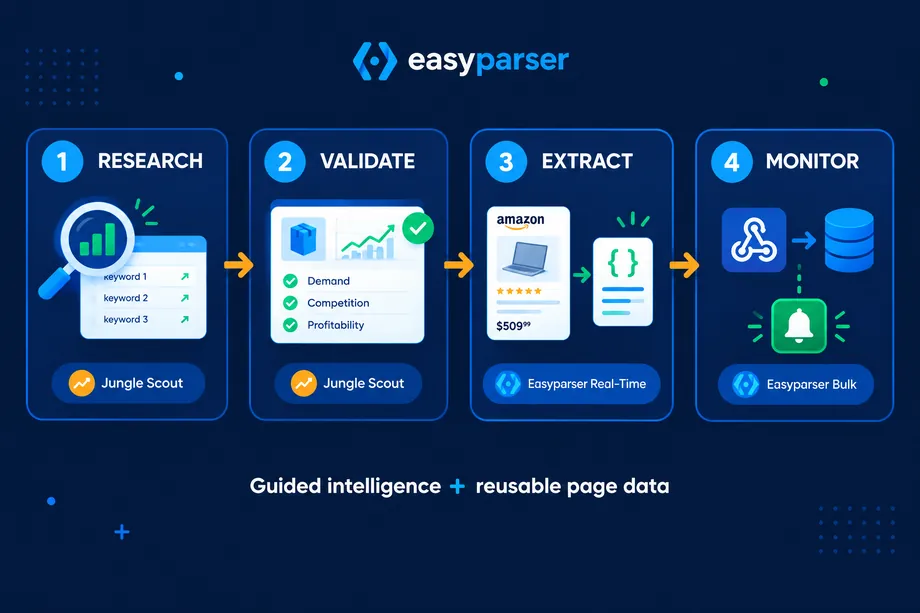
Quick answer: choose Jungle Scout when you want a seller-facing research workspace that helps you discover and interpret opportunities. Choose Easyparser when you already know which listings, offers, sellers, or searches to collect and need reusable output for a database, application, spreadsheet, or AI workflow. Use both when modeled research and current page observations must coexist.
What Jungle Scout Does Best: Guided Research and Estimates
Jungle Scout Catalyst combines a web app and browser extensions with Product Database, Opportunity Finder, Keyword Scout, Product Tracker, Sales Estimator, Rank Tracker, listing tools, inventory features, review automation, Advertising Analytics, and Sales Analytics. This guided layer reduces the work required to turn data into a research decision.
That guided layer matters most before a seller commits capital. Product Database and Opportunity Finder help narrow a large catalog. Keyword Scout and Rank Tracker organize search demand and visibility. Sales Estimator provides a modeled demand signal. The extension keeps research close to an Amazon page. A first-time private-label seller can use these workflows without designing a schema, running a scheduler, or maintaining a webhook.
Where estimates help, and where caution begins
Jungle Scout's sales and revenue figures are modeled estimates, not an Amazon order ledger. They help compare opportunities but cannot guarantee units, margin, or inventory velocity. Combine them with fees, cost of goods, freight, advertising, returns, and seasonality. Keyword search volume also answers a different question from the products displayed for a query.
Why Developers Look Beyond the Jungle Scout Interface
A dashboard is efficient until a team needs a custom field, schedule, geography, or destination. Jungle Scout does offer an API, but its documented endpoint families focus on keywords, historical search volume, Product Database, Sales Estimates, and Share of Voice. That is valuable modeled intelligence, not a general Amazon page extraction layer.
Current plan documentation says API access requires Catalyst Growth Accelerator or Brand Owner, while Starter is not eligible. API requests are then purchased through add-ons, each response page counts as a call, and cursor-based pagination can increase consumption. A developer should therefore model subscription cost, API add-on cost, pagination, rate limits, and engineering time together.
Easyparser's Advantage: Current Page Data and Flexible Pipelines
Easyparser organizes Amazon extraction around operations. The Product Detail API is designed to retrieve listing fields such as title, brand, category, price or variation range, images, stock text, specifications, and Prime eligibility. The Product Offer API focuses on active sellers, price, discounts, fulfillment, Buy Box status, seller information, and quantity limits. Search operations return ranked listing fields and sponsored-placement information.
The output can enter your own data contract with source, ASIN, marketplace, address, currency, request ID, collection time, and observed values. Easyparser also documents saved addresses and inline ZIP, city, district, and country parameters. Support varies by marketplace, so production systems should log the applied address rather than assume one result represents every buyer.
Data Accuracy: Estimates vs Real-Time Extraction
"Accuracy" is too vague to decide the Easyparser vs Jungle Scout question. Separate field correctness, freshness, coverage, and model error. A price can be current but localized differently; a sales estimate can be directionally useful without matching future orders.
Easyparser calls its Real-Time results live or current. Its FAQ says responses are typically under five seconds with a ten-second maximum, while technical documentation specifies a 15-second timeout. Jungle Scout describes refined models, but the reviewed public sources do not expose a complete formula or independent audit. Treat both as claims to test.
A practical validation protocol
- Select ten ASINs across two categories and record marketplace, address, timestamp, plan, and request parameters.
- Compare visible page fields separately from modeled units, revenue, keyword volume, and share of voice.
- Repeat selected price, stock, Buy Box, and search checks three times in one day.
- Report exact matches, missing values, timestamp differences, and model differences without claiming a small sample proves universal accuracy.
Pricing: Jungle Scout vs Easyparser API
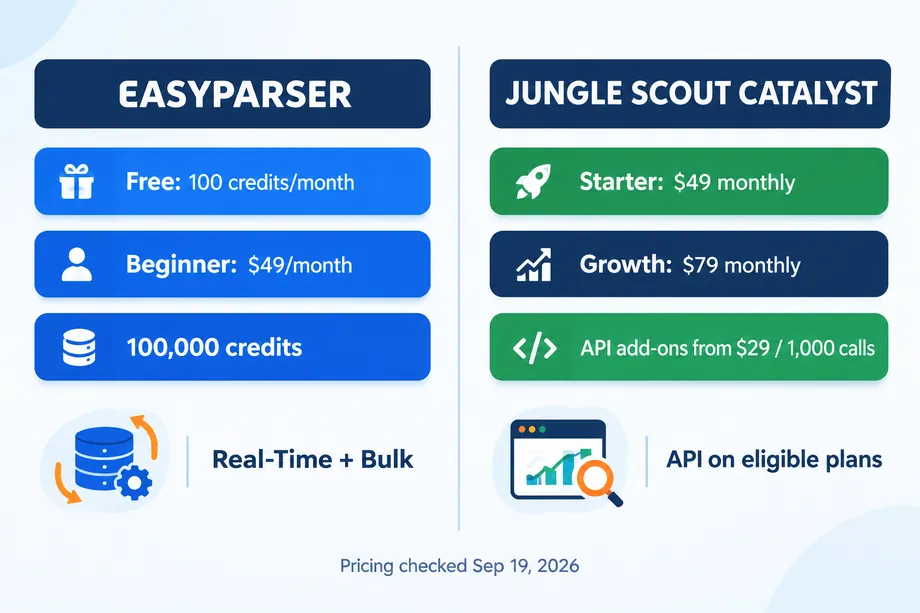
The public prices below were checked on September 19, 2026. They are not perfectly comparable. Easyparser prices extraction capacity. Jungle Scout prices a guided product suite, then charges separately for API requests on eligible plans.
| Product or path | Public price snapshot | Important qualification |
|---|---|---|
| Easyparser Free/Demo | 100 credits each month | Useful for an extraction proof of concept, not a full research suite |
| Easyparser Beginner | $49/month for 100,000 credits | Real-Time and Bulk shown; technical credit exceptions apply |
| Easyparser Starter | $150/month for 350,000 credits | Do not confuse this plan name with Jungle Scout Starter |
| Jungle Scout Catalyst Starter | $49 monthly or $29/month billed annually | Current documentation says Starter is not API-eligible |
| Jungle Scout Growth Accelerator | $79 monthly or $49/month billed annually | API eligibility is shown, but API requests are separate |
| Jungle Scout Brand Owner + CI | $149 monthly or $129/month billed annually | Larger research limits; verify current seats and features |
| Jungle Scout API add-on | $29/1,000, $99/4,000, or $199/10,000 calls | Each response page counts as a call; requests do not roll over |
Easyparser's one-credit headline has exceptions for A+ content, pagination, and specialized operations. Jungle Scout can bill multiple response pages for one query. A beginner may value Catalyst's interpretation layer; a developer may value Easyparser's 100,000-credit entry plan. Agencies should add seats, storage, compute, retries, and staff time.
Real-Time API for On-Demand Product Checks
Easyparser's Real-Time API is synchronous: the caller sends an operation and identifier, then receives JSON in the same request. It fits on-demand checks and application screens.
import requests
API_KEY = "YOUR_API_KEY" # Get your key from app.easyparser.com
ASIN = "B098FKXT8L"
params = {
"api_key": API_KEY,
"platform": "AMZ",
"operation": "DETAIL",
"asin": ASIN,
"domain": "com"
}
response = requests.get(
"https://realtime.easyparser.com/v1/request",
params=params, timeout=20
)
response.raise_for_status()
payload = response.json()
print(payload.get("result", {}))
Bulk API for Monitoring at Scale
The Bulk API is asynchronous. Easyparser documents up to 5,000 items per request, a required callback URL, a five-minute processing window, and separate result retrieval through the Data Service.
import requests
API_KEY = "YOUR_API_KEY"
headers = {
"api-key": API_KEY,
"Content-Type": "application/json"
}
payload = {
"callback_url": "https://example.com/easyparser/callback",
"requests": [{
"platform": "AMZ",
"operation": "DETAIL",
"domain": "com",
"asins": ["B098FKXT8L", "B0BR8J5M7X"]
}]
}
response = requests.post(
"https://bulk.easyparser.com/v1/bulk",
headers=headers, json=payload, timeout=30
)
response.raise_for_status()
print(response.json())
In production, validate callback authenticity, acknowledge quickly, persist results before the temporary retention window ends, and use idempotency to prevent duplicates.
Integration Options: Which Tool Fits Your Stack?
In the Easyparser vs Jungle Scout API comparison, Easyparser offers Real-Time and Bulk requests, a Data Service, exports, common-language examples, and a hosted MCP path. Jungle Scout documents REST/JSON endpoints, Postman, a Python client, Google Apps Scripts, and Zapier. Store the sources separately so an estimate never overwrites a page observation.
Build a Defensible ASIN Monitoring Data Contract
A reliable comparison starts before the first request. Define one record for every ASIN, marketplace, address, and collection time. Store the source product, request ID, raw response location, normalized value, and any transformation applied. This prevents a later analyst from treating a Jungle Scout estimate as if it were a price observed on an Amazon page.
| Field class | Examples | Required context |
|---|---|---|
| Observed | Price, seller, stock text, Buy Box, rating | ASIN, marketplace, address, timestamp, variation |
| Modeled | Estimated units, revenue, search volume, share of voice | Source, model period, category, query, retrieval date |
| Operational | Request status, latency, credits, calls, pages, retries | Plan, endpoint, request ID, error code |
Reconciliation should preserve disagreement instead of hiding it. A price difference can come from a coupon, address, seller, variation, or collection time. A missing rank is not zero. An estimated revenue figure should not overwrite a calculated revenue field. Keep the original values, add a normalized comparison column, and document the rule used. For monitoring, create alerts only after two consecutive failures or a material field change so temporary collection errors do not become business events.
This contract also improves cost analysis. Record Easyparser credits and Jungle Scout response pages beside each successful result. Include failed attempts, retries, storage, and processing time. After one week, you will have evidence about coverage, freshness, and unit economics for your actual catalog rather than a generic score assembled from marketing pages.
When to Use Jungle Scout and When to Use Easyparser
| Persona | Start with | Reason |
|---|---|---|
| First-time private-label seller | Jungle Scout | Guided discovery, keywords, estimates, and education |
| Developer or data team | Easyparser | Structured extraction, localization, bulk, and schema control |
| Established brand | Hybrid test | Modeled research plus page and offer monitoring |
| Wholesale or arbitrage operator | Matched test | Buy Box, seller, fulfillment, history, and location decide fit |
| PPC or inventory-led seller | Jungle Scout or specialist | Easyparser is not a native PPC or inventory suite |
Choose Jungle Scout for product ideas, reverse-ASIN keywords, rank tracking, listing tools, and a guided interface. Choose Easyparser for current page fields, location checks, high-volume extraction, and downstream control. Use both when research intelligence determines what to watch and page-level evidence powers the monitor.
A Seven-Day Evaluation Plan
- Define the job. Choose product discovery, keyword research, or monitoring.
- Use a matched sample. Test the same ten ASINs, three keywords, and marketplaces.
- Record entitlements. Note plan, seats, credits, calls, pagination, and trial terms.
- Test both data classes. Keep observed fields separate from estimates and history.
- Prototype APIs. Run Easyparser Real-Time and Bulk requests plus a Jungle Scout API call if eligible.
- Calculate total cost. Include software, storage, retries, staff time, and migration risk.
Limitations and Compliance Questions
Easyparser states that it accesses public information and places third-party terms compliance on the user. That is not universal legal clearance. Review Amazon terms, access controls, law, licensing, and retention. Operationally, Easyparser has temporary Bulk retention and marketplace variation; Jungle Scout has plan gates, endpoint limits, pagination, and key-specific country access. Verify enterprise support and security terms separately.
Final Verdict
The Easyparser vs Jungle Scout decision is straightforward once the job is explicit. For guided product discovery, keyword intelligence, estimates, seller education, and an integrated operating interface, Jungle Scout is the stronger default. For current public page extraction, offer-level data, localization, reusable JSON, and custom automation, Easyparser is the stronger fit.
Test the same ASINs and keywords, label observations and estimates separately, and calculate full workflow cost. Teams needing both research intelligence and programmable page data may reach an honest hybrid verdict.
Sources and Update Note
Prices and feature access were checked on September 19, 2026. Recheck current pages before purchase. Core product references include Easyparser pricing, the operation pages linked above, Jungle Scout Catalyst plans, its API product page, and the developer documentation. Vendor claims were not treated as an independent performance audit.
Try the best-rated Amazon API for free
Start Your Free Trial100 free credits, no credit card required.