When choosing an API for e-commerce data extraction in 2026, the decision often comes down to specialized tools versus general-purpose scrapers. In the easyparser vs zenrows comparison debate, developers and data analysts must evaluate whether a dedicated Amazon scraping solution outperforms a versatile, all-in-one web scraping infrastructure. Both platforms offer robust capabilities, but their approaches to pricing, data structure, and Amazon-specific features differ significantly. This comprehensive comparison will analyze both services to help you determine the best zenrows alternative 2026 for your specific Amazon data requirements. Understanding the nuances of easyparser vs zenrows will save you significant budget and engineering time.
Easyparser vs ZenRows: At a Glance
Before diving into the technical details, it is crucial to understand the fundamental philosophy behind each platform. ZenRows is a powerful, general-purpose web scraping API designed to bypass anti-bot systems across millions of websites. It provides a universal scraper that handles JavaScript rendering, premium proxies, and CAPTCHA solving for domains ranging from Zillow to Google. In contrast, Easyparser is purpose-built exclusively for Amazon. It functions as a specialized data extraction engine, offering endpoints tailored to the unique architecture of Amazon's marketplace.
This fundamental difference shapes every aspect of the user experience. While ZenRows requires developers to configure proxy settings and rendering options to ensure successful extraction, Easyparser abstracts these complexities, delivering structured JSON data directly from Amazon. For businesses focused solely on Amazon market intelligence, the specialized nature of Easyparser often translates to faster integration and more reliable data streams.
Amazon-Specific vs General Web Scraping APIs
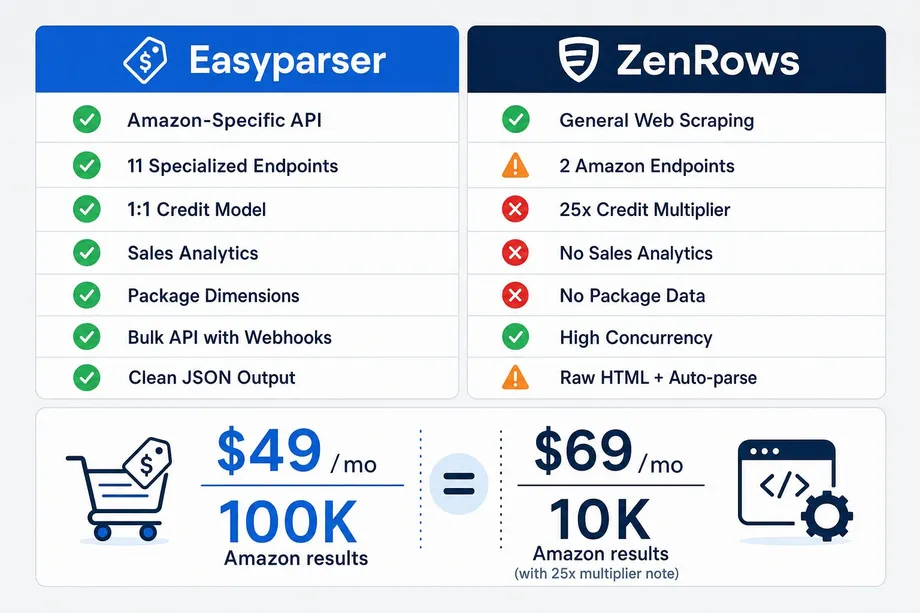
The distinction between an Amazon-specific API and a general web scraper becomes apparent when examining the available data endpoints. ZenRows offers an Amazon Product Information API and an Amazon Discovery API, which extract standard product details and search results. However, because it is built for the broader web, it lacks the deep, specialized intelligence required by advanced e-commerce sellers.
Easyparser, on the other hand, provides a suite of eleven specialized operations. Beyond basic product details, it includes unique endpoints such as the Amazon Product Offers API for Buy Box tracking, the Sales Analytics API for historical performance, and the Package Dimensions API for FBA fee auditing. This depth of Amazon-specific functionality makes Easyparser a superior choice for users who need granular insights into seller profiles, category listings, and product variations.
Pricing Comparison: What You Get Per Dollar
The most critical factor in the easyparser vs zenrows pricing comparison is the credit structure, specifically how credits are consumed. Easyparser operates on a transparent 1:1 credit model. If you subscribe to the Beginner plan ($49/month for 100,000 credits), you are guaranteed 100,000 successful product extractions. There are no hidden fees or complex calculations; one successful request equals one credit.
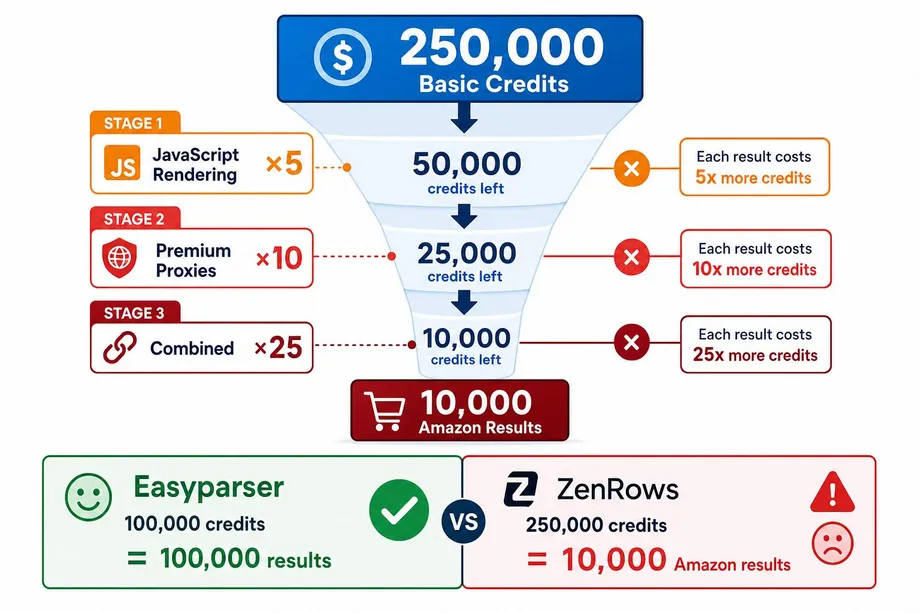
ZenRows employs a credit multiplier system that significantly impacts the actual cost of scraping Amazon. While their Developer plan ($69.99/month) advertises 250,000 basic results, scraping Amazon requires advanced features to bypass robust anti-bot protections. Specifically, you must enable JavaScript Rendering (a 5x multiplier) and Premium Proxies (a 10x multiplier). Combined, this creates a 25x multiplier. Therefore, the 250,000 basic requests translate to only 10,000 successful Amazon requests. This hidden cost structure makes ZenRows considerably more expensive for high-volume Amazon data extraction.
Success Rate on Amazon Product Pages
Amazon employs some of the most sophisticated anti-bot mechanisms on the internet, including dynamic CAPTCHAs, behavioral analysis, and IP blocking. A high success rate is non-negotiable for automated data pipelines. ZenRows boasts an impressive 99.93% success rate across the general web, leveraging its adaptive stealth mode and premium residential proxies to mimic human behavior effectively.
Easyparser reports a 98.2% success rate specifically on Amazon. Because Easyparser focuses entirely on Amazon's infrastructure, its anti-blocking algorithms are fine-tuned for this specific domain. It handles proxy rotation and CAPTCHA solving natively, ensuring consistent data retrieval without requiring the user to manually configure headers or session management parameters. Both platforms excel in reliability, but Easyparser's domain-specific optimization provides a slight edge in stability for Amazon-centric workflows.
Data Structure: Raw HTML vs Clean JSON
The format in which data is returned dictates how quickly it can be integrated into your database or analytics dashboard. ZenRows can return raw HTML, which requires you to write custom parsing logic using tools like BeautifulSoup or Cheerio. While they do offer auto-parsing features for popular domains to return JSON, the structure may require further cleaning depending on the specific Amazon page layout.
Easyparser guarantees clean, structured JSON output for every request. Whether you are querying the DETAIL operation or the Amazon Search Listing API, the response schema is consistent and predictable. This eliminates the need for maintaining complex parsing scripts that break whenever Amazon updates its user interface, saving significant engineering hours.
Anti-Bot and JavaScript Rendering Capabilities
Modern e-commerce sites rely heavily on JavaScript to load pricing, reviews, and variant data dynamically. ZenRows excels in this area with its headless browser technology, which executes JavaScript just like a real user. This capability is essential for rendering complex pages and bypassing advanced WAF (Web Application Firewall) protections.
Easyparser achieves similar results without requiring the user to explicitly enable or pay extra for JavaScript rendering. The Easyparser infrastructure is designed to automatically execute whatever scripts are necessary to extract the requested Amazon data. This built-in capability ensures that users always receive complete product information, including dynamically loaded elements, without managing browser instances or worrying about rendering costs.
Bulk Processing: Handling Large-Scale Requests
For enterprise users, the ability to process millions of ASINs efficiently is a primary requirement. ZenRows supports high concurrency (up to 100 parallel requests on the Business plan), allowing developers to build fast, multi-threaded scrapers. However, managing these parallel requests and handling potential timeouts remains the developer's responsibility.
Easyparser offers a dedicated Bulk API designed specifically for large-scale operations. Users can submit thousands of ASINs in a single job and receive the structured data asynchronously via webhooks. This architecture is ideal for catalog updates and comprehensive market analysis, as it offloads the concurrency management and error handling entirely to the Easyparser servers.
Integration: Python, Node.js & No-Code Options
Both platforms offer straightforward integration with popular programming languages. ZenRows provides comprehensive documentation and SDKs for Python, Node.js, and Java, making it easy to incorporate into existing codebases. Their universal scraper endpoint accepts standard HTTP requests, allowing for quick setup.
Easyparser also supports simple REST API calls and provides code snippets for seamless integration. Below is an example of how to retrieve real-time product details using Python with Easyparser. Notice how the parameters are specific to Amazon operations, such as defining the platform and the target domain.
import requests
params = {
"api_key": "YOUR_API_KEY",
"platform": "AMZ",
"operation": "DETAIL",
"asin": "B0CJB6V2L5",
"domain": "com"
}
response = requests.get("https://realtime.easyparser.com/v1/request", params=params)
print(response.json())
For developers using ZenRows, the integration involves passing the target Amazon URL through the ZenRows proxy endpoint, ensuring that the appropriate parameters for JavaScript rendering and premium proxies are enabled to guarantee success.
import requests
apikey = "YOUR_ZENROWS_API_KEY"
url = "https://www.amazon.com/dp/B0CJB6V2L5"
params = {
"url": url,
"apikey": apikey,
"js_render": "true",
"premium_proxy": "true"
}
response = requests.get("https://api.zenrows.com/v1/", params=params)
print(response.text)
ZenRows Credit Multiplier: The Hidden Cost
When evaluating easyparser vs zenrows from a financial perspective, the ZenRows credit multiplier is the most critical financial consideration. As demonstrated in the pricing section, the requirement to use premium proxies and JavaScript rendering for Amazon scraping drastically reduces the effective number of requests you receive per plan.
For example, a business needing 100,000 Amazon product updates per month would find the ZenRows Startup plan ($129.99 for 1M basic credits) insufficient, as the 25x multiplier reduces the capacity to only 40,000 protected requests. They would be forced to upgrade to the Business plan ($299.99). In contrast, the Easyparser Beginner plan ($49.00) provides exactly 100,000 successful Amazon extractions, offering a clear and substantial cost advantage for Amazon-specific projects.
Which Is Better for Amazon Data in 2026?
The choice between Easyparser and ZenRows ultimately depends on the scope of your data extraction needs. If your business requires scraping data from a wide variety of websites - such as real estate listings, social media platforms, and various e-commerce stores - ZenRows provides an exceptional, highly capable universal scraping infrastructure.
However, if your operations are focused entirely on Amazon, Easyparser is the clear winner. Its specialized endpoints for sales analytics and package dimensions, combined with a transparent 1:1 pricing model, make it the most efficient and cost-effective solution. By eliminating the hidden costs of credit multipliers and providing clean, structured JSON data natively, Easyparser stands out as the premier zenrows amazon alternative for dedicated e-commerce professionals in 2026. For teams evaluating easyparser vs zenrows, the data speaks clearly: specialized tools outperform general scrapers when the target is Amazon.
Start monitoring your competitors for free
Start Your Free Trial100 free credits, no credit card required.