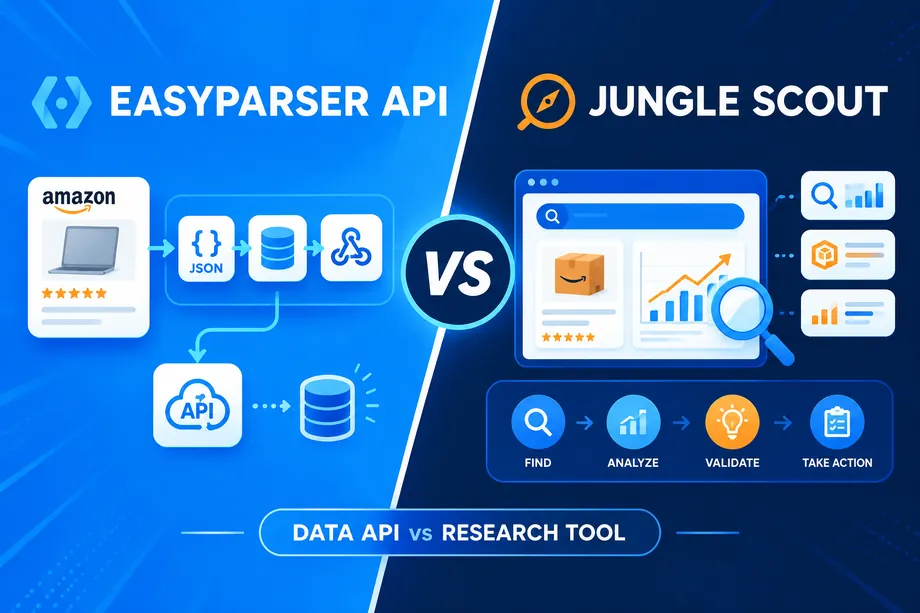
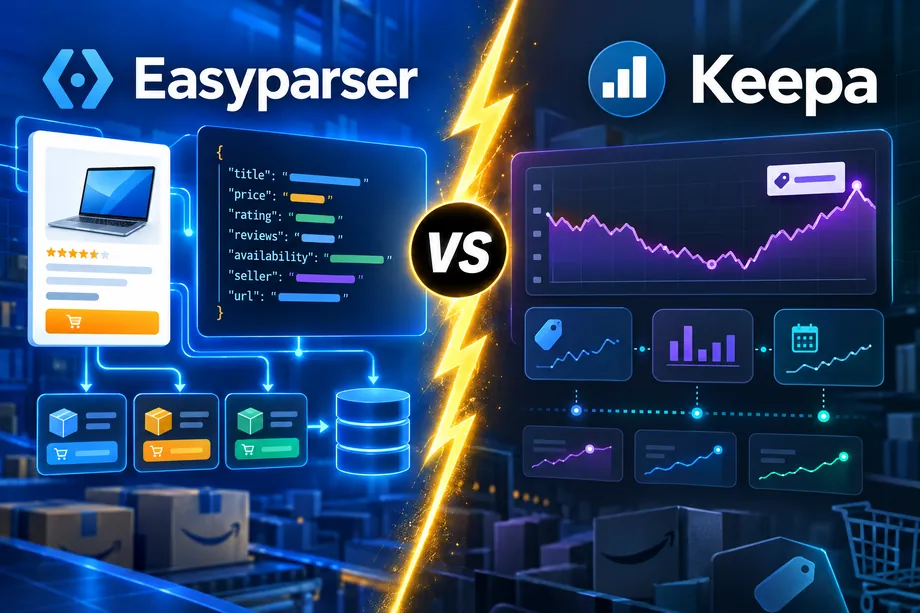
A sourcing team may open a Keepa chart to understand an ASIN's past, then need the current Buy Box, shipping terms, fulfillment, seller list, and availability in its own dashboard. These are connected questions, but not the same data job. That distinction is the fastest way to understand Easyparser vs Keepa.
Keepa is an Amazon price-tracking and historical-data platform. Easyparser is an Amazon data extraction platform with Real-Time and Bulk APIs. Neither is automatically better. This guide separates historical signals from current observations and shows when a hybrid workflow is more honest than a forced replacement.
Easyparser vs Keepa: Quick Comparison
| Decision factor | Easyparser | Keepa |
|---|---|---|
| Primary job | Collect current public Amazon page data as structured JSON | Study Amazon price history, trends, tracking, and product research signals |
| Best default user | Developer, data team, agency, or technical seller | Buyer, seller, or analyst who values historical charts and tracking tools |
| Freshness model | Real-Time requests for current page observations; Bulk for asynchronous volume | Tracked historical database with API refresh and update rules |
| Price unit | Credits per successful result, with option-level exceptions | Token generation rate per minute, with endpoint and option multipliers |
| Seller intelligence | Current offers, fulfillment, coupons, shipping, and Buy Box context | Offer, seller, and Buy Box information through API options and historical views |
| Historical charting | Build your own time series through scheduled collection | Core strength: vendor-maintained price and related history |
| Engineering trade-off | More control, but you own storage, alerts, interpretation, and history | Ready-made history and trackers, but token planning and API integration still matter |
Quick answer: use Keepa when the decision starts with historical price movement, price alerts, sales-rank context, or chart-led product research. Use Easyparser when the decision starts with the current state of an Amazon page and the result must feed a database, application, spreadsheet, workflow, or AI process. Use both when historical context tells you what to watch and current observations tell you what is true now.
What Keepa Does Well: Price History Charts
Keepa's clearest advantage is its historical perspective. Its API covers price history, statistics, offers, Buy Box information, variations, deals, best sellers, sellers, and tracking. Its interface turns much of that information into charts and watchlists before a purchase or inventory decision.
For a buyer, a price chart can show whether a deal is unusual. For a seller, history can reveal seasonality, volatility, sales-rank movement, Buy Box changes, and offer-count patterns. Tracking and notifications let users watch products without building alerts first.
History is not a live snapshot
A historical series supplies context across time; a current observation identifies what a page returned for a marketplace, variation, delivery context, and timestamp. Keep the two fields separate and label the source and collection time.
Keepa is a strong starting point when the first question is what happened before, or when a team needs vendor-maintained history rather than its own archive.
Where Keepa Falls Short: API Limitations
Keepa's API is capable, but its token model requires planning. Tokens generate continuously, expire after 60 minutes, and the bucket holds at most one hour of the plan rate. That differs from a monthly allowance that can be saved for a late-month batch.
Cost also changes by endpoint and option. Official documentation lists one token per ASIN for a standard product request, six additional tokens per found offer page of up to ten offers, and ten tokens for a search of up to 20 results. Estimate real request shapes instead of comparing plan labels.
Keepa's default product behavior refreshes an item when its last update is older than approximately one hour. A caller can request another update rule, including immediate refresh, subject to token rules. Test real ASINs and freshness needs rather than assume history-first data behaves like a live scraper response.
Keepa is not just a browser extension, and its API is not the same product as its consumer tools
Do not treat a free or Pro charting experience as proof of API economics. Keepa API access uses a separate token-based subscription, with JSON over HTTPS and official Java and PHP clients. Model token expiry, options, retries, and storage.
Easyparser's Advantages: Real-Time Data and Seller Intelligence
Easyparser retrieves current Amazon page data as structured responses. The Amazon Product Detail API is an entry point for title, price, images, specifications, variations, stock text, category information, and Prime eligibility. Real-Time returns the response in the same interaction.
The Amazon Product Offers API covers active seller offers, fulfillment, shipping, coupon signals, seller reputation, and Buy Box context. Buyers can validate a real buying condition; sellers can build monitoring, repricing, margin, or brand-protection logic.
Real-Time fits a dashboard, sourcing review, or trigger that needs JSON immediately. Bulk processes multiple operations asynchronously through a callback and later retrieval, making it useful for scheduled catalog refreshes and recurring offer monitoring.
Where Easyparser should not be oversold
Easyparser is not a ready-made substitute for Keepa's chart interface and vendor-maintained multi-year history. A team using it for trends must create a durable time-series store, choose a cadence, and build alerts and visualizations.
For demand and trend analysis, the Amazon Sales Analysis API adds a separate operational signal. It is not the same as a price-history chart or audited order ledger, so retain timestamps, definitions, and validation rules.
Pricing Comparison: Keepa API vs Easyparser
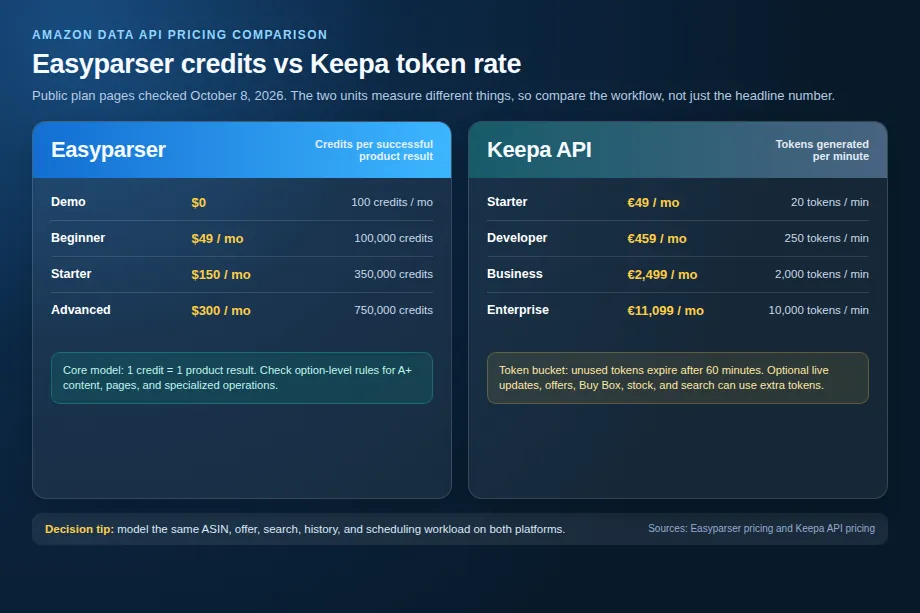
The public plan snapshots below were checked on October 8, 2026. In this Easyparser vs Keepa comparison, they are different models, not a one-to-one conversion. Easyparser lists a 100-credit Demo plan and 100,000 credits for $49 per month. Keepa begins at 20 tokens per minute for EUR 49 per month. Verify live terms before purchase.
| Planning question | Easyparser | Keepa API |
|---|---|---|
| What is the baseline unit? | One credit per successful product result in the standard case | One token per requested product in the standard product endpoint case |
| What changes cost? | Operation, A+ content, pages, and specialized operations | Endpoint, found offer pages, live update setting, Buy Box, stock, rating, and search options |
| How is capacity delivered? | Monthly credit allowance by plan | Tokens replenish continuously per minute and expire after 60 minutes |
| How should a team compare? | Count successful results, pages, and enabled options per workflow | Count ASINs, offer pages, searches, update settings, and the required token rate |
| What should not be assumed? | That every operation is exactly one credit | That a published monthly token total can be stored or spent in a single burst |
A catalog team that needs 1,000 current records per day should specify whether it needs listing details, offer pages, A+ content, or history. Build a matched estimate for the same ASINs and options, then test it for a week.
Data Depth: What Each Tool Returns
Data depth is not only field count. It also depends on whether a field is historical, current, localized, paginated, or available only with an option.
| Data need | Easyparser approach | Keepa approach | Decision note |
|---|---|---|---|
| Current listing details | DETAIL response for live title, price, availability, images, specs, and variations | Product object and update controls | Test timestamps and variant behavior against the same listing |
| Long price and rank history | Build and own a scheduled archive | Core product history and charting strength | Keepa wins when existing vendor history is the primary requirement |
| Current seller offers | OFFER operation for current sellers, fulfillment, shipping, coupons, and Buy Box context | Product request with offer options and token multipliers | Compare offer depth, timestamps, and cost per ASIN |
| Keyword result pages | SEARCH operation for a current Amazon result page | Product Search returns up to 20 results and excludes sponsored content | Do not treat the two outputs as identical ranking definitions |
| Product discovery or deals | Use operational searches and build a scoring workflow | Product Finder, Deals, Best Sellers, and tracking endpoints | Keepa provides a broader ready-made research database layer |
| Custom location context | Address-aware collection can be part of the request strategy | Test locale and field behavior using supported domain IDs | Location can change price, delivery, availability, and offers |
Write a data contract before comparing screenshots. Store ASIN, marketplace, variation, collection timestamp, source, options, status, and raw-response location. Classify each value as observed, historical, or modeled so an old chart point is not mistaken for a live price.
Use Case Match: When to Use Keepa vs Easyparser
| Persona or job | Best starting fit | Why |
|---|---|---|
| Deal-seeking buyer | Keepa | Price charts, watchlists, and alerts answer the immediate historical question |
| Private-label product researcher | Keepa, then a matched test | Historical context and discovery tools are useful before a custom monitor is needed |
| Wholesale or arbitrage analyst | Hybrid evaluation | History informs risk, while current offers, fulfillment, and shipping inform margin |
| Brand protection or repricing team | Easyparser | Current offer-level observations can feed a custom monitoring and action system |
| Marketplace data engineer | Easyparser | Real-Time and Bulk modes support direct integration and schema control |
| Team without engineering capacity | Keepa | Ready-made charts and tracking reduce the need to build storage and UX |
The fair answer to Easyparser vs Keepa is persona-based. Keepa is usually the simpler start for chart-led research. Easyparser is usually stronger for programmable collection and current operational data.
Real-Time API for On-Demand Product Checks
When a user action or service needs a current product observation, send a small Real-Time request and store the returned context with it. The example below uses DETAIL as a baseline. In production, add timeout handling, response validation, retry rules, and a cache policy that treats price and stock differently from stable title or image fields.
import requests
API_KEY = "YOUR_API_KEY"
ASIN = "B0CJB6V2L5"
params = {
"api_key": API_KEY,
"platform": "AMZ",
"operation": "DETAIL",
"domain": ".com",
"asin": ASIN
}
response = requests.get("https://realtime.easyparser.com/v1/request", params=params, timeout=30)
response.raise_for_status()
product = response.json()
print(product.get("title"))
Bulk API for Scheduled Catalog and Offer Monitoring
For recurring volume, move an explicit ASIN manifest into a Bulk job. Persist the task identifiers, receive the callback, retrieve results promptly, and make your processing idempotent. Bulk does not remove the need for cost planning. Deduplicate inputs before submission and calculate pages and optional features before you schedule the run.
import requests
API_KEY = "YOUR_API_KEY"
payload = [{
"platform": "AMZ",
"operation": "OFFER",
"domain": ".com",
"payload": {"asins": ["B0CJB6V2L5", "B0BR8J5M7X"]},
"callback_url": "https://api.example.com/easyparser/webhook"
}]
headers = {"api-key": API_KEY, "Content-Type": "application/json"}
response = requests.post("https://bulk.easyparser.com/v1/bulk", headers=headers, json=payload, timeout=30)
response.raise_for_status()
print(response.json())
Migrating from Keepa to Easyparser: A Developer's Guide
Migration should begin with a scoped data contract, not a vendor-wide switch. Retain only historical information you are entitled to keep, then define which current fields the new workflow must observe. A chart, Buy Box state, seller-offer list, and title have different refresh rules.
- Choose a matched sample. Select 10 to 20 ASINs across the categories, marketplaces, and seller counts that matter to the business.
- Write acceptance rules. Define the fields, freshness window, address context, variation handling, and failure behavior that make an output usable.
- Map the sources. Classify each Keepa field as historical, current, or derived. Map it only to an Easyparser response field that means the same thing.
- Run Real-Time tests. Capture raw responses, timestamps, status codes, and observed page values for the sample.
- Run a Bulk pilot. Test manifests, callback handling, duplicate prevention, result persistence, and retry logic before production scale.
- Measure the whole cost. Include credits or tokens, pages, optional data, storage, compute, alerting, dashboards, and engineering effort.
- Cut over by workflow. Move one job at a time and retain a rollback path until the output has passed its acceptance checks.
A migration ledger should record ASIN, marketplace, request type, source, timestamp, options, status, unit cost, and downstream decision. It exposes the difference between a request that produces a row and one that changes a decision.
A Seven-Day Evaluation Plan
If you are choosing a Keepa alternative for developers, run a small test instead of relying on feature lists. Document the sample, compare listing, offer, and history fields, test failures and cost, then test the downstream alert, dashboard, or export before comparing total cost and human time.
Buyers should include a normal listing, a variation-heavy listing, many offers, and an unusual delivery condition. Sellers should include competitor ASINs, a volatile Buy Box, an FBA and FBM mix, and shipping-sensitive margin. Use the test to decide whether required fields are present, fresh enough, and affordable at your cadence.
Final Verdict: Which Amazon Data Tool Is Right for You?
The right answer depends on the next decision. Keepa is a capable choice for price history, research, charting, tracking, and a ready-made intelligence interface. Easyparser is a natural choice for teams that need current structured page and offer data in their own automation or analytics stack.
Easyparser vs Keepa is not a contest between good and bad tools. It is a choice between history-first research and programmable current-data collection. Start with Keepa when historical trend context is the business requirement. Start with Easyparser when your data must move through a Real-Time or Bulk API into your own workflow. Use a seven-day matched evaluation when both are plausible, and keep the evidence that supports the final decision.
Try the best-rated Amazon API for free
Start Your Free Trial100 free credits, no credit card required.