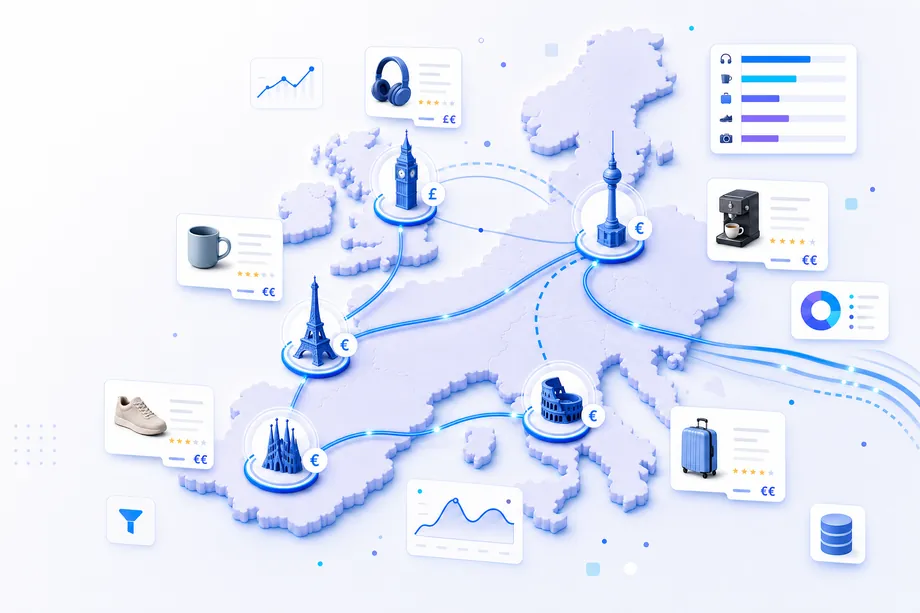
A seller once copied a successful US listing into Europe and expected the same sales pattern. The UK produced clicks, Germany showed a different competitive set, and the product had no active offer in two other stores. The issue was not a lack of ambition. It was a lack of comparable amazon europe marketplace data.
Europe is a network of country stores with different languages, currencies, search habits, delivery, seller populations, and compliance. Amazon reports that more than 80% of the UK population bought online in 2024, compared with more than 71% in Germany, and lists average customer spend of $2,940 in the UK and $2,050 in Germany. [1] This guide compares the UK, Germany, France, Italy, and Spain using price, offer, search, BSR, localization, and operating evidence.
Quick Answer: Which Marketplace Should You Test First?
There is no universal winner. Start where your product fits, then validate it with the same product and keyword sample in every store.
| Marketplace | Starting signal | Key risk | Good first fit |
|---|---|---|---|
| UK (.co.uk) | English-language path and $2,940 average spend in Amazon's 2024 UK/Germany comparison | GBP, post-Brexit customs and separate operations | English-speaking teams |
| Germany (.de) | Major opportunity and central logistics position | Native localization and competition | Brands seeking an EU hub |
| France (.fr) | Potential fit for design, quality, and specialty products | Literal translation misses intent | Teams with French copy review |
| Italy (.it) | Focused category and seasonal tests | Lower overall online adoption | Lean experimenters |
| Spain (.es) | Local-language and seasonal reach | UK keywords do not transfer | Sellers with Spanish localization |
Choose the market that passes demand, visibility, margin, competition, and compliance checks. Do not choose from a generic list. That is the practical meaning of amazon europe marketplace data.
What Amazon Europe Marketplace Data Measures
A useful dataset joins five layers: consumer context, search visibility, product economics, competition, and operations. Consumer context shows whether online buying is common. Search data shows what shoppers see. Product and offer data explain price, stock, seller, and fulfillment. BSR and history add demand signals. Operations test whether margin survives fulfillment, returns, currency, tax, and localization.
| Layer | Measures | Decision |
|---|---|---|
| Demand | Online-shopping context, keywords, seasonality | Whether to test |
| Visibility | Organic position, sponsored placement, local copy | Click difficulty |
| Economics | Price, shipping, currency, fees | Margin potential |
| Competition | Offers, reviews, Buy Box, BSR | Differentiation potential |
| Operations | Stock, delivery, dimensions, compliance | Execution risk |
Broad ecommerce statistics are context, not Amazon demand. The Council of the EU reports that 77% of EU internet users bought online in 2024, but Italy was at 60% while Ireland, the Netherlands, and Denmark were above 90%. [2] A lower-adoption country can still contain a good Amazon niche, but it needs stronger product-level evidence.
Why European Amazon Marketplaces Differ
Language, currency, seasonality, seller density, and inventory placement change the result. Amazon says a listing in one Europe store does not automatically cross-list into the others, so local taxes, VAT, safety, and listing requirements must be reviewed. [1]
Amazon UK: Market Size, Pricing, and Competition
The UK is often the easiest first test for an English-speaking team. Amazon's published comparison reports more than 80% of the UK population bought online in 2024 and $2,940 average spend per customer. [1] Research the UK in GBP. Capture displayed price, shipping, Prime status, condition, and Buy Box seller separately, then model source currency, conversion, fulfillment, returns, and import handling. A lower-looking price can still produce a lower margin.
Combine organic position with offer count. A first-page result crowded with sponsored placements may be harder to enter than a smaller result set with stable organic visibility. Buyers should compare delivered price and seller reputation, not the headline price alone.
Amazon Germany: The Largest EU Marketplace
Germany is an important candidate because Amazon describes it as a major commercial hub and one of Europe's largest ecommerce opportunities. Amazon reports more than 71% of the German population bought online in 2024 and $2,050 average spend per customer. [1] The main requirement is native-quality localization: translate benefits, search German terms, inspect local titles and attributes, and keep original and local keywords separate in the dataset.
Review fulfillment and tax exposure before forecasting. Amazon explains that European fulfillment may distribute inventory across countries, creating obligations where goods are stored. [1] Data identifies an opportunity; it does not replace tax or legal advice.
Amazon France, Italy, and Spain: Focused Opportunities
France: Test products whose value depends on design, quality, ingredients, or sustainability. Use local search phrases and review language rather than literal title similarity, and keep euro price and shipping separate.
Italy: The Council of the EU reports that 60% of Italian internet users bought online in 2024. [2] This does not disqualify Italy; it makes category selection, seasonality, and conservative forecasts more important. Start with a focused product family.
Spain: Household, sports, travel, and seasonal products can fit Spanish demand, but local keywords and review themes must be measured directly. A clear image can win a click while unclear sizing or delivery loses the conversion.
Apply the same timestamp, ASIN rules, currency policy, and sponsored-result treatment in all three stores. Never compare a sponsored UK result with an organic French result or a used offer with a new Buy Box offer.
Price Comparison: Same Product Across EU Markets
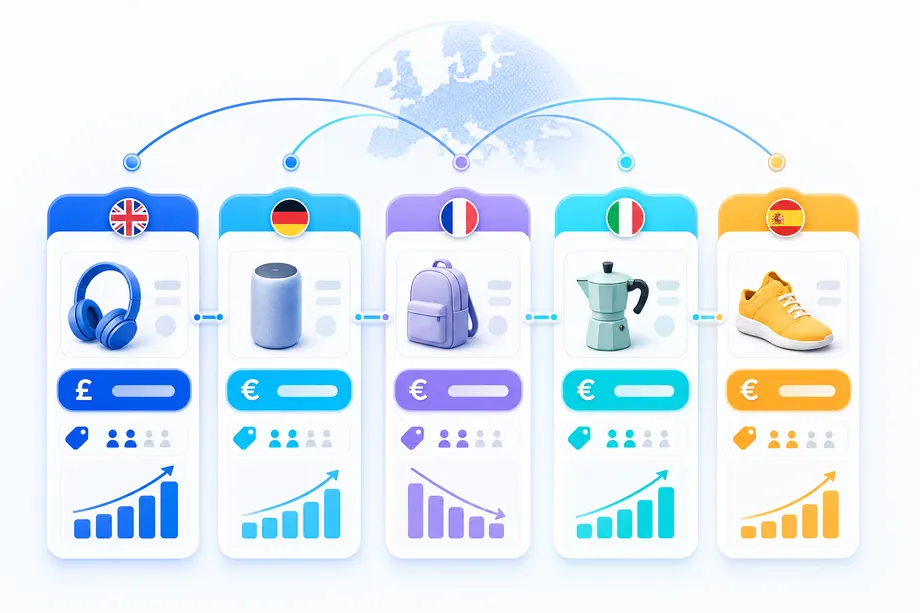
Price comparison requires more than converting five numbers into euros. Capture local price, currency, shipping, tax display, condition, fulfillment, seller, Buy Box status, coupon state, and timestamp. Use the same ASIN when active in each store; otherwise define an equivalent-product set.
| Field | Why it matters | Bad shortcut |
|---|---|---|
| Displayed price | Local shopper view | FX conversion without a timestamp |
| Shipping and delivery | Changes landed cost | Calling free shipping a lower product price |
| Condition | New and used are not equivalent | Using the lowest used offer as the floor |
| Seller and fulfillment | Shapes the Buy Box | Assuming the lowest offer wins |
| Coupon state | Explains temporary gaps | Building a permanent strategy from a promotion |
A real Easyparser smoke test on August 21, 2026 requested ASIN B01GJOMWVA through DETAIL, OFFER, and BEST_SELLERS_RANK for the five target domains. DETAIL returned localized titles in all five stores. OFFER returned zero active offers for .co.uk, .de, .fr, and .es in that snapshot, while .it returned one FBM offer at USD178.18. This is not a permanent claim about Italy. It shows why availability, currency, condition, and response quality must be validated before scoring a gap.
When a price is present, preserve local and normalized values. When an offer is absent, store null with a reason such as unavailable. Never encode missing data as a zero price.
BSR Differences: What Sells Where
Best Sellers Rank is relative to a category and marketplace. A lower rank usually indicates stronger sales velocity, but 2,000 in a broad category is not directly comparable with 2,000 in a narrow subcategory. Store category name or node with every rank.
BSR changes with promotions, stockouts, reviews, and seasonality. Collect the same ASIN set at similar times, repeat the request, and analyze direction as well as level. A rank that improves from 20,000 to 8,000 tells a different story from a rank that stays at 8,000 in a tiny category.
| Observation | Possible meaning | Next check |
|---|---|---|
| Low main-category rank | Strong relative velocity | Price, offers, reviews, history |
| Strong subcategory, weak main rank | Niche dominance | Category size and keywords |
| Rank with missing price | Availability mismatch | DETAIL and OFFER validation |
| Rank zero or missing | Placeholder or invalid rank | Exclude from scoring |
| One short-term jump | Promotion or seasonality | Repeat over several weeks |
For sellers, BSR is useful with price, reviews, offers, and stock. A validated trend is evidence.
How to Build a Comparable Dataset
Define the product family, local keywords, ASIN list, delivery location, date window, currency policy, and sponsored-result rules first. For SEARCH, save position, sponsorship, ASIN, title, price, rating, reviews, Prime flag, and page. For DETAIL, save stock, price, BSR context, and dimensions. For OFFER, save seller, condition, shipping, fulfillment, and Buy Box. For history, save price, BSR, reviews, and estimated views.
Use three quality gates: identity, localization, and completeness. Confirm that products are comparable, that local keywords remain visible, and that missing prices, zero offers, and invalid ranks are marked rather than silently scored. A clean null is more valuable than a fabricated zero.
Using Easyparser for Multi-Market Research
Use the Product Detail operation for product identity, localized content, price, stock, and dimensions. Use the Product Offer operation for seller pricing, shipping, fulfillment, and Buy Box context. Use the Product Lookup operation when a source catalog contains EAN, UPC, GTIN, or another identifier rather than an ASIN.
SEARCH supports keyword or URL research. BEST_SELLERS_RANK provides category context. SALES_ANALYSIS_HISTORY adds historical price, BSR, review, and estimated traffic or view signals. PACKAGE_DIMENSION connects the opportunity to fulfillment economics. Keep operation names uppercase and send only the documented domain extension: .co.uk, .de, .fr, .it, or .es.
Real-Time API: validate a decision now
Real-Time API fits dashboards, small samples, triggered checks, and schema validation. This example requests DETAIL for one ASIN in all five stores and prints fields that should be checked in production.
import requests
API_KEY = "YOUR_API_KEY" # Get your key from app.easyparser.com
ASIN = "B01GJOMWVA"
markets = [".co.uk", ".de", ".fr", ".it", ".es"]
for domain in markets:
params = {
"api_key": API_KEY,
"platform": "AMZ",
"operation": "DETAIL",
"asin": ASIN,
"domain": domain
}
response = requests.get("https://realtime.easyparser.com/v1/request", params=params, timeout=30)
data = response.json()
detail = data.get("result", {}).get("detail", {})
print(domain, detail.get("price"), detail.get("bestsellers_rank"))
Bulk API: collect a decision dataset
Bulk API is better for many ASINs, keywords, or operations. Submit a POST job to https://bulk.easyparser.com/v1/bulk, receive result IDs, and retrieve completed data through the callback and data-service flow. Easyparser documents batches of up to 5,000 items, subject to plan limits. [3]
Persist each result ID and handle accepted, invalid, failed, insufficient-credit, and rate-limited items separately. The example submits one organic keyword search to all five stores.
import requests
import json
API_KEY = "YOUR_API_KEY"
jobs = []
for domain in [".co.uk", ".de", ".fr", ".it", ".es"]:
jobs.append({
"platform": "AMZ", "operation": "SEARCH", "domain": domain,
"payload": {"keywords": ["insulated water bottle"], "exclude_sponsored": True},
"callback_url": "https://your-domain.com/easyparser/webhook"
})
response = requests.post("https://bulk.easyparser.com/v1/bulk", headers={"api-key": API_KEY, "Content-Type": "application/json"}, data=json.dumps(jobs), timeout=30)
print(response.json())
Case Study: Choosing a First EU Market
For a reusable insulated bottle with two localization resources and a limited budget, do not send inventory to all five stores. PRODUCT_LOOKUP resolves identifiers; SEARCH checks local keywords; selected ASINs are enriched with DETAIL, OFFER, BEST_SELLERS_RANK, SALES_ANALYSIS_HISTORY, and PACKAGE_DIMENSION.
| Score | Weight | Evidence |
|---|---|---|
| Demand and visibility | 35% | Organic position, BSR trend, keywords |
| Contribution margin | 25% | Price, fees, fulfillment, returns, FX |
| Competition | 20% | Offers, reviews, Buy Box, sponsored density |
| Operations | 10% | Inventory route, delivery, dimensions |
| Localization and compliance | 10% | Copy, VAT, safety, product documents |
Germany may lead on logistics, the UK on launch speed, France on a design-led product, and Italy or Spain on a focused niche. The winning market remains attractive after missing data and operating costs are included. This is how amazon europe marketplace data becomes a decision.
Buyer and Seller Decision Guide
Buyers should compare delivered price, condition, seller reputation, delivery, returns, and warranty language. Sellers should start where they can localize and fulfill reliably. Analysts should save raw responses, timestamps, domain, operation, query, and confidence. Easyparser makes inputs repeatable, but it does not replace VAT, customs, safety, consumer-protection, or tax advice.
A Practical 30-Day Test Plan
Days 1-7: define the product family, local keywords, ASIN list, margin threshold, currency rule, and compliance assumptions. Run SEARCH across the five domains. Days 8-14: enrich comparable ASINs with DETAIL and OFFER, storing price, shipping, condition, fulfillment, Buy Box, reviews, stock, title language, and seller count.
Days 15-21: add BEST_SELLERS_RANK and SALES_ANALYSIS_HISTORY, then compare category context, rank direction, price movement, reviews, and seasonality. Use PACKAGE_DIMENSION to test fulfillment cost. Days 22-30: review local copy, verify documentation, model VAT and returns, choose one or two markets, set an inventory ceiling, and schedule the next refresh.
Conclusion: Choose the Market You Can Measure
The UK, Germany, France, Italy, and Spain deserve different assumptions. Amazon's figures show strong opportunity in the UK and Germany, while EU statistics show wide variation in online-shopping adoption. [1] [2] A local, data-led test beats a generic European average.
Compare the same products and keywords, preserve local currencies, validate offer and rank fields, and connect demand to margin and operations. With amazon europe marketplace data, sellers can choose where to test and analysts can explain why results differ.
Start scaling your e-commerce business today
Start Your Free Trial100 free credits, no credit card required.