A US home-accessories seller can translate a title, convert dollars into yen, and still miss different Japanese queries, non-comparable pack sizes, and unresolved importer duties. Good amazon japan marketplace data turns expansion into evidence gates before inventory is committed.
Sources were checked on September 23, 2026. Recheck live fees, programs, regulations, and API coverage for the exact product and route. Japan-wide e-commerce figures are context, not Amazon.co.jp revenue, market share, or a sales forecast.
Quick Answer: Should You Research Amazon Japan?
Amazon Japan is worth a structured test when three conditions hold. The product has a verified path to import and sale, repeated Amazon.co.jp observations reveal a plausible local opportunity, and a yen-denominated model remains viable after all material costs. A single bestseller page, translated US listing, or broad market statistic is not enough.
| Gate | Evidence to proceed | Revise or stop signal |
|---|---|---|
| Eligibility | Exact SKU, importer, documents, labels, and category approval have a credible path. | Unknown product classification, restricted category, or no assigned importer responsibility. |
| Commercial evidence | Repeated Japanese-query observations show comparable products, stable price architecture, relevant category rank, and an understandable offer gap. | US-only keywords, one-day BSR, unrelated pack sizes, or missing seller and fulfillment context. |
| Economics | The contribution model stays positive under documented freight, FX, advertising, return, duty, and tax scenarios. | Margin works only when costs are omitted or optimistic assumptions are fixed. |
Why Amazon Japan Is Worth Considering
METI reports that domestic business-to-consumer e-commerce reached ¥26.1 trillion in 2024, up 5.1%. The physical-goods merchandising segment reached ¥15.2194 trillion, up 3.70%. These figures cover Japanese e-commerce across channels, not Amazon alone. Use METI's FY2024 survey to frame an investigation, then validate the category and SKU on amazon.co.jp.
For sellers, scale justifies research. For buyers, the real test is a lawful product with clear Japanese information, delivered price, service, and returns. A large national market does not remove those requirements.
Amazon Japan Market Size and Growth
| 2024 measure | Value | How to use it | What it cannot prove |
|---|---|---|---|
| Domestic B2C e-commerce | ¥26.1tn | National market context and direction | Amazon.co.jp GMV or share |
| Physical-goods merchandising | ¥15.2194tn | Closer context for product sellers | Demand for a particular SKU |
| B2C EC ratio | 9.8% | Share of covered transactions conducted online under METI's definition | Amazon conversion or category competition |
| Annual B2C growth | 5.1% | Direction of the wider domestic market | A future growth rate or seller forecast |
Use macro data to choose where to investigate, then move from category to Japanese query, comparable listings, and the exact SKU.
Top Categories on Amazon Japan: Build Hypotheses, Not Winners
METI's merchandising categories are useful hypothesis pools. They should not be presented as Amazon best sellers because the source covers Japanese e-commerce as a whole.
| METI 2024 category | Market scale | EC ratio | Research implication |
|---|---|---|---|
| Food, drinks, and liquor | ¥3.1163tn | 4.52% | Large context, but import notifications, shelf life, labeling, and category rules require early review. |
| Clothes and apparel goods | ¥2.7980tn | 23.38% | Investigate Japanese sizing, variants, return exposure, seasonality, and price bands. |
| Electrical appliances, AV, PCs, and peripherals | ¥2.7443tn | 43.03% | High online maturity merits research, while voltage, radio, battery, and PSE screening may be decisive. |
| Household goods, furniture, and interiors | ¥2.5616tn | 32.58% | Compare dimensions, fulfillment cost, materials, pack count, and local use cases. |
| Books and visual or music software | ¥1.8708tn | 56.45% | Illustrates online maturity, not an automatic opportunity for overseas physical-product sellers. |
Define a narrow buyer need, test Japanese script variants, separate organic and sponsored results, and document why each product is comparable.
How to Turn Amazon Japan Marketplace Data into a Comparable Dataset
A useful dataset preserves the Japanese query or ASIN, timestamp in Japan Standard Time, category path, variant, pack count, local price and shipping, availability, rating, reviews, offer context, fulfillment, BSR, and raw evidence. Keep missing values null with a reason, never zero.
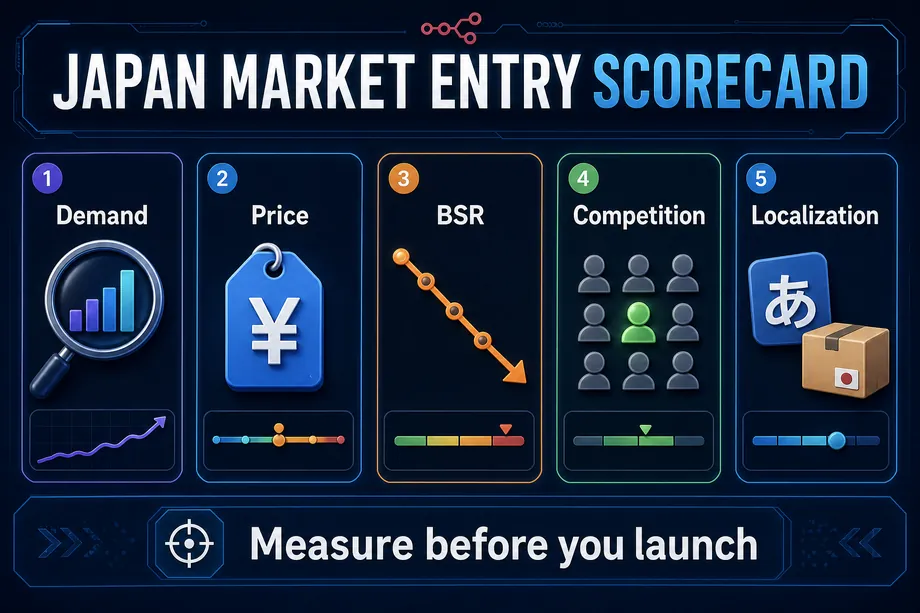
Define comparability before collection: the products should serve the same Japanese buyer need, sit in a relevant category, and have similar unit, pack, variant, and fulfillment conditions. Separate organic from sponsored results. Repeat the same sample over several weeks, preserving Japanese source text beside translated analyst fields. The record should show what was observed, what was inferred, and what remains unknown.
Pricing Patterns: Japan vs US and Europe
Model Japan locally, not as a converted US launch. Amazon Japan's pricing page, checked September 23, 2026, lists ¥100 per sold item for the Individual plan and ¥4,900 per month excluding tax for Professional, plus selling fees. Most listed referral fees range from 5% to 15.4% by category and price tier. FBA varies with packaged size and weight. Use the live pricing page and revenue calculator for the exact SKU.
For the US, account for Amazon's USD 39.99 Professional reference and any linked global-account billing rule. For Europe, compare the specific store, currency, VAT treatment, fee schedule, fulfillment route, and returns. Europe is not one jurisdiction.
Contribution per unit in JPY = buyer-paid price and shipping - Amazon fees - fulfillment and storage - product cost - freight, prep, duty, import tax, brokerage, advertising, returns, FX, localization, and compliance.
Also test cash timing. Inventory and import costs may be paid well before disbursement, so a positive unit margin can still produce a cash-flow problem.
BSR Benchmarks: What Sells Well in Japan?
Amazon defines Best Sellers Rank (BSR) as a category-relative sales-rank metric using recent and historical sales, with recent sales weighted more heavily. A lower number generally means a stronger position in that category. BSR is not determined by page views or reviews and is not organic search rank. See Amazon's official BSR guide.
A lower BSR is a stronger category sales position, not a published unit-sales count. Amazon publishes no universal Japan BSR-to-units formula. One ASIN can hold several ranks, and it can rank differently in Japan, the US, and the UK. Good amazon japan marketplace data keeps the exact browse node, JPY price, stock, rating, reviews, offers, fulfillment, and timestamp beside every rank.
| Observation | Interpretation | Next check |
|---|---|---|
| Rank improves repeatedly | Relative category position strengthened | Price, stock, promotion, offers |
| Strong subcategory, weak main rank | Possible niche strength | Node relevance and comparable set |
| Missing or invalid rank | Missing data, not zero demand | Detail page, category, response quality |
Use Product Opportunity Explorer, when available, as a separate Seller Central signal. Amazon says it can support demand, competition, search, pricing, review, and return research, but it does not guarantee sales.
Using Easyparser for Amazon Japan Research
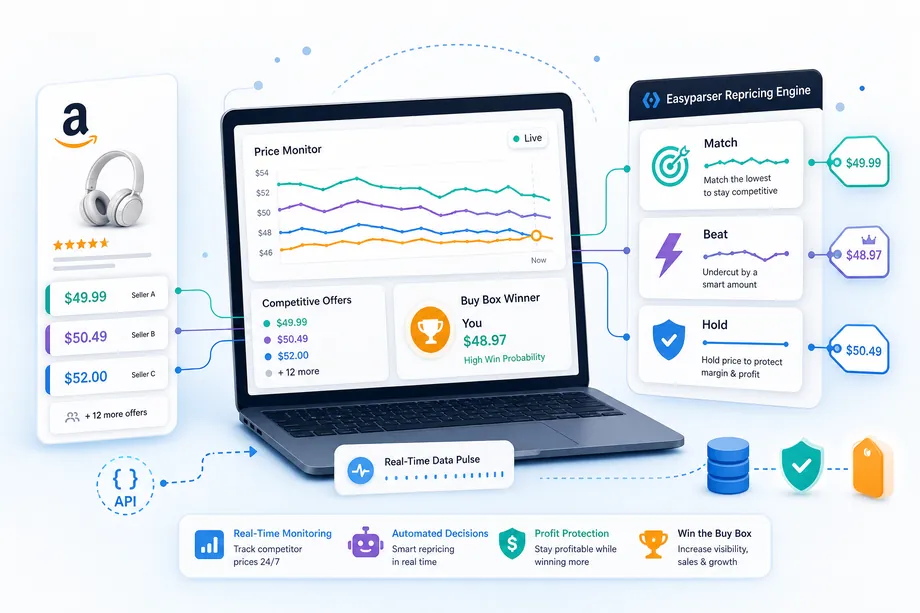
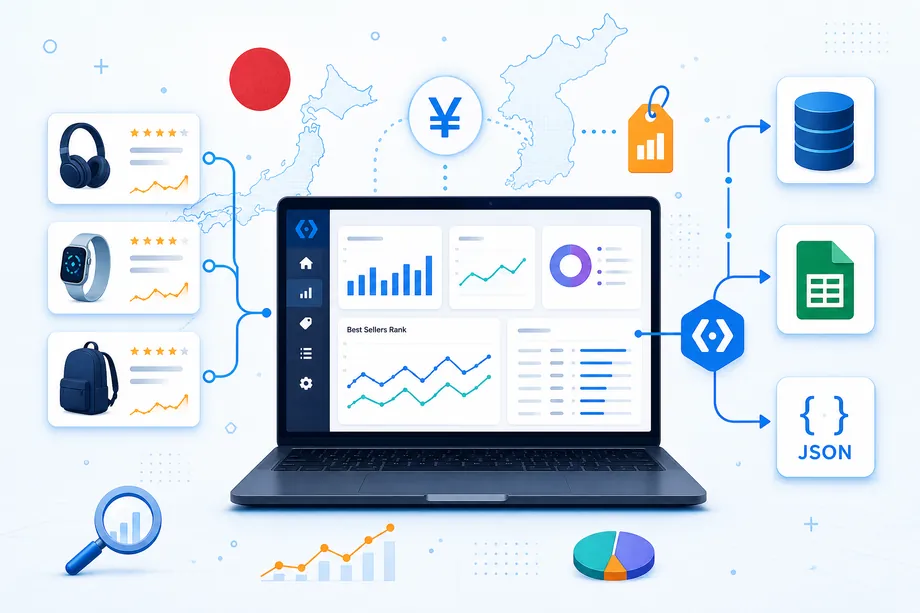
Easyparser supports amazon.co.jp as a repeatability layer after the question is defined. Use Search Listing for Japanese-query results and sponsored context, Product Offer for visible sellers, price, fulfillment, and Buy Box conditions, and Best Sellers Rank for category-relative rank.
| Question | Operations | Boundary |
|---|---|---|
| What appears for a Japanese query? | Search | Visibility is not search volume or conversion |
| Is the product comparable? | Detail, Product Lookup | Does not prove eligibility or authorization |
| How is the offer structured? | Offer | Does not reveal total market sales |
| How do rank and price change? | BSR, Sales Analysis History | Does not create official unit sales |
| Could size alter economics? | Package Dimension | Not a freight quote or final FBA fee |
Real-Time API or Bulk API?
Use the synchronous Real-Time API for small samples and immediate checks. Use the asynchronous Bulk API for larger keyword and ASIN sets, then store request IDs, webhook results, timestamps, failures, and retries. Test current domain parameters, plan limits, and field coverage first.
Easyparser collects observable amazon japan marketplace data; it does not establish official Amazon sales, approve a product, select an HS code, or replace Seller Central and professional review.
Localization Challenges: Language and Buyer Readiness
Localization is a product-information process, not a translation task. A Japan-ready listing should be reviewed for Japanese title, bullets, attributes, search terms, image text, instructions, warnings, warranty, service templates, units, pack count, compatibility, voltage, materials, size conventions, and legally required representations. Keyword research should test useful kanji, hiragana, katakana, and common product-language variants rather than importing an English list.
For buyers, the item, price, delivery, warnings, support, and returns should be clear. Japan's Consumer Affairs Agency identifies price, shipping, payment, delivery, return, and seller information as important direct mail-order disclosures; marketplace and seller-controlled surfaces remain distinct.
Compliance, Customs, and Importer Responsibility
Compliance is the first sourcing gate. Record the exact model, use, materials, voltage, radio functions, battery, ingredients, packaging, and origin. Check both Amazon restrictions and the Japanese regulator, then assign the importer of record and customs-declaration owner before freight is booked.
- Classify and document. Determine HS classification, origin, tariff treatment, and required records. Japan Customs offers advance classification rulings.
- Separate duty and tax. Imported goods are generally subject to customs duty and consumption tax. The standard consumption-tax rate is 10%, with 8% for defined cases, but seller registration and tax-agent duties are fact-specific.
- Check product law. Electrical items may trigger PSE duties; commercial food imports can require notification; cosmetics and quasi-drugs follow different standards and approval paths.
- Verify listing readiness. Required Japanese labels, warnings, instructions, claims, and documents must match the item, and legal importability does not guarantee Amazon category approval.
This is screening guidance, not Japan legal, customs, tax or product-certification advice. Obtain qualified advice for the exact product and route before shipping or listing. Start with Japan Customs import procedures.
FBA, Merchant Fulfillment, or a Japan 3PL?
| Route | Seller must fund and own | Buyer-facing consequence | Do not assume |
|---|---|---|---|
| Inventory in Japan FBA | Importer setup, clearance, prep, inbound plan, fees, inventory buffer, removal, returns | Amazon provides the FBA services described for eligible inventory | FBA is always cheapest or automatically suitable |
| Cross-border merchant fulfillment | Transport, customs payer, tracking, delivery promise, Japanese service, returns and refunds | Total charges and delivery or return certainty become critical | Direct shipping avoids import responsibility |
| Japan 3PL or self-fulfillment | Import and product duties plus the provider SLA, stock, support, and returns | A domestic route can simplify delivery if the actual SLA works | A local warehouse removes marketplace or legal responsibility |
Compare routes using the same volume, dimensions, delivery standard, returns, support workload, and inventory risk, not the lowest fee line alone.
Case Study: Launching a Product on Amazon Japan
Hypothetical worked example, not a fee quote or profitability forecast. A non-regulated household accessory has passed the assumed feasibility screen and is tested at a ¥2,400 buyer price.
| Line | Input | Treatment |
|---|---|---|
| Product cost | ¥520 | Hypothetical supplier input |
| Freight, brokerage, prep | ¥260 | Hypothetical lane allocation |
| Duty and import tax | D + T | Determine from classification and customs facts |
| Referral and FBA | R + F | Insert live category and package results |
| Storage, ads, returns, FX, localization | ¥350 | Illustrative reserves, not Japan benchmarks |
| Modeled contribution | ¥1,270 - D - T - R - F | Unresolved until live inputs are verified |
Test higher freight and FX, then higher advertising and returns. If contribution fails under a plausible downside, revise price, packaging, route, or product before ordering inventory.
A Practical 30-Day Amazon Japan Research Plan
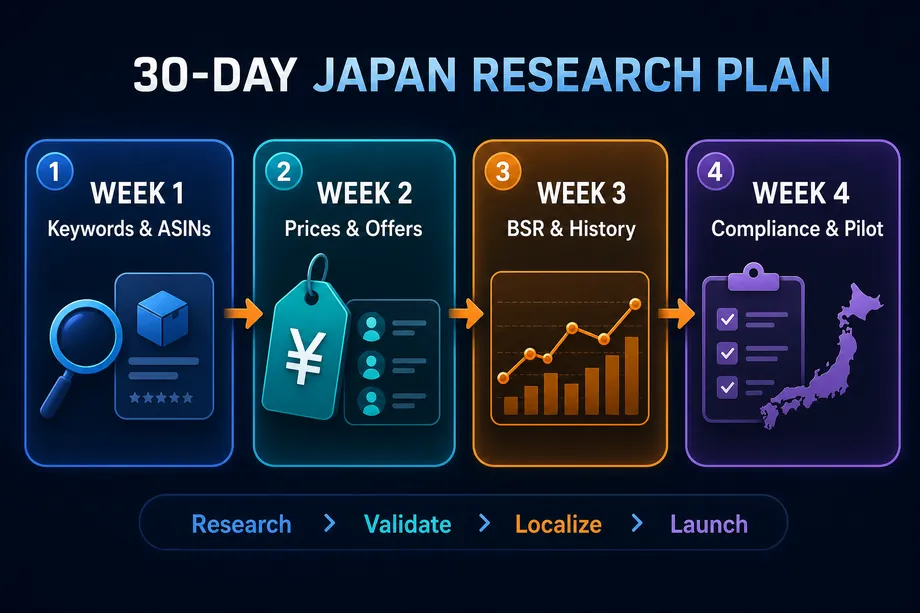
Days 1-7: define the exact SKU, regulator questions, importer options, Japanese buyer need, keyword variants, category, and comparable-set rule. Record exclusions.
Days 8-14: capture repeated query and ASIN observations. Normalize packs and fulfillment, preserve JPY, inspect sponsored density and seller coverage, and build the margin sheet.
Days 15-21: add BSR with browse-node context, availability, reviews, offers, and history. Compare FBA, merchant fulfillment, and 3PL cash timing. Request live fee, freight, customs, and service inputs.
Days 22-30: complete language and product-information QA, verify legal and Amazon pathways, stress-test economics, and define a limited pilot with stop conditions.
Go when eligibility, repeated evidence, downside margin, and buyer readiness all pass. Revise when a fix remains credible. Stop when compliance, data quality, or economics fail.
Buyer and Seller Decision Guide
Buyers should compare the exact variant, Japanese information, delivered price, seller, fulfillment, delivery, returns, warranty, and labels. Sellers should compare eligibility, importer ownership, demand evidence, competition, contribution, cash timing, localization, service, and inventory risk. Analysts must keep observations, assumptions, and decisions separate in every amazon japan marketplace data record.
Conclusion: Enter Japan with Evidence, Not Assumptions
Japan's ¥26.1 trillion domestic B2C e-commerce market is a strong reason to investigate, not a promise that a listing will succeed. A defensible entry sequence is eligibility, Japanese-language marketplace evidence, category-relative BSR, full yen economics, buyer-ready localization, and a limited test.
Document every go, revise, or stop decision before spending on inventory. Use amazon japan marketplace data to challenge the launch thesis before inventory makes the decision expensive. Easyparser can make search, offer, rank, and product observations repeatable across amazon.co.jp, while live Amazon tools, regulators, logistics providers, and qualified advisors supply the facts an extraction API cannot.
Start scaling your e-commerce business today
Start Your Free Trial100 free credits, no credit card required.