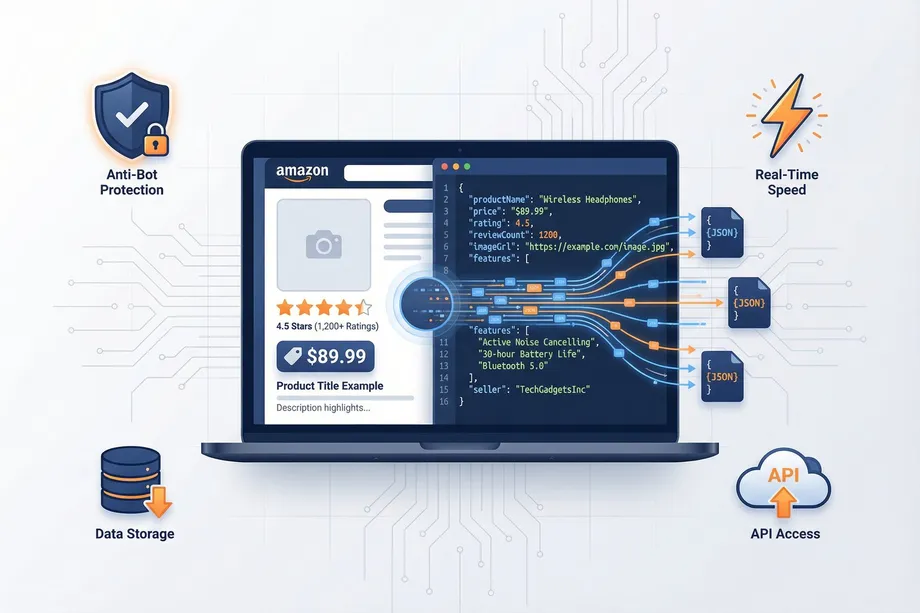
Extracting data from Amazon has never been more critical for e-commerce success, yet it has also never been more difficult. Whether you are building a dynamic pricing engine, monitoring competitor inventory, or conducting large-scale market research, the quality of your data directly impacts your business decisions. However, the world's largest e-commerce platform functions less like a simple website and more like a highly fortified data fortress.
For many engineering teams and data analysts, the initial instinct is to build a custom scraper in-house. This approach often seems cost-effective at first glance. However, the reality of maintaining a DIY scraper against Amazon's constantly evolving architecture quickly turns into a full-time engineering burden. The solution is clear: leveraging a dedicated how to choose an amazon scraper api is essential. But with dozens of providers on the market, how do you separate the truly reliable APIs from those that break at the first sign of a layout change? This guide provides a comprehensive checklist to help you evaluate and choose the right Amazon scraping solution.
Why Generic Scrapers Fail on Amazon?
Before diving into the selection criteria, it is crucial to understand why standard web scraping tools struggle with Amazon. Amazon does not simply serve static HTML pages; it employs a sophisticated, multi-layered defense system designed to identify and block automated traffic.
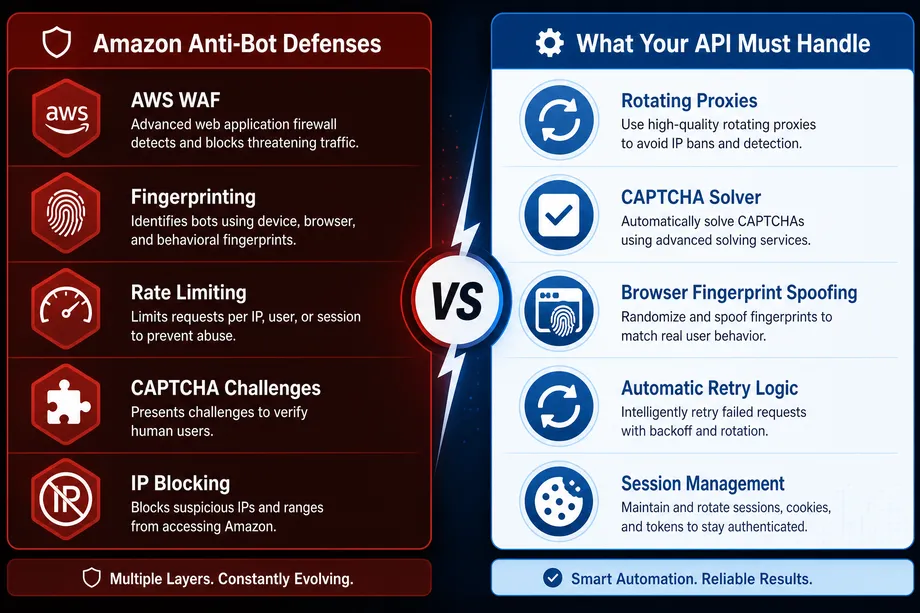
When a generic scraper attempts to access an Amazon product page, it immediately encounters several hurdles. First, AWS Web Application Firewall (WAF) analyzes the traffic patterns. If the request volume is too high or the IP address is suspicious, the connection is instantly severed. Second, Amazon uses advanced device fingerprinting to analyze browser characteristics, screen resolution, and even mouse movements. If these do not match human behavior, the request is flagged.
Finally, even if a scraper bypasses the initial firewall and fingerprinting checks, it will likely be presented with a CAPTCHA. Manual solving is impossible at scale, and basic OCR tools fail against Amazon's complex puzzles. This is why DIY scrapers and generic APIs often suffer from high failure rates, returning incomplete data or getting IP banned entirely.
What Makes an Amazon Scraper API "Reliable"?
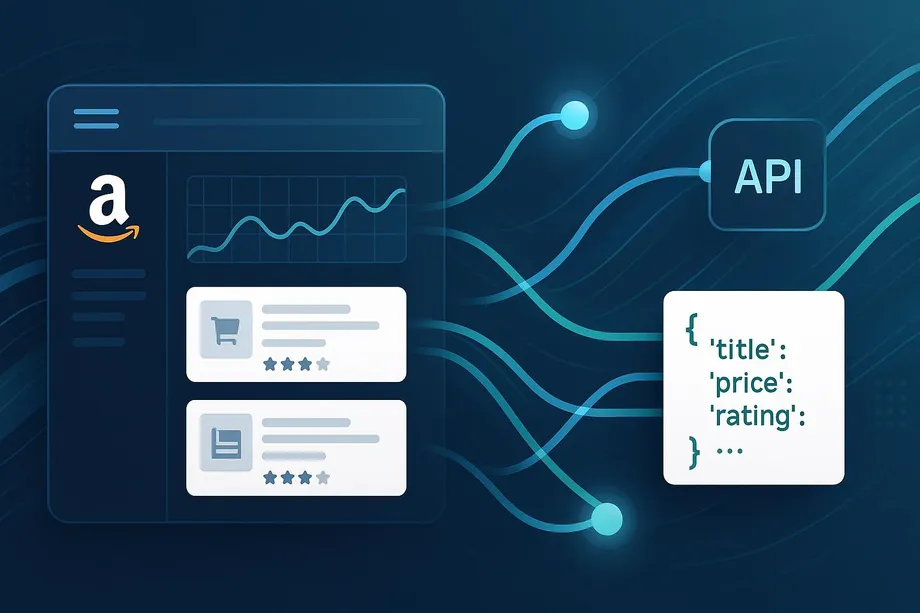
A truly reliable Amazon scraper API must act as a complete abstraction layer between your application and Amazon's infrastructure. It should allow you to send a simple request (like an ASIN or a search query) and receive clean, structured data in return, without you ever needing to worry about proxies, CAPTCHAs, or HTML parsing.
When evaluating providers, you should not just look at marketing claims. You need to assess their technical capabilities across several critical dimensions. The following sections break down the essential checklist for choosing an amazon scraper api.
Anti-Bot Handling: Why It Determines Uptime
The foundation of any reliable amazon scraper api is its ability to handle anti-bot measures. This is the single biggest factor that determines the API's uptime and success rate.
A production-ready API must possess a massive, high-quality proxy pool, primarily consisting of residential IPs. Datacenter IPs are quickly identified and blocked by Amazon. Furthermore, the API must intelligently rotate these proxies, managing sessions and cookies to simulate natural user behavior.
Beyond proxies, the API must feature robust, automated CAPTCHA solving capabilities. It should also handle browser fingerprint spoofing, ensuring that every request appears to come from a unique, legitimate user device. Finally, the API needs intelligent retry logic. If a request fails, the system should automatically retry using a different proxy and fingerprint combination before returning an error to your application.
Marketplace Coverage and Localization Support
E-commerce is global, and your data extraction strategy must be as well. A common mistake is choosing an API that only performs well on Amazon.com but fails when targeting European or Asian marketplaces.
When evaluating an API, verify its support for the specific regional domains you need (e.g., .co.uk, .de, .co.jp). More importantly, investigate its localization capabilities. Amazon frequently alters prices, shipping costs, and product availability based on the buyer's location.
This is where features like Address Targeting become invaluable. A top-tier API will allow you to specify a delivery ZIP code or postal code in your request. This ensures that the data you receive accurately reflects what a customer in that specific region sees, which is crucial for accurate competitive analysis and pricing strategies.
Data Structure: JSON, CSV, and Export Flexibility
The primary goal of using an API is to obtain data that is ready for analysis, not raw HTML that requires further processing. Therefore, the structure and format of the output data are critical evaluation criteria.
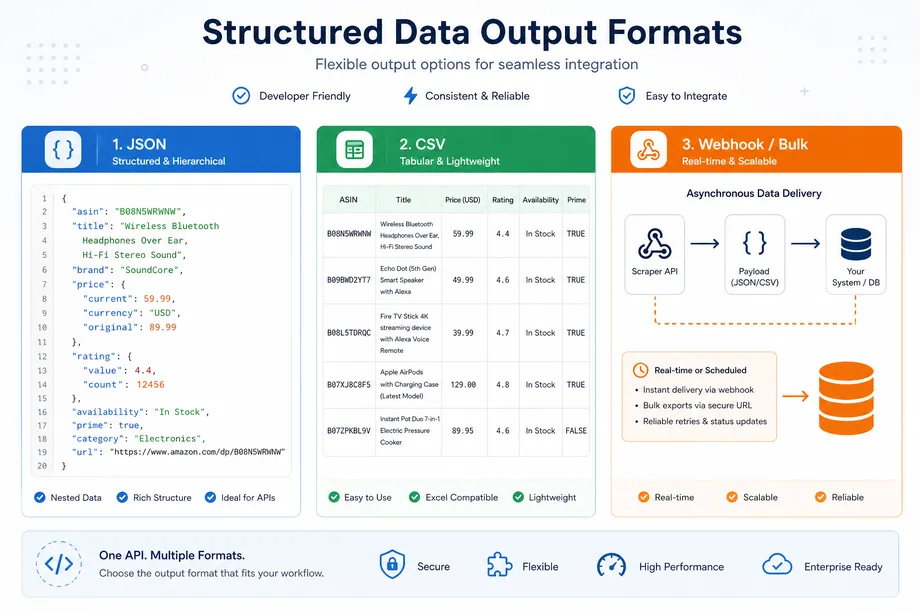
The industry standard is JSON (JavaScript Object Notation). A reliable API should return a deeply structured, hierarchical JSON payload. This payload should cleanly separate different data points, such as the base price, shipping cost, currency, seller information, and detailed product specifications. This structured format makes it incredibly easy to integrate the data into your databases or analytics dashboards.
Additionally, some APIs offer CSV export options, which are beneficial for teams that prefer to work directly in spreadsheet applications like Excel or Google Sheets. For large-scale operations, look for APIs that support webhook integrations or bulk export features, allowing you to receive asynchronous data deliveries directly to your systems.
Real-Time Data vs Cached Data
Timing is everything in e-commerce. Depending on your use case, you need to understand whether the API provides real-time data or relies on cached responses.
If you are building a dynamic pricing tool that needs to react instantly to a competitor's price drop, you require a Real-Time API. These APIs fetch the data directly from Amazon at the moment of your request, typically responding within a few seconds. However, real-time extraction is resource-intensive and often more expensive.
If you are conducting historical market research or tracking long-term trends, a Cached or Bulk API might be more appropriate. These systems may return data that is a few hours old but are generally more cost-effective and capable of handling massive volumes of ASINs simultaneously.
Rate Limits, Scaling, and Bulk Processing
As your business grows, your data needs will scale exponentially. An API that works perfectly for tracking 100 products might completely collapse when you try to monitor 100,000 products.
You must carefully examine the API's rate limits and concurrency allowances. How many simultaneous requests can you make? Are there hourly or daily request caps? A robust API should offer high concurrency limits, allowing you to process large batches of ASINs quickly.
For enterprise-level scaling, look for APIs that offer dedicated bulk processing endpoints. These allow you to submit a list of thousands of ASINs in a single request and receive the results asynchronously via a webhook or a downloadable file, significantly reducing the overhead on your own servers.
Pricing Models: Credits vs Per-Request Costs
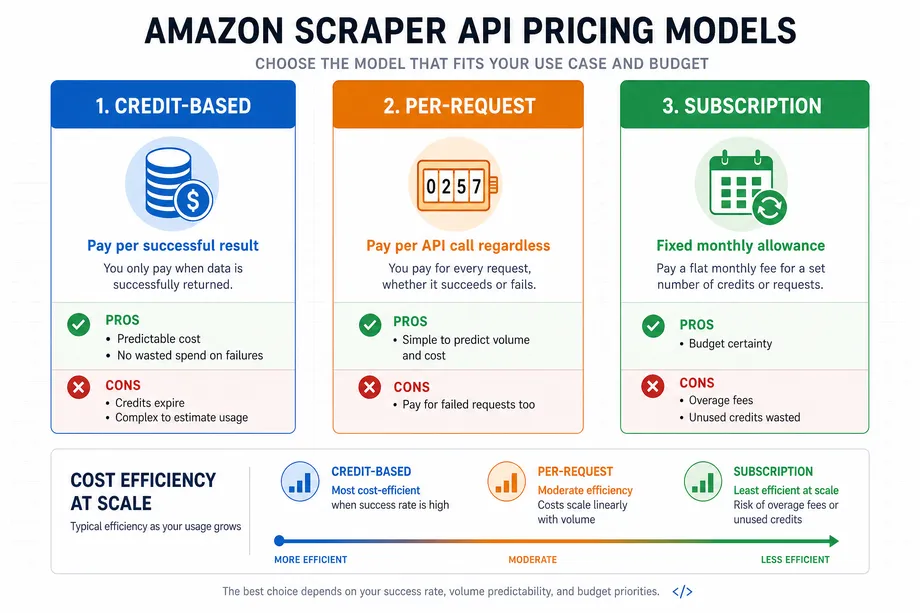
Understanding the pricing model is arguably the most confusing part of choosing an amazon scraper api. Providers typically use one of two main models: Credit-Based or Per-Request.
In a Per-Request model, you pay a fixed fee for every API call you make, regardless of the outcome. If the request is blocked by Amazon or returns an error, you still pay for it. This model can be risky if the API has a low success rate, as your effective cost per successful result will be much higher than the advertised price.
The Credit-Based model is generally more favorable for users. In this system, you purchase a pool of credits, and you are only charged when the API successfully returns the requested data. If a request fails, you do not lose a credit. This provides much better cost predictability and ensures you are only paying for actual value.
A Quick Checklist Before You Commit
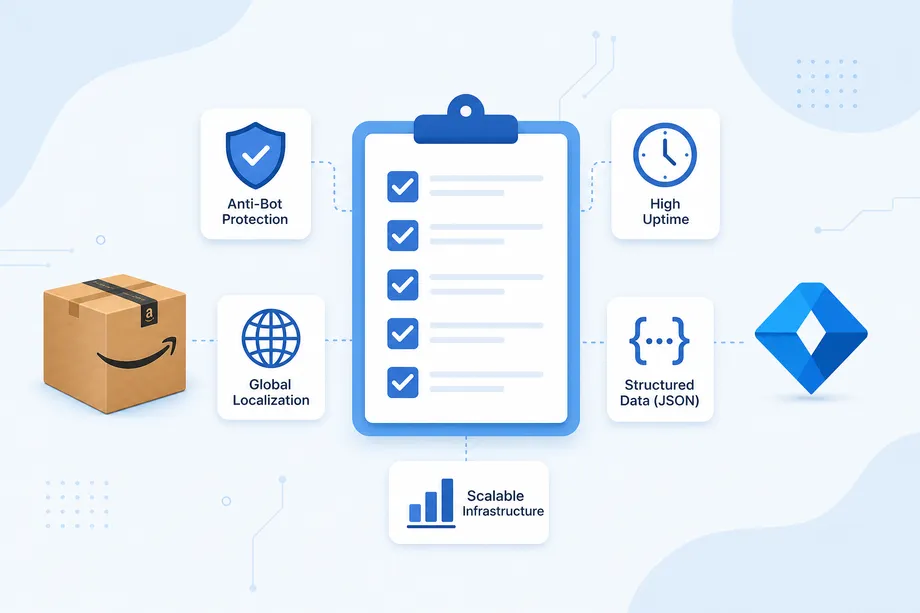
To summarize, before you integrate an API into your production environment, ensure it passes this checklist:
- High Success Rate: Does it consistently bypass CAPTCHAs and IP blocks?
- Structured Output: Does it return clean, parsed JSON data?
- Localization: Can you target specific ZIP codes for accurate pricing?
- Scalability: Can it handle your required concurrency and request volume?
- Fair Pricing: Do you only pay for successful requests?
For a deeper dive into how different tools stack up against these criteria, you can review our Best Amazon Scraper API Comparison Guide, which provides a detailed analysis of the top providers in the market.
Where Easyparser Fits Each Criterion
When evaluating options based on this checklist, Easyparser emerges as a purpose-built solution designed specifically for the complexities of Amazon data extraction. Unlike generic web scrapers that attempt to be a jack-of-all-trades, Easyparser focuses entirely on providing the most reliable Amazon data infrastructure.
For instance, Easyparser handles all anti-bot measures internally, boasting an exceptionally fast real-time response rate of approximately 7.5 seconds. It natively supports Address Targeting, allowing you to extract hyper-localized pricing data. Furthermore, it offers unique data channels that many competitors lack, such as detailed Sales Analysis and Package Dimensions.
Perhaps most importantly, Easyparser utilizes a transparent 1:1 credit model. You only pay for successful requests, eliminating the hidden costs associated with failed API calls. To see how simple it is to integrate, consider the following Python example using the Product Detail operation:
import requests
API_KEY = "YOUR_API_KEY" # Get your key from app.easyparser.com
ASIN = "B098FKXT8L"
params = {
"api_key": API_KEY,
"platform": "AMZ",
"operation": "DETAIL",
"asin": ASIN,
"domain": "com"
}
response = requests.get("https://realtime.easyparser.com/v1/request", params=params)
data = response.json()
product = data.get("product", {})
print(f"Title: {product.get('title')}")
print(f"Price: ${product.get('price')}")
print(f"Rating: {product.get('rating')} stars")
Whether you need to monitor a few hundred products or build a massive competitive intelligence database, choosing an API that checks all the boxes for reliability, structure, and fair pricing is the first step toward actionable e-commerce insights. If you need to monitor competitor pricing across all sellers, you can easily switch the operation to Product Offer, or use Product Lookup to find products by keyword, all within the same robust infrastructure.
Start running your own Amazon analysis for free
Start Your Free Trial100 free credits, no credit card required.