The Amazon FBA fee changes 2027 come down to one number and three dates. Amazon says US fulfillment fees rise by $0.19 per unit sold on average, about 0.8% of the average selling price, but the real change for your products depends on size tier, shipping weight and price band. Most fulfillment changes start on January 15, 2027; storage, low-inventory-level, AWD and returns changes follow on February 1; and AWD storage becomes age-based on March 1. This guide lists what changes, shows old and new rates side by side from Amazon's own rate card, works through four example products, and ends with a checklist of what to re-check before January 15.
Amazon FBA fee changes 2027: what changes
Amazon published the update on November 5, 2026 in Seller Central, together with separate help pages for the fulfillment rate card, low-price FBA, storage and the low-inventory-level fee. In short:
- FBA fulfillment fees rise for most standard-size products, with the largest increases for small standard-size items and for anything priced above $50.
- Low-price FBA rates (products under $10) rise slightly and are no longer available in five fee categories.
- Bulky and extra-large products move to a new tier structure: four bulky tiers and six oversize tiers. Many large items get cheaper, heavier and larger ones get more expensive.
- Storage becomes a single unified monthly fee that depends on inventory age. The storage utilization surcharge and the separate aged inventory surcharge disappear.
- The low-inventory-level fee keeps its 28-day threshold but measures demand differently.
- Referral fees only change in two narrow places: a new tiered rate for 3D printers and a temporary 10% rate for Amazon Renewed products.
- Promotions get a new fee for Buy X, Get Y offers and monthly billing for every promotion type.
Two things do not change: the inbound placement service fee rate card stays the same, and the 3.5% fuel and logistics-related surcharge that Amazon introduced in April 2026 stays on top of fulfillment fees.
Key dates: January 15, February 1 and March 1
| Date | What takes effect |
|---|---|
| November 5, 2026 | New 3D printer referral fee (12% up to $200, 5% above). Promotional 10% referral fee for eligible Amazon Renewed products, running through October 18, 2027. |
| October 15, 2026 to January 14, 2027 | Holiday peak fulfillment fees (already in force). |
| January 15, 2027 | Peak fees end and the new 2027 non-peak fulfillment rates start, including new bulky and oversize tiers, the low-price FBA eligibility change and new oversize handling fees. Returns processing fee changes for Apparel and Shoes. |
| February 1, 2027 | Unified monthly storage fee, no more storage utilization surcharge, new low-inventory-level fee test, returns processing fee changes for other high-return categories, new AWD processing and transportation fees. |
| February 2027 | Monthly billing for all promotions; fees that would have been charged in January move to the first February cycle. |
| March 1, 2027 | AWD storage fees vary by inventory age; inventory stored more than 12 months is charged 2.5 times the standard rate. |
One detail is easy to miss. Between October 15, 2026 and January 14, 2027 you are paying holiday peak rates. On January 15, fees go back to non-peak levels and the 2027 changes apply at the same moment. Compared with what you pay today, some fees will actually fall on January 15. Compared with the 2026 non-peak rates you paid most of the year, nearly all standard-size fees rise. For budgeting, compare 2027 non-peak with 2026 non-peak.
FBA fulfillment fees: old vs new by size tier
The table below takes selected rows from Amazon's 2027 US FBA fulfillment fee changes page, for non-apparel, non-dangerous goods products. Both columns are non-peak rates and exclude the 3.5% fuel and logistics-related surcharge. Rates checked on November 23, 2026.
| Size tier and shipping weight | Under $10: 2026 / 2027 | $10 to $50: 2026 / 2027 | Above $50: 2026 / 2027 |
|---|---|---|---|
| Small standard, 2 oz or less | $2.43 / $2.64 | $3.32 / $3.75 | $3.58 / $4.31 |
| Small standard, 6+ to 8 oz | $2.66 / $2.83 | $3.54 / $3.97 | $3.80 / $4.53 |
| Small standard, 14+ to 16 oz | $2.95 / $2.99 | $3.96 / $4.32 | $4.22 / $4.88 |
| Large standard, 4 oz or less | $2.91 / $2.91 | $3.73 / $3.79 | $3.99 / $4.35 |
| Large standard, 12+ to 16 oz | $3.78 / $3.78 | $4.60 / $4.67 | $4.86 / $5.23 |
| Large standard, 1.75+ to 2 lb | $5.00 / $5.00 | $5.82 / $5.98 | $6.08 / $6.54 |
| Large standard, 2.75+ to 3 lb | $5.85 / $5.85 | $6.67 / $6.85 | $6.93 / $7.41 |
| Large standard, 3+ to 20 lb (base, plus $0.08 per 4 oz above 3 lb) | $6.15 / $6.15 | $6.97 / $7.16 | $7.23 / $7.73 |
The pattern is clear. Small standard-size products pay the most extra: Amazon puts the average at $0.40 per unit for the $10 to $50 band and $0.70 above $50. Large standard-size products rise by $0.12 on average in the $10 to $50 band and $0.47 above $50. In the under-$10 band, small standard rises by about $0.20 and large standard stays flat for non-apparel products. Apparel and dangerous goods have their own tables with similar increases.
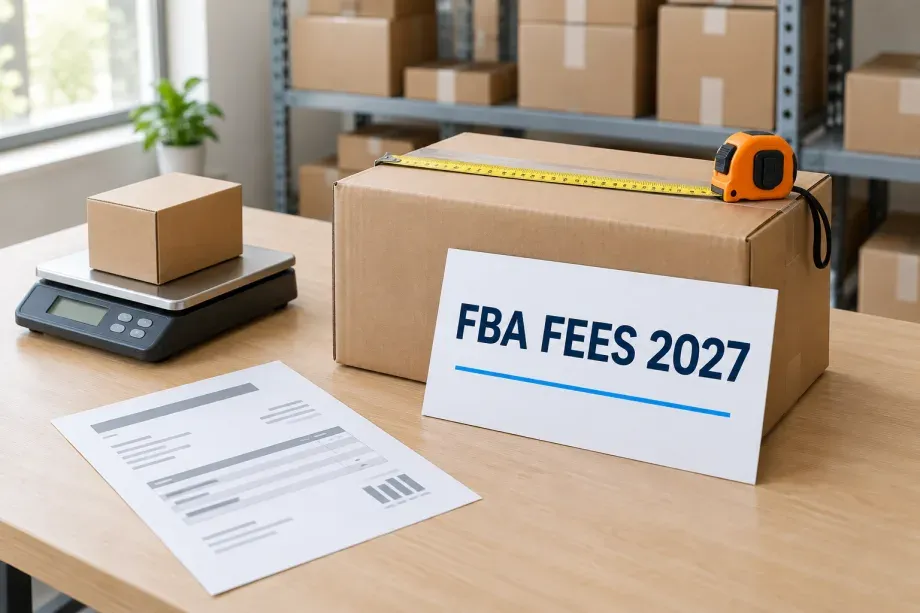
Remember that small standard fees use unit weight, while large standard, bulky and oversize fees use the greater of unit weight and dimensional weight (length x width x height divided by 139). A box that is a little too big can push a product into a heavier row. Our guide on how to reduce FBA fees with better package dimensions explains how to check this.
Low-price FBA loses five categories
From January 15, products in these fee categories can no longer use low-price FBA rates and pay the $10 to $50 rates instead: Automotive and Powersports, Compact Appliances, Computers, Musical Instruments and AV Production, and Media (Books, DVD, Music, Software, Video). For a cheap book or a small car accessory this is the biggest single change in the whole update. A small standard item of 6+ to 8 oz that paid the under-$10 rate of $2.66 in 2026 would pay $3.97 in 2027 at the $10 to $50 rate, an increase of $1.31 before the surcharge.
Bulky and oversize: new tiers, often lower fees
Small bulky splits into small and medium bulky, large bulky splits into large and extra-large bulky, and the old extra-large tiers become six oversize tiers. Amazon's own examples show how different the outcome can be. A 41 lb monitor (small oversize, previously extra-large 0 to 50 lb, priced $10 to $50) goes from $43.81 to $27.10. A 62 lb TV (medium oversize, priced above $50) goes from $48.57 to $36.55. A 7.9 lb baby cot in small bulky goes from $10.21 to $10.24. The overmax handling fee is removed and new flat product and overhang handling fees are introduced, so check irregular items separately.
Storage, low-inventory-level and AWD changes
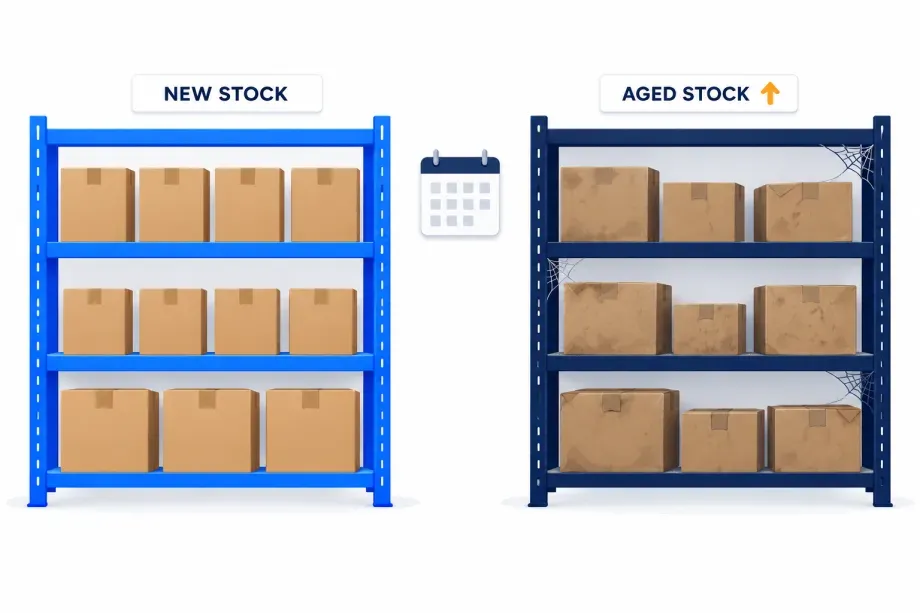
Storage is the second big part of the Amazon FBA fee changes 2027. From February 1, 2027, the base monthly storage fee, the storage utilization surcharge and the aged inventory surcharge are replaced by one unified monthly storage fee per cubic foot. The rate depends on how long each unit has been stored. For standard-size, non-dangerous goods in the off-peak months (January to September), the comparison looks like this:
| Inventory age | Before February 1, 2027 (base $0.78 + aged surcharge) | From February 1, 2027 (unified fee) |
|---|---|---|
| 0 to 180 days | $0.78 per cu ft | $0.78 per cu ft |
| 181 to 210 days | $1.28 | $2.78 |
| 211 to 240 days | $1.78 | $2.78 |
| 241 to 270 days | $2.28 | $2.78 |
| 271 to 300 days | $6.23 | $6.68 |
| 301 to 330 days | $6.48 | $6.68 |
| 331 to 365 days | $6.68 | $6.68 |
| 366 to 455 days | $7.68 (or the per-unit minimum) | $7.68, or $0.78 plus $0.30 per unit if greater |
The old column leaves out the storage utilization surcharge, which added up to $1.88 per cubic foot for standard-size inventory when your storage ratio was high. Its removal is good news for sellers who build stock before a sales event. The flip side is that inventory between 181 and 330 days old becomes more expensive. Clothing, shoes, bags, jewelry and watches, which were exempt from the first aged surcharge tiers, now pay $1.78 per cubic foot from 181 to 270 days. In October to December, a peak add-on of $1.62 per cubic foot (standard size) or $0.84 (bulky and oversize) applies on top.
Amazon's own example makes the scale clear: 100 units of 0.05 cubic feet each, all under 180 days old, cost $3.90 a month in July. Shift 20 of them into the 181 to 270 day tier and the bill becomes $5.90. For a single unit of that size, monthly storage goes from about $0.04 to about $0.14 once it passes 180 days.
Low-inventory-level fee. The fee still applies when inventory falls below 28 days of supply, but from February 1 Amazon measures supply with actual shipments in the four weeks before and after the assessment date, instead of trailing 30 and 90 day sales. Amazon says this should reduce charges caused by sudden demand spikes or by end-of-season and end-of-life products. The rate itself was not changed in the announcement.
AWD. From February 1, AWD processing fees become $1.55 per box and transportation $1.58 per cubic foot, single-SKU pallets get a 40% inbound processing discount, and the fuel and logistics-related surcharge applies to AWD transportation. From March 1, AWD storage depends on age. FNSKUs that are 70% or more auto-replenished from AWD to FBA always pay the lowest FBA storage rate, whatever their age.
Referral fee changes and new category rates
For most sellers, referral fees do not change in 2027. The two exceptions:
- 3D printers get their own category from November 5, 2026: 12% on the first $200 of the total sales price and 5% on any amount above $200. A $500 printer pays $24 plus $15, or $39 in total. They were previously charged as Business, Industrial and Scientific Supplies.
- Amazon Renewed products in eligible fee categories pay a promotional 10% referral fee through October 18, 2027, with no enrollment needed.
Promotion costs change too. Buy X, Get Y offers get a $5 upfront fee plus a 2% variable fee capped at $2,000, the same model as deals and coupons. From February 2027 all promotions are billed monthly. If you are not sure which selling plan and fee structure applies to your account, our overview of Amazon seller types is a good starting point.
Worked example: what one unit costs before and after
Here are four product profiles priced with Amazon's published rate card. The fees include the 3.5% fuel and logistics-related surcharge, rounded to the cent (Amazon's own rounding may differ by a cent). Referral fees are left out because they do not change for these categories.
| Product profile | Tier and row used | 2026 non-peak fee | 2027 non-peak fee | Change per unit | Change as share of price |
|---|---|---|---|---|---|
| Phone case, $14.99, 3 oz | Small standard, 2+ to 4 oz, $10 to $50 | $3.54 | $3.91 | +$0.37 | 2.5% |
| Kitchen gadget, $29.99, 1.9 lb shipping weight | Large standard, 1.75+ to 2 lb, $10 to $50 | $6.02 | $6.19 | +$0.17 | 0.6% |
| Premium skincare item, $59.99, 7 oz | Small standard, 6+ to 8 oz, above $50 | $3.93 | $4.69 | +$0.76 | 1.3% |
| Small accessory, $8.99, 2 oz | Small standard, 2 oz or less, under $10 | $2.52 | $2.73 | +$0.21 | 2.3% |
The main lesson of the Amazon FBA fee changes 2027 is that the average of $0.19 hides a wide range. A light, cheap item can lose more than two percentage points of margin, while a heavier mid-price item barely moves. A seller with 2,000 units a month of the phone case above pays about $740 more per month in fulfillment fees; the same volume of the kitchen gadget costs about $340 more. If a product sits near a price boundary, note that items priced at exactly $10 or $50 use the $10 to $50 rates, and anything above $50 jumps to the higher column.
For a quick sanity check across your catalog, Amazon offers a Fee Change Comparison dashboard in Profit Analytics and updated figures in the Revenue Calculator, both inside Seller Central.
What to re-check before January 15
Use this list to prepare your catalog for the Amazon FBA fee changes 2027 while there is still time to adjust prices and stock.
- Size tier and shipping weight of every active SKU. Confirm the dimensions and weight Amazon has on file. A wrong measurement now costs more, and Amazon offers a re-measurement and reimbursement tool.
- Products near $10 and $50. A price of $50.49 pays the above-$50 rate; $49.99 does not. Model both before you change prices.
- Low-price items in the five affected categories. Books, media, computer and car accessories under $10 may need a price change or a bundle.
- Inventory that will be older than 180 days in February. Run promotions or create removal or liquidation orders before the new aged rates start.
- Clothing, shoes, bags, jewelry and watches. These now pay aged storage from day 181; plan sell-through accordingly.
- Bulky and oversize items. Many get cheaper; recalculate before raising prices on them.
- Replenishment rhythm. Stay above 28 days of supply for steady sellers, and check whether AWD auto-replenishment makes sense for slow movers.
- Buy X, Get Y promotions. Add the new $5 plus 2% fee to promotion budgets.
Conclusion
The Amazon FBA fee changes 2027 are modest on average and uneven in practice: small standard and above-$50 products carry most of the increase, five categories lose low-price rates, many bulky and oversize items get cheaper, and aged storage becomes more expensive while the utilization surcharge goes away. The work is to price each SKU with the new rate card rather than trusting the $0.19 headline. Do that before January 15 and the Amazon FBA fee changes 2027 become a planning exercise instead of a surprise on your February statement.
If you need package dimensions and weights for many ASINs, for example to check competitors' size tiers or to audit your own catalog in bulk, the Easyparser Package Dimension endpoint returns them per product, so the rate card above can be applied to a full list at once.
Sources
- 2027 US Referral and Fulfillment by Amazon fees, Amazon Seller Central (accessed )
- 2027 US FBA fulfillment fee changes, Amazon Seller Central (accessed )
- Unified Monthly Storage Fee, Amazon Seller Central (accessed )
- Update to US Referral and Fulfillment by Amazon fees for 2027, Amazon Selling Partners (accessed )
Start optimizing your Amazon strategy today
Start Your Free Trial100 free credits, no credit card required.